Science1 distinct publisher3 min readPublished
Twelve pennycress lines, 360 plants and more than 24,000 camera observations went into a nickel screen whose analysis now takes minutes, though the accumulation figures that would make phytomining a supply story sit outside the release.
The Scientist · Science desk

Compiled by The ScientistSomething wrong?How this is made
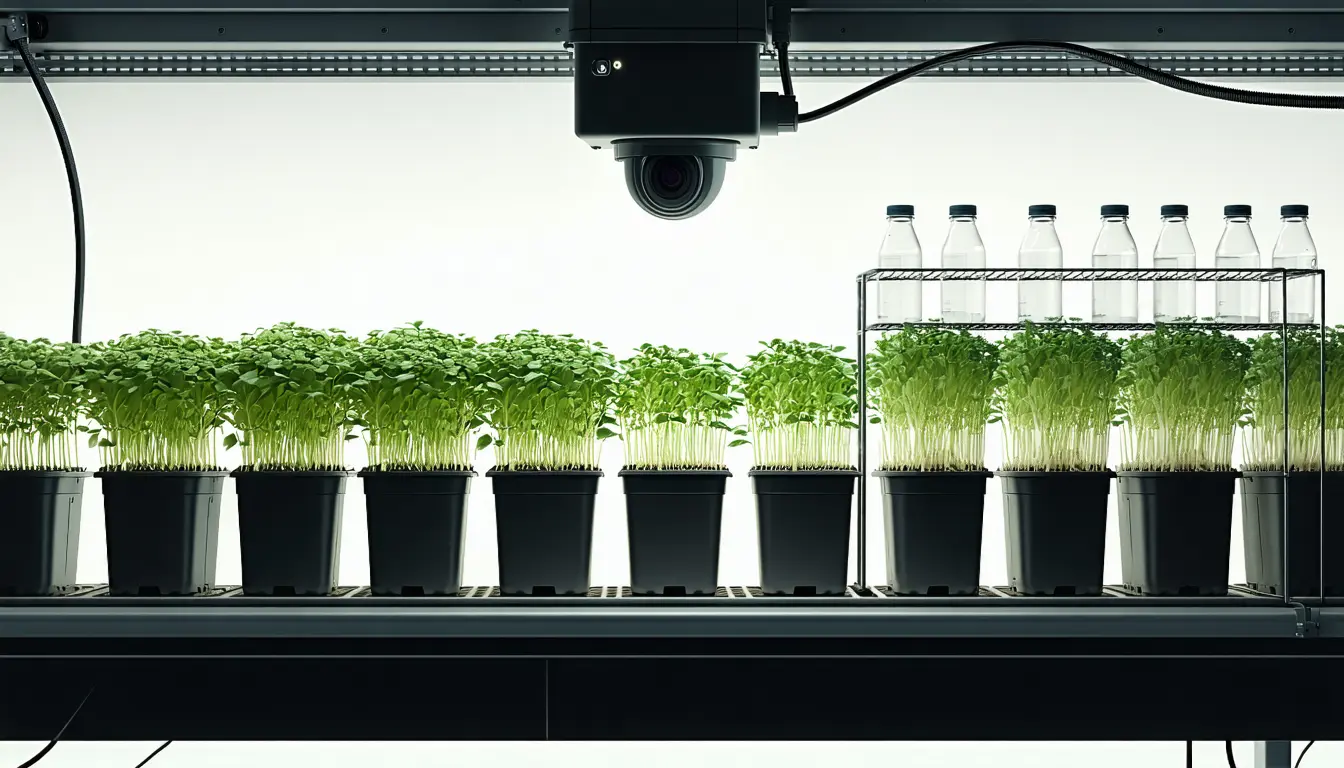
The design is the part worth dwelling on. Twelve pennycress lines, collected from different growing regions and chosen because the plant grows fast and belongs to the same family as a known nickel accumulator [7], were grown in soils treated with a range of nickel concentrations [8]. That is a genotype-by-dose layout, and it separates a line that merely tolerates nickel from a line whose response tracks the dose upward. A single line at a single concentration cannot tell those apart. With 360 plants spread over 12 lines, an average of 30 per line [20], there is enough replication to speak about lines rather than lucky individuals, and the automated conveyors and cameras logged more than 24,000 observations of leaf color, plant architecture, growth, stress response and mineral content [9][10], which is at least 67 observations per plant [21].
The agent sits downstream of all that. It runs a loop rather than answering one question: it plans, writes and runs code, retrieves results, supplies context and hands recommended next steps back to the researchers [12]. It was built on Frontier, which ORNL describes as the fastest supercomputer for open science [2][13], and the reported gain is narrow and specific. Analysis of more than 1,000 physical plant traits went from hundreds of hours of manual labor to a few minutes of interaction with the agent [6]. Both of those are ranges rather than point values, so any speedup multiplier would be my arithmetic on their vagueness, and I am not going to supply one.
The thing this does not tell you is how much nickel anything accumulated. The public account reports counts of lines, plants and observations and no tissue metal concentrations, no biomass and no recovered mass [22]. Metal per hectare per year is the quantity that decides whether phytomining is a supply channel or a screening program, and it is absent. What did get faster is the reading of an experiment; what sets the calendar is plant generations, and then planting on the marginal lands, warmer regions and mine rehabilitation zones the project has in mind [17].
The siting logic is the quietly strong part of the case. ORNL is aiming at large, low-grade deposits that are unsuitable both for conventional mining and for food crops [17], which designs the usual acreage argument out of the problem, and plants have been used for years to remediate soils at former industrial and mining sites [16], so the agronomy is not starting from zero. The framing around it, in the phys.org account, is import reliance for most of the raw materials in smartphones, battery packs and semiconductors [19].
My read: this is a genuine reduction in the cost of asking a phenotyping question, and its value is portability, since the same agent stack pointed at cobalt, selenium or rare earths [15] across four national laboratories [4] compounds in a way that one nickel result does not. Whether pennycress can put nickel into lithium-ion batteries or jet-engine superalloys [18] is a question for tissue assays and field yields, and those are the numbers I would want on the table before calling this a minerals play.
Ranked by verification strength, evidence, and original report placement.
OPAL partners include Oak Ridge, Argonne, Lawrence Berkeley and Pacific Northwest national laboratories, combining AI, robotics and automated experimentation into an interconnected network of labs.
ORNL researchers' initial focus within OPAL is biodesign for critical minerals and materials recovery.
Researchers at DOE's Oak Ridge National Laboratory created an agentic artificial intelligence system to help develop crops that selectively hyperaccumulate critical minerals from soil until they are harvested and processed to recover the metals.
The co-scientist agentic AI platform harnesses the Frontier supercomputer to train, fine-tune and generate output for the Orchestrated Platform for Autonomous Laboratories (OPAL) project, a multilaboratory initiative of DOE's Genesis Mission.
The Genesis Mission is described as a national initiative to build the world's most powerful scientific platform to accelerate discovery science, strengthen national security and drive energy innovation.
ORNL researchers investigated how 12 unique lines of pennycress, collected from varied growing regions around the world, accumulated nickel; the plant is fast-growing and in the same family as a known nickel accumulator.
Distinct publishers with included, body-backed reporting in this cluster.
phys.org
1 article · September 1, 2026
Follow any of these and your For You feed starts watching them — no settings page required.
build
Nuclear AI program adds an AI security vendor, and the $60M is not the company's1 distinct publisher
science
ORNL says the lipid bilayer itself remembers, putting membranes on the neuromorphic parts list1 distinct publisher
product
Nuclea buys Moltex's entire patent shelf out of administration, in cash1 distinct publisher
product
Argonne's nano-bio sheet makes hydrogen peroxide from sunlight, air and water1 distinct publisher
Evidence-backed comparisons of source perspectives and observed adoption signals. Read the methodology
Which Builder, Operator, and Investor concerns the observed source mix emphasized—not a truth score.
Evidence, demonstrated adoption, hype gap, incentives, and confidence are assessed independently, each on its own current evidence. How these are measured.
One release, retold once
Twelve lines, 360 plants, 1,000 traits, 24,000 observations — every figure in this story traces to Oak Ridge's own write-up as phys.org carries it, with no paper, preprint or dataset behind it and no second outlet touching it. The counts are specific enough to be checkable in principle, which is a point in their favour; nothing here checks them. The headline speedup is weaker still, since the same hours-to-minutes result appears in the same text as something already demonstrated earlier.
Live inside one lab's pipeline
This is past the demo stage: the agent chewed through an actual 360-plant run, alerted researchers to anomalies mid-experiment, and its output went into the American Science Cloud and a DOE environmental-research database. It also reuses Argonne-built modules, which is the one sign of the four-lab network functioning as a network. But the users are all inside DOE, there is no release, license or second experiment described, and nobody outside the program has picked it up.
Supply-crisis frame, tolerance-screen data
The piece opens on smartphones, battery packs and semiconductors and closes on national security; the experiment it describes ranks nickel tolerance in twelve pennycress lines. The number that would connect the two — how much nickel any plant actually put in its tissue — is not published. That the analysis step got dramatically faster is a fair claim about tooling; that this addresses a minerals supply crisis is a leap the reporting leaves entirely to the reader.
Mission-budget publicity, unmediated
A national lab is describing its own flagship work in the vocabulary of a brand-new federal program — Genesis Mission, OPAL, American Science Cloud, four partner labs, 'world's most powerful scientific platform.' That is the language of a program establishing standing and funding, not of a results write-up. phys.org passes it through with no added reporting, so the promotional frame arrives at the reader exactly as the issuer built it.
Clear read, thin base
What was done and what is missing are both easy to state here, which makes this reading stable rather than tentative. What holds it down is that it all rests on one self-interested account: a published dataset, a paper, or an independent phenotyping comparison would move the assessment quickly in either direction.