Science1 publisher3 min readPublished Updated
COVID reactivates 11 sleeping viruses, and an obscure one tracks with long COVID disability
A Nature study of 1,154 hospitalized patients links Anelloviridae reactivation to lasting physical disability, which gives post-viral clinics something to measure instead of a syndrome of exclusion.
The Scientist · Science desk
Drafted by a language model from the sources cited here and checked against its claim ledger before publication. How we use AISend a correction
What happened
- Researchers at Boston Children's Hospital and collaborating institutions published findings in Nature from a study involving 15 biomedical research institutions across the United States.
- The study found that COVID-19 can reactivate certain dormant viruses in hospitalized patients, including Epstein-Barr, cytomegalovirus and several herpes viruses.
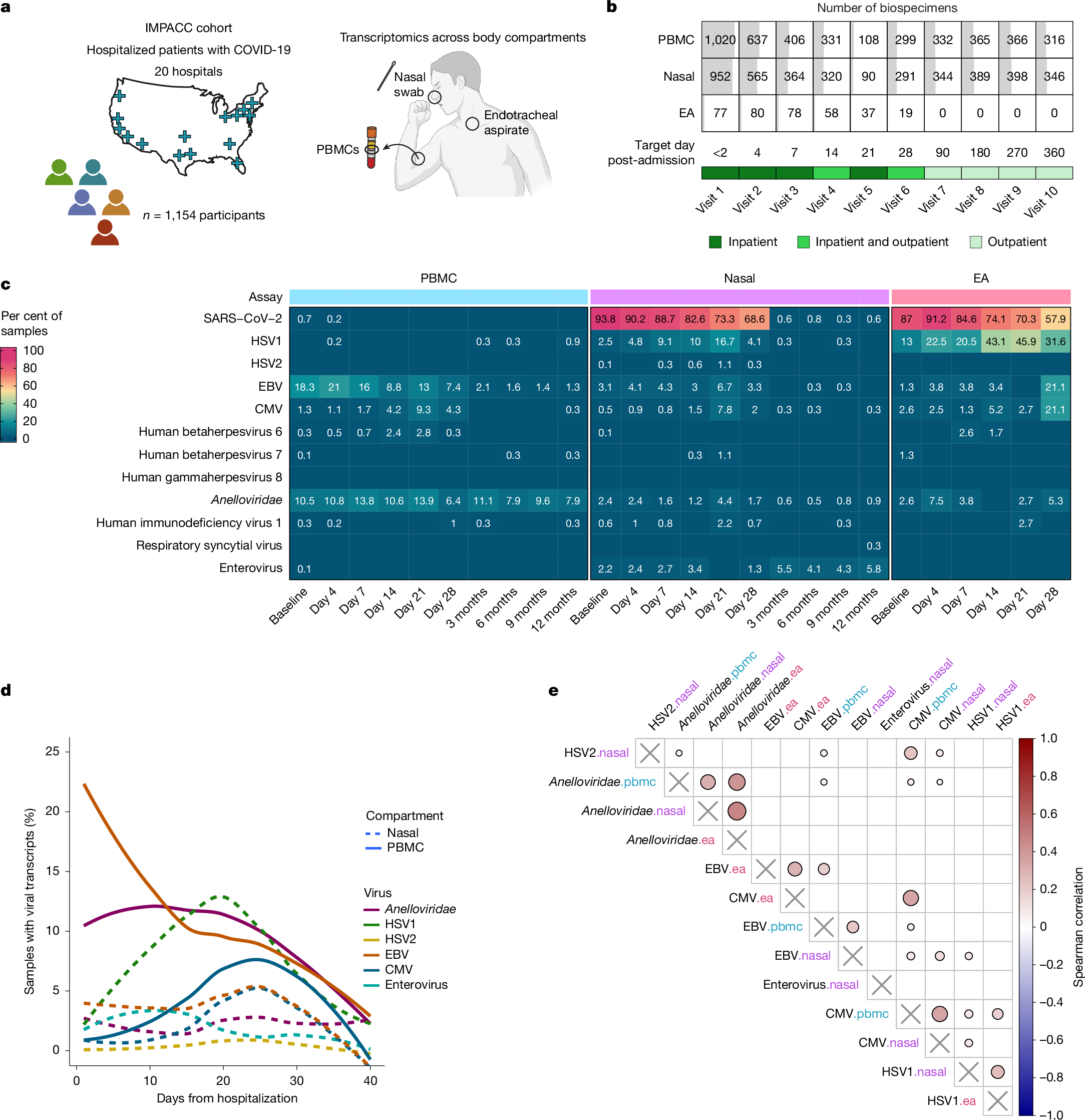
- The study followed 1,154 patients across 20 U.S. biomedical research hospitals and was designed to identify biomarkers associated with COVID severity and patient outcomes.
- The research was funded by the National Institutes of Health, and Ofer Levy, MD, PhD, director of the Precision Vaccines Program at Boston Children's Hospital, served as a site principal investigator.
- Joann Diray Arce, PhD, who leads the Precision Vaccines Program Data Management and Analysis Core and the study's Clinical and Data Coordinating Center, said the study followed more than one thousand patients, collected more than 200,000 samples and generated more than 1 billion data points over the course of a year for a public resource.
Compiled by The ScientistSomething wrong?How this is made
Why it matters
Researchers at Boston Children's Hospital and collaborating institutions reported in Nature that COVID-19 reactivates dormant viruses in hospitalized patients, and that reactivation of Anelloviridae, a poorly understood viral family, showed a prominent association with long-term physical disability and long COVID [1][2][7]. For clinics that currently diagnose long COVID by ruling everything else out, the useful part is not the mechanism story but the fact that the candidate marker is a sequence you can go count.
The cohort is large by post-viral standards: 1,154 patients followed at 20 US biomedical research hospitals, in NIH-funded work for which Ofer Levy of the Precision Vaccines Program was a site principal investigator [3][4]. The release describes the study as involving 15 biomedical research institutions while the patients were followed across 20 hospitals, a distinction worth resolving before anyone cites a site count [1][3]. According to Joann Diray Arce, who leads the study's Clinical and Data Coordinating Center, the effort collected more than 200,000 samples and generated more than a billion data points over a year and is being released as a public resource [5]. That works out to roughly 173 samples per enrolled patient [14], which is the sampling density you need to say anything about the timing of reactivation rather than its mere presence.
Within the first 40 days after admission, the team identified 11 reactivated viruses, most frequently Epstein-Barr, herpes simplex 1, cytomegalovirus and Anelloviridae [6]. Anelloviridae is the odd one out: it typically stays latent in about 90 percent of the population [8]. Because near everyone already carries it, a serology-style present-or-absent test is useless here. Any clinical assay would have to track activity or load over time, which is a harder build but a more informative one.
The second finding matters for how you would intervene. Blood analysis suggested Epstein-Barr and cytomegalovirus became active in response to inflammation rather than because the immune system had been suppressed [9], which the researchers say challenges the prevailing view that chronic reactivation is mainly a consequence of immunosuppression [10]. Reactivation occurred frequently in patients who appeared to have functioning immune systems during severe illness, particularly when systemic inflammation was elevated [11]. If that direction of causation holds, the lever in an acute ward is inflammatory control, not only antivirals. The material reports associations; it does not report a trial of either.
Levy frames the stakes in current numbers: up to 50,000 Americans died of COVID in the 2025-2026 respiratory season, and some estimates put more than 10 million US adults with long COVID [12][13]. The obvious limit is the population studied. These were hospitalized patients [2], and much of the long COVID burden follows mild outpatient infection, which this cohort cannot speak to.
What to watch: whether Anelloviridae load can be measured reliably in outpatient long COVID cohorts and whether it separates cases from recovered controls; whether the public data resource is actually usable by outside groups rather than nominally open [5]; and whether anyone designs a trial that tests the inflammation-first hypothesis [9] with an anti-inflammatory arm rather than defaulting to antiviral suppression.