Science1 publisher3 min readPublished
Congo's Ebola outbreak is now its largest, and the shelf vaccine matches the wrong strain
Bundibugyo virus has caused 5,021 cases and 2,378 deaths through August 16, reaching 1,000 cases in 40 days against 235 in 2018. The licensed Ebola vaccine was built for a different virus.
The Scientist · Science desk
Drafted by a language model from the sources cited here and checked against its claim ledger before publication. How we use AISend a correction
What happened
- Congo's Ministry of Health counted 5,021 confirmed Ebola infections and 2,378 deaths through August 16, 2026, according to figures reported by the Associated Press and the European Centre for Disease Prevention and Control.
- The outbreak has overtaken Congo's 2018-2020 epidemic as its largest and now ranks second worldwide behind the 2014-2016 West Africa epidemic.
- The outbreak crossed 1,000 cases within 40 days of the response beginning; Congo's 2018 outbreak took about 235 days, according to the CDC.
- Bundibugyo virus, a type of Ebola virus first identified in Uganda in 2007, is causing the epidemic, and before 2026 authorities had documented only two related outbreaks, according to the CDC.
- Officials declared the outbreak on May 15, 2026, although the Associated Press reports transmission may have begun around the mining town of Mongbwalu in February; it is Congo's 17th recognized Ebola outbreak since 1976.
Compiled by The ScientistSomething wrong?How this is made
Why it matters
Congo's Ministry of Health counted 5,021 confirmed Ebola infections and 2,378 deaths through August 16, 2026, according to figures reported by the Associated Press and the European Centre for Disease Prevention and Control [1]. That makes this the largest outbreak in Congo's history, passing the 2018-2020 epidemic, and the second largest recorded anywhere after the 2014-2016 West Africa epidemic [2].
The number that should worry response planners is not the total but the slope. The outbreak crossed 1,000 cases within 40 days of the response beginning; Congo's 2018 outbreak took about 235 days to reach the same mark, according to the CDC [3]. That is roughly six times faster to the same milestone [17]. Officials declared this outbreak on May 15, 2026, and in the 93 days to August 16 the confirmed count averaged about 54 cases a day [5][20][22]. The AP reports transmission may have begun around the mining town of Mongbwalu as early as February, months before the declaration [5]. The apparent fatality ratio among confirmed cases stands at about 47 percent [16].
The pathogen is the reason the standard playbook does not apply cleanly. This is Bundibugyo virus, first identified in Uganda in 2007, with only two related outbreaks documented before 2026, according to the CDC [4]. No vaccine or targeted medication has been approved for it; the licensed Ebola vaccine was developed for a different virus, and the WHO is still evaluating candidates, including a treatment trial that had enrolled more than 100 patients by mid-August [8]. Early diagnosis and supportive care remain the intervention that demonstrably helps [21]. The biology is otherwise familiar: spread by direct contact with bodily fluids and with bodies during burial, not airborne, not transmissible before symptoms, with an incubation window of 2 to 21 days and an early presentation that looks like malaria until a lab says otherwise [9].
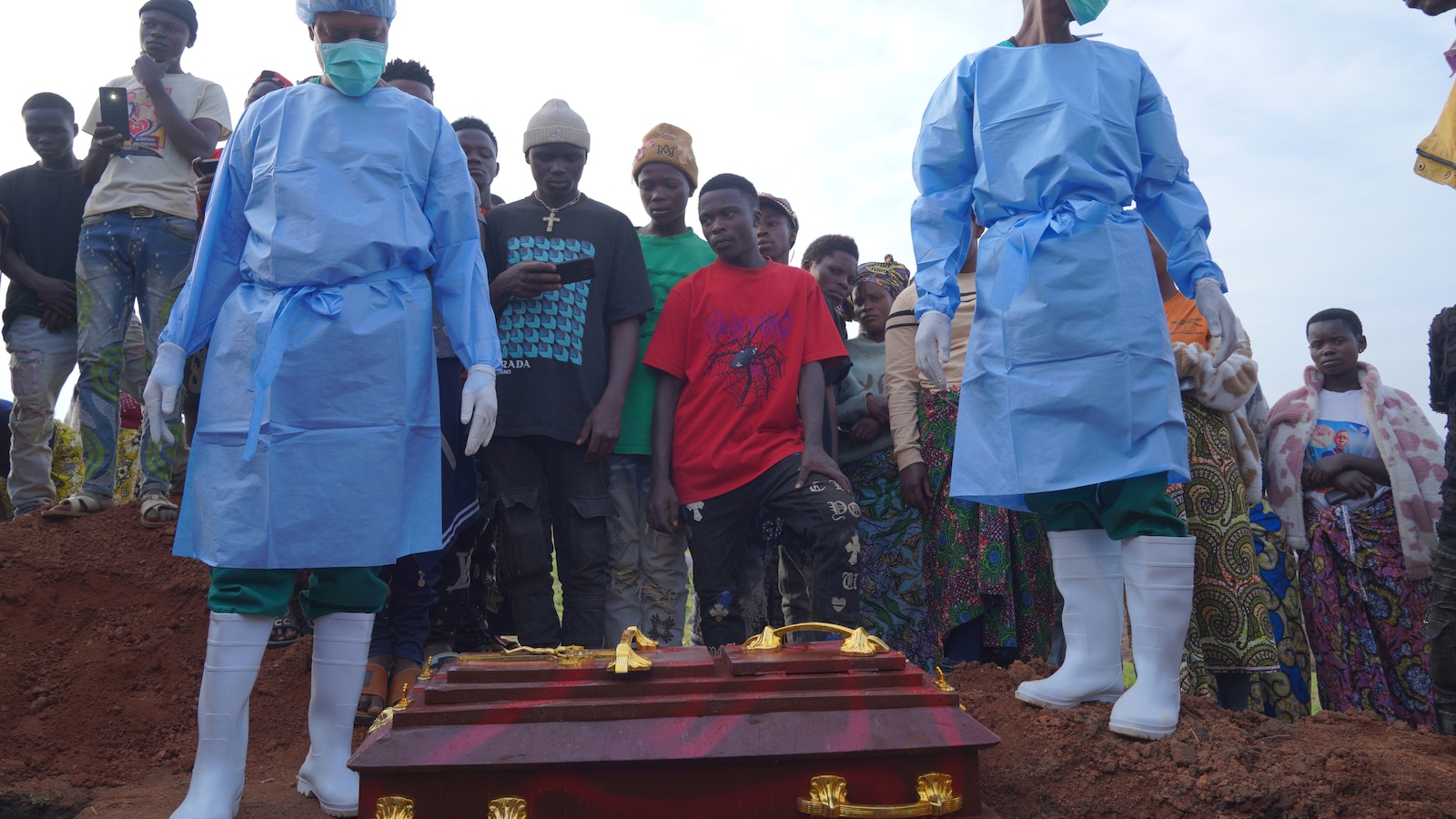
Detection is losing the race. Many patients in this outbreak have not appeared on existing contact lists, according to the AP, which means teams are finding chains only after the virus has already moved [10]. On August 12 the WHO reported reaching 17,460 of 20,740 contacts scheduled for follow-up, about 84 percent, leaving roughly 3,280 people unmonitored on a single day [11][18]. By August 16 infections had reached about 55 health zones across six provinces, with Ituri accounting for about 85 percent of confirmed cases [6]. At least 155 health workers had been infected by August 9 and 45 had died, a fatality share of about 29 percent among that group [12][19]. The WHO recorded 12 attacks on health care between its May 17 emergency declaration and August 12 [13]. Armed conflict, displacement, mining-related travel, poor roads, misinformation and mistrust all compound the reach problem [15].
Watch the containment perimeter and the trial pipeline. People linked to the outbreak have tested positive in Uganda and France, though the WHO's mid-August update recorded new cases only in Congo [7]. The WHO rates risk within Congo very high and global risk low; the CDC calls the threat to the American public low, with no US cases connected to the outbreak [14]. On August 18 burial teams in Bunia buried two children, aged 3 and 6, both dead of Ebola [22].