Product1 publisher3 min readPublished
China's 350-ton electric haul truck gives diesel fleet planners a spec sheet to argue with
Zijin Longking's ZL230E carries 230 tons on a reported 1,400 kWh pack with EACON's driverless stack. The charging math, not the tonnage, is the hard part.
The Product Desk · Product desk
Drafted by a language model from the sources cited here and checked against its claim ledger before publication. How we use AISend a correction
What happened
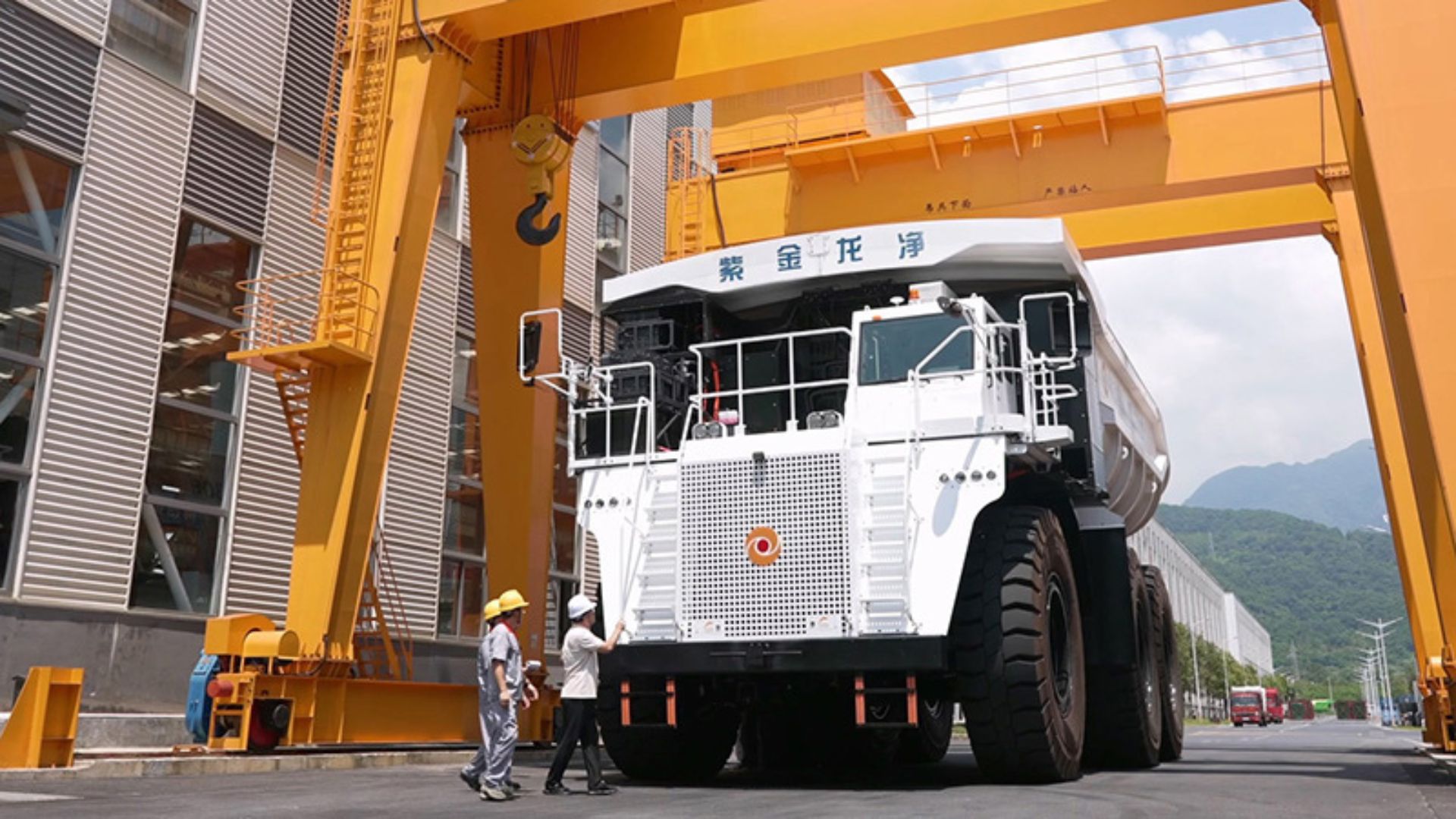
- The ZL230E (formerly LK350E) is a 350-ton gross weight electric haul truck developed by Zijin Longking for continuous open-pit mining operations.
- The ZL230E has a 230-ton payload capacity and a 125-cubic-meter cargo box.
- China's largest pure electric mining truck officially rolled off the assembly line last week.
- The truck uses a multi-axle, centrally distributed independent drive architecture powered by dual 800 kW motors, with the powertrain matching energy output in real time.
- Reportedly, the ZL230E houses a 1,400 kWh battery pack.
Compiled by The Product DeskSomething wrong?How this is made
Why it matters
Zijin Longking's ZL230E, a 350-ton gross weight battery-electric haul truck with a 230-ton payload and a 125-cubic-meter box, came off the assembly line last week [1][2][3]. What matters for operators is not the tonnage record but that the largest and most diesel-hungry class of open-pit haulage now has a published specification, which is the minimum requirement before a replacement cycle can be modelled.
The drivetrain is a multi-axle, centrally distributed independent drive architecture on dual 800 kW motors [4], or 1,600 kW installed [1]. Under the frame sits a battery pack reported at 1,400 kWh [5]. Those two figures set the duty cycle between them: at continuous full motor draw the pack holds roughly 53 minutes of energy [2], so this is a short-cycle machine whose economics rest entirely on the charging claim. Zijin Longking says the pack reaches 90 percent in 25 minutes [6], which implies an average charge power of about 3,000 kW from empty [3]. Benchmarking exercises should price the substation, cabling and pit-side charger placement before they price the truck.
Autonomy comes from a partnership with EACON, an Australian autonomous mining developer, whose cloud-based dispatch, perception and decision-making stack is integrated for driverless operation [7][8]. The vehicle also carries a patented high-rigidity frame, a dual-control chassis, intelligent energy management, and redundant braking and steering [9]. Huang Wei, president of Zijin Longking, called it "a powerful tool tailor-made for high-intensity continuous operations in ultra-large open-pit mines" [10]. Su Zimeng, president of the China Construction Machinery Association, framed the rollout as a demonstration of Chinese technological innovation and industrial upgrading in construction machinery [11]. The launch took place at an investment promotion event for the "Mining + Intelligent Manufacturing" industry in Xinluo District [12], so part of the audience was financial rather than operational.
The fleet numbers are more informative than the launch. Zijin Mining says it went from 13 electric mining trucks in 2020 to 1,719 in 2025 under its dual-carbon strategy, and is targeting a full diesel-to-electric transition within three years [13], which is growth of roughly 132 times over five years [4]. Its first 15 pure electric 150-ton trucks at the Julong Copper Mine returned uptime above 90 percent, daily haulage over 2,000 tons, and a 17 percent drop in energy consumption, according to the company [14]. That is single-operator, single-site evidence from a smaller truck class, but it is operating data rather than a render.
For comparison, BHP and Rio Tinto have partnered with Caterpillar to trial Cat 793 XE battery-electric haul trucks at the Jimblebar iron ore mine in the Pilbara, evaluating both static and in-motion dynamic charging [15], and Rio Tinto is separately trialing a battery-swap fleet at the Oyu Tolgoi copper mine in Mongolia [16]. The majors are still deciding how to get energy into the truck. Zijin has picked fast charging and is building units.
Three things to watch. Whether the 1,400 kWh figure and the 25-minute charge are independently confirmed, given the source itself hedges the battery capacity as reported [5]. Whether uptime above 90 percent survives the jump from the 150-ton class to 350 tons [14]. And whether the planned pairing with wind, solar and storage arrives with the trucks [17], because roughly 3,000 kW of charging power [3] drawn from diesel generation moves the emissions rather than removing them.