Loading today’s stories
Product1 distinct publisher2 min readUpdated
China's S4000 flew the full loop at 4,000 metres without publishing a kilowatt-hour
China's airship-borne wind system ran a complete flight cycle at 4,000 metres, according to CCTV News. Judging it against tower turbines needs numbers the report does not carry.
The Product Desk · Product desk
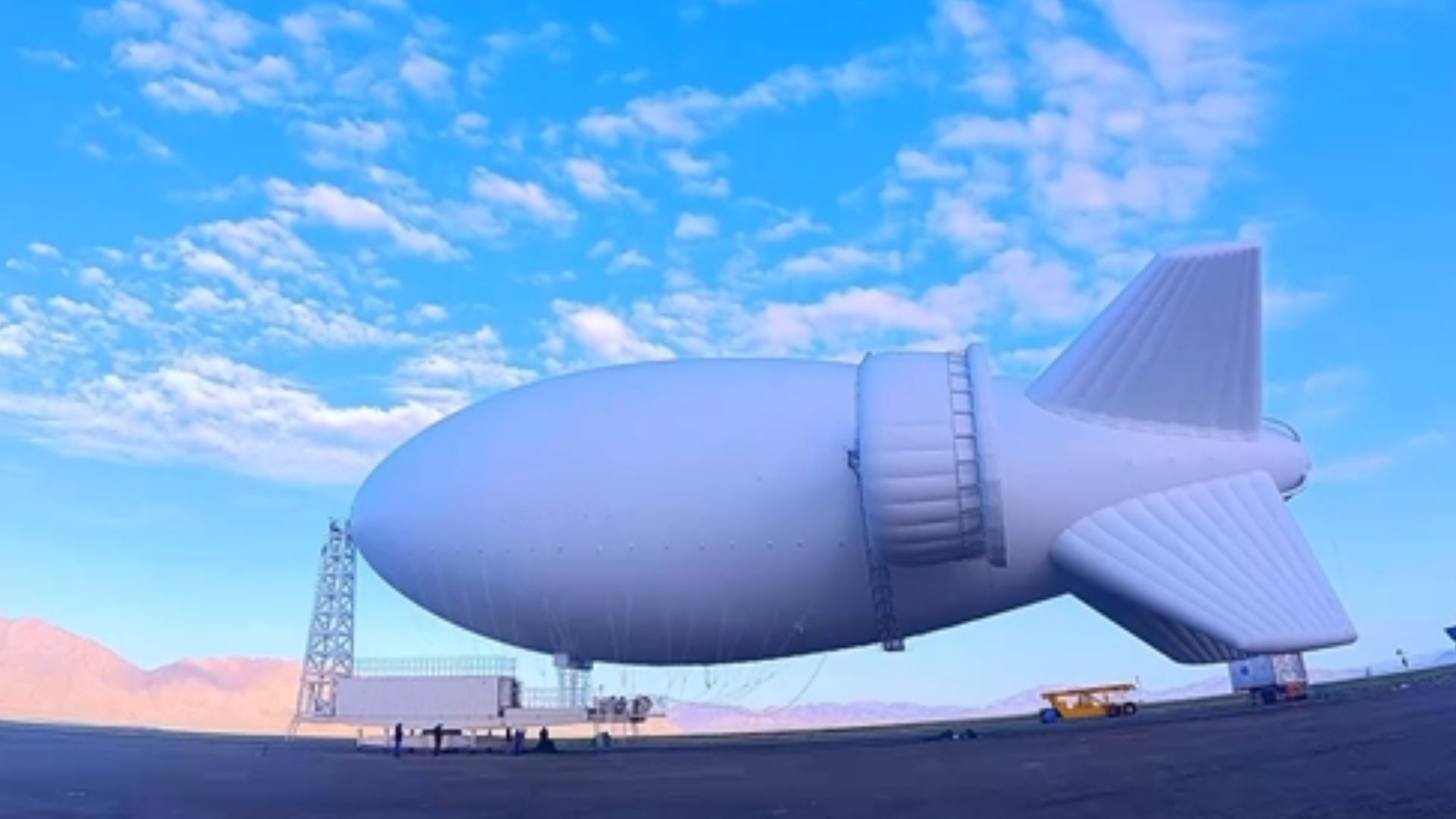
What happened
- China has completed a full-process flight test of its upgraded S4000 Stratosphere Airborne Wind Energy System (SAWES).
- The test was recently conducted at a base in Northwest China, according to a CCTV News report.
- The trial covered the complete operating process: ascent, station-keeping, electricity generation testing and controlled recovery.
- All key indicators reportedly met the required standards.
- The S4000 can operate at heights of up to 13,123 feet (4,000 metres), above the reach of conventional wind turbines.
Compiled by The Product DeskSomething wrong?How this is made
Why it matters
The only output figure on record for either machine is 385 kilowatt-hours, delivered into a local grid by the smaller S2000 in January from 2,000 metres [11]. Set that against the developer's own label for that platform, the world's first megawatt-level airborne wind system intended for use near urban areas [12], and the arithmetic is unkind: 385 kWh is roughly 23 minutes of a one-megawatt machine running flat out [15]. That is a demonstration of a connection, not of a duty cycle.
The S4000 account, which reaches us from CCTV News by way of Interesting Engineering, carries no kilowatt-hours and no hours aloft at all [2][16]. What it carries instead is a sequence: ascent, station-keeping, a generation test and controlled recovery, with key indicators reported as met [3][4]. Read narrowly, that is the more useful result. Video of a tethered aerostat making power has existed for a while; a closed loop that ends with the asset back on the ground is what has to work repeatedly before the 20-year design service life credited to the platform means anything [7].
The mechanism shows where the risk concentrates. A helium-filled aerostat lifts a lightweight generating unit [8], and a single tether both moves the electricity down and helps hold the platform on station [9]. A conventional turbine buys its wind with tower height and a foundation [10]; this design buys it with one line that is export cable and mooring at the same time. Availability depends on that line, and so does the recovery step that has just been tested.
Altitude is the cleanest part of the claim. The stated ceiling of 4,000 metres is double what the S2000 reached in its January flight [5][14], which is the sort of step that changes the wind resource rather than the press release. But the grid side is still written as design intent: the S4000's new configuration is described as allowing direct connection to mainstream power grids [6], which is a different statement from having done it at 4,000 metres. The one time these machines actually sold electrons, it was the smaller platform, at half the height, and the figure was 385 kWh [11]. Anyone weighing high-altitude wind against a tower turbine is being asked to extrapolate from that, plus a test in which the developer's own indicators were reportedly satisfied [4] and the technology is said to be closer to engineering application [13].
Topics and entities
Follow any of these and your For You feed starts watching them — no settings page required.
Topics
Loading related stories