Product1 publisher3 min readPublished
Feagine's Fi0 bets the durable asset in robotics is task knowledge, not the arm
The cross-embodiment model treats a robot's body as an input rather than a fixed assumption. For buyers, that turns hardware selection into a question about what transfers.
The Product Desk · Product desk
Drafted by a language model from the sources cited here and checked against its claim ledger before publication. How we use AISend a correction
What happened
- Feagine Robotics introduced Fi0, a cross-embodiment foundation model designed to retain task knowledge across robots with different physical structures.
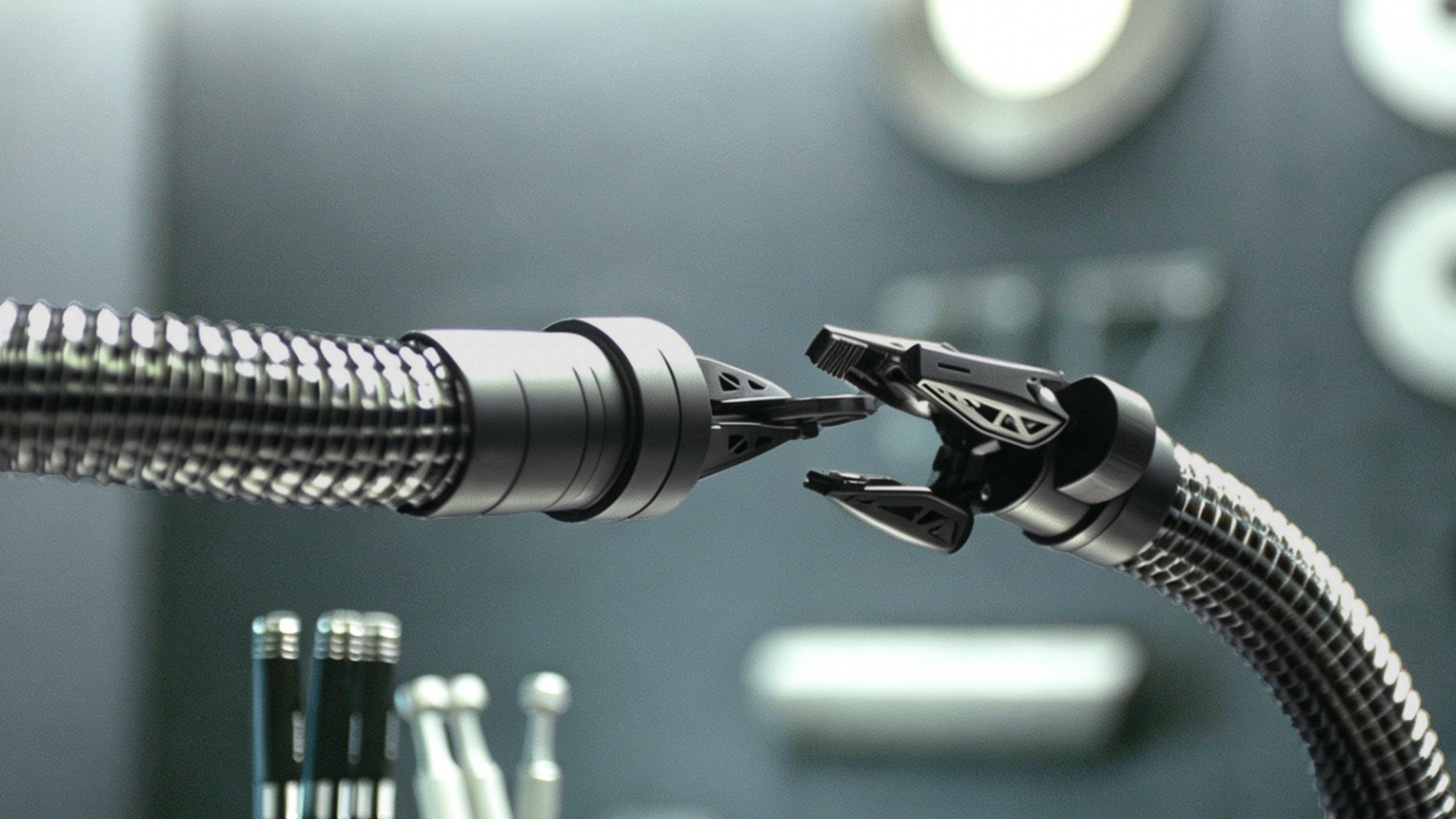
- Alongside Fi0, Feagine introduced three tendon-driven soft manipulators, A01, A02 and A03, providing different lengths, segment counts and degrees of freedom to test the cross-embodiment idea; the manipulators are intended to make those differences systematic.
- The A01 has one flexible segment and two degrees of freedom, weighs 750 grams, and carries a 200-gram payload.
- The A02 has two segments, four degrees of freedom, and a 400-gram payload.
- The A03 has three segments, 6+1 degrees of freedom, a 50-centimeter arm length, and a 600-gram payload.
Compiled by The Product DeskSomething wrong?How this is made
Why it matters
Feagine Robotics has introduced Fi0, a cross-embodiment foundation model built to retain task knowledge across robots with different physical structures, alongside three tendon-driven soft manipulators, A01, A02 and A03, that differ in length, segment count and degrees of freedom [1][2]. The procurement consequence is the interesting part: if the intelligence layer survives a change of body, the thing being bought is a portable model rather than a controller welded to one arm.
The three arms are positioned as a deliberate test rig for that idea [2]. The A01 has one flexible segment, two degrees of freedom, weighs 750 grams and carries a 200-gram payload [3]. The A02 has two segments, four degrees of freedom and a 400-gram payload [4]. The A03 has three segments, 6+1 degrees of freedom, a 50-centimeter arm and a 600-gram payload [5]. That is a threefold payload spread and roughly a 3.5x spread in degrees of freedom across the family [6][7], which is a real morphology gap to generalise over, though the reported top payload is still under one kilogram [8]. Mass is disclosed only for the A01 [9].
Mechanically, Fi0 encodes the robot's structure and current state as part of the information used to generate actions [10]. Feagine calls that representation an Embodiment Graph, covering morphology, sensing, actuation and state, with further components for understanding the environment, interpreting demonstrations and predicting outcomes of actions [11][12]. The company's label for the combination is soft embodied intelligence [13].
The retraining claim is the one operators should read carefully. According to Feagine, when Fi0 meets a task outside its capabilities, a human gives a single demonstration, and the model uses it as context at inference time instead of running another training cycle to update parameters [14]. What it is meant to extract is not the precise trajectory of the human hand but the task's objects, sequence, contact events and desired end state, leaving the robot to work out how to achieve that with its own body [15]. This shifts cost out of the data-and-retrain loop and into inference-time reliability, which is a different, less familiar failure surface.
Soft arms make the test harder on purpose. Rigid manipulators have joints with defined positions and ranges of motion, while a soft manipulator bends continuously, changes shape and interacts compliantly with its surroundings [16], so the robot's configuration becomes part of what the model has to understand rather than a fixed parameter [17]. Existing cross-embodiment research already indicates that exposure to more diverse robot bodies improves generalisation to unfamiliar machines [18], which is the bet being placed here.
The strategic argument behind it is that robotics may never converge on one universal machine, with rigid arms suiting precision manufacturing, soft manipulators suiting delicate interaction, and other platforms suiting confined or hazardous spaces [19]. That is an explicit alternative to the humanoid thesis, which draws attention because human environments are already built around human dimensions and capabilities [20].
What is missing is evidence. The published material carries no transfer success rates, no benchmark results and no third-party evaluation of Fi0 [21], so the portability claim currently rests on architecture and intent.
Three things to watch: whether Feagine publishes task-level transfer numbers between A01, A02 and A03 rather than demonstrations; whether the single-demonstration path holds on tasks introducing contact events the model has not seen [15]; and whether the Embodiment Graph ever accepts third-party hardware, since a portability layer that only spans one vendor's arms is a product line, not a standard [11].