Science1 publisher2 min readPublished
Two passivators too bulky to react with each other clear both perovskite defect signs
Charged defects of opposite sign need opposite chemical fixes, and those fixes normally quench each other, so one group built Lewis acid and base families too hindered to react and certified a cell at 25.8% steady state.
The Scientist · Science desk
What happened
- Lewis acids passivate anionic defects and Lewis bases passivate cationic ones, but mixed into the same cell they form quenching adducts and leave the traps unpassivated.
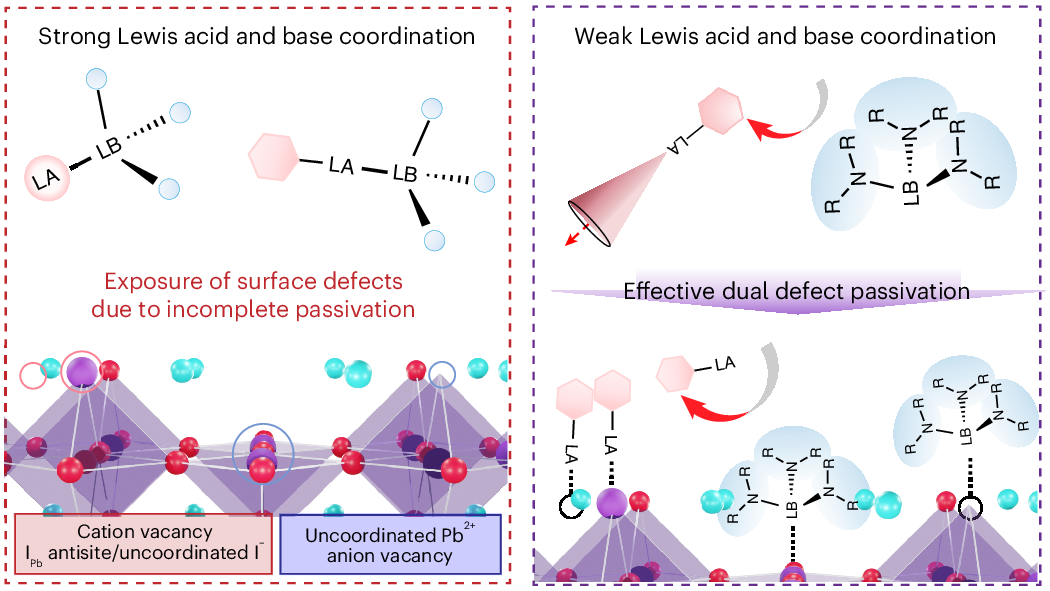
- The design rests on a size comparison: a surface defect site is more sterically accessible to either passivator than the two passivators are to one another.
- Spectroscopic and defect-profiling measurements reported in the paper indicate that the two treatments suppress traps additively rather than cancelling each other out.
- The best cells reached 27.4% power conversion efficiency, with a certified steady-state figure of 25.8%.
Compiled by The ScientistSomething wrong?How this is made
Why it matters
- capability A cell developer can now treat anionic and cationic traps in the same stack with two molecules chosen to ignore each other, instead of trading one defect population against the other.
- constraint The selection rule cuts both ways and narrows the candidate library: a passivator has to be hindered enough to leave its partner alone and still compact enough to sit on a surface site.
- decision If the suppression really is additive, the gain from adding a second passivator is predictable in advance. A formulator needs that to decide whether the extra process step pays.
- cost Independent checking costs money: the density-functional work needs a VASP licence, and the paper sits behind a paywall even though the datasets are open.
The selectivity is geometric. Both molecules have to reach the same perovskite surface, and the authors' argument is about access: a defect site on that surface is easier for either passivator to approach than the two passivators are for each other [5]. Bulk around the phosphorus is what creates that difference. The paper reports that hindered sp3-phosphine bases do not react with fluorinated aromatic acids, suppressing the Lewis acid-base orbital overlap that would otherwise form an adduct [4].
"Additive" is the precise word in the abstract, and the modest one [6]. Each family suppresses its own population of traps and neither blocks the other; that is what the authors mean by chemically orthogonal families, achieved by weakening mutual interactions [12]. The evidence offered for it is spectroscopic and defect-profiling measurement [6].
Two efficiencies are reported: up to 27.4%, and a certified steady state of 25.8% [7]. The gap is 1.6 percentage points [8]. The higher figure is an upper bound on what the group measured, so it describes the best device [7]. If I were sizing anything on this chemistry I would plan with 25.8%, because that figure has been outside the laboratory.
The abstract reports efficiency and does not state device area or an operating-lifetime figure [14]. That gap bears on the motivation: charged point defects are blamed for instability as well as efficiency loss [1], and an efficiency number tests only the efficiency half. How the two passivators hold up after a few hundred hours at maximum power is the open question, and a quenching adduct would show up there if the steric gate leaked.
The underlying datasets are posted on Zenodo [9]. The calculations used VASP, which is proprietary commercial software, and ORCA, which is free for academic use through FACCTs [10]. Re-running the computational half therefore needs a VASP licence, and reading the paper itself costs USD 39.95 for anyone without an institutional subscription [11].
What to watch
- Replication by another group using a different hindered base and a different fluorinated acid, which would show whether the steric rule transfers beyond the two families reported.
- What the certified steady-state figure does as cell area grows toward module scale.
- Whether other laboratories combining the two families report additive trap suppression or find the passivators competing.