Invest1 publisher3 min readPublished
A Canadian VC's pitch: the costliest tariff response is capital left undeployed
Graphite Ventures' Aaron Bast argues Canada should back founders first instead of copying Silicon Valley's home-run model. The arithmetic of his own fund shows how thin the pool still is.
The Investor · Invest desk
Drafted by a language model from the sources cited here and checked against its claim ledger before publication. How we use AISend a correction
What happened
- Aaron Bast is managing director at Graphite Ventures.
- Bast writes: "The capital exists, and the founders are building. The real danger isn't writing the cheques, but not writing the cheques and expecting to win." He also argues that what Canada can control is capital, and that Canada's opportunity is to become first-conviction investors for founders building durable, globally competitive businesses, rather than to copy American firms that chase a home run every time at bat.
- Last month Washington announced 50 percent tariffs on a broad list of Canadian goods, hockey sticks included.
- Prime Minister Mark Carney responded that Canada is ready for those tariffs "because we have been focusing on what we can control."
- Bast credits the federal AI strategy, the push toward Canadian-controlled investment, the economic sovereignty agenda, and OMERS's commitment to add at least $10 billion in new investment in Canada over five years with shifting the debate from whether Canada should bet on itself to how the bet should be made.
Compiled by The InvestorSomething wrong?How this is made
Why it matters
Aaron Bast, managing director at Graphite Ventures, has argued in BetaKit that Canada's answer to US tariffs is capital rather than counter-tariffs, and that the sector's real exposure is money that does not get deployed [1][2]. That is a claim about investor behaviour rather than about supply, and it is testable against the arithmetic of his own fund.
The trigger is dated. Last month Washington announced 50 percent tariffs on a broad list of Canadian goods, hockey sticks included [3]. Prime Minister Mark Carney said Canada was ready for them "because we have been focusing on what we can control" [4]. Bast's reading of what can be controlled is capital [2], and he credits four things with moving the debate from whether Canada should bet on itself to how: the federal AI strategy, the push toward Canadian-controlled investment, the economic sovereignty agenda, and OMERS's commitment to add at least $10 billion in new investment in Canada over five years [5].
The OMERS number is where the case gets concrete, and smaller. Graphite's most recent fund is a Canadian-focused $120-million seed vehicle anchored by $25 million each from the Province of Ontario and OMERS, with another $25 million from Canadian founders and more from committed institutions and corporates [6]. That is $75 million named and roughly $45 million still attributed to unnamed backers [7]. It also means OMERS's participation represents about 0.25 percent of its own five-year Canadian commitment [8]. Pension money is arriving at the seed stage in slivers.
Bast reports, on Graphite's own data, that a portfolio grown since the firm's 2021 formation to more than 140 Canadian companies has produced more than 1,350 new jobs, $800 million in follow-on capital and more than $10 billion in new enterprise value over five years [9][10]. Those are self-reported figures. Averaged across the portfolio, the follow-on works out to under $6 million per company [11], which sits at the bottom edge of the $5 million to $25 million financing gap Bast himself calls a real bottleneck for Canadian companies [12].
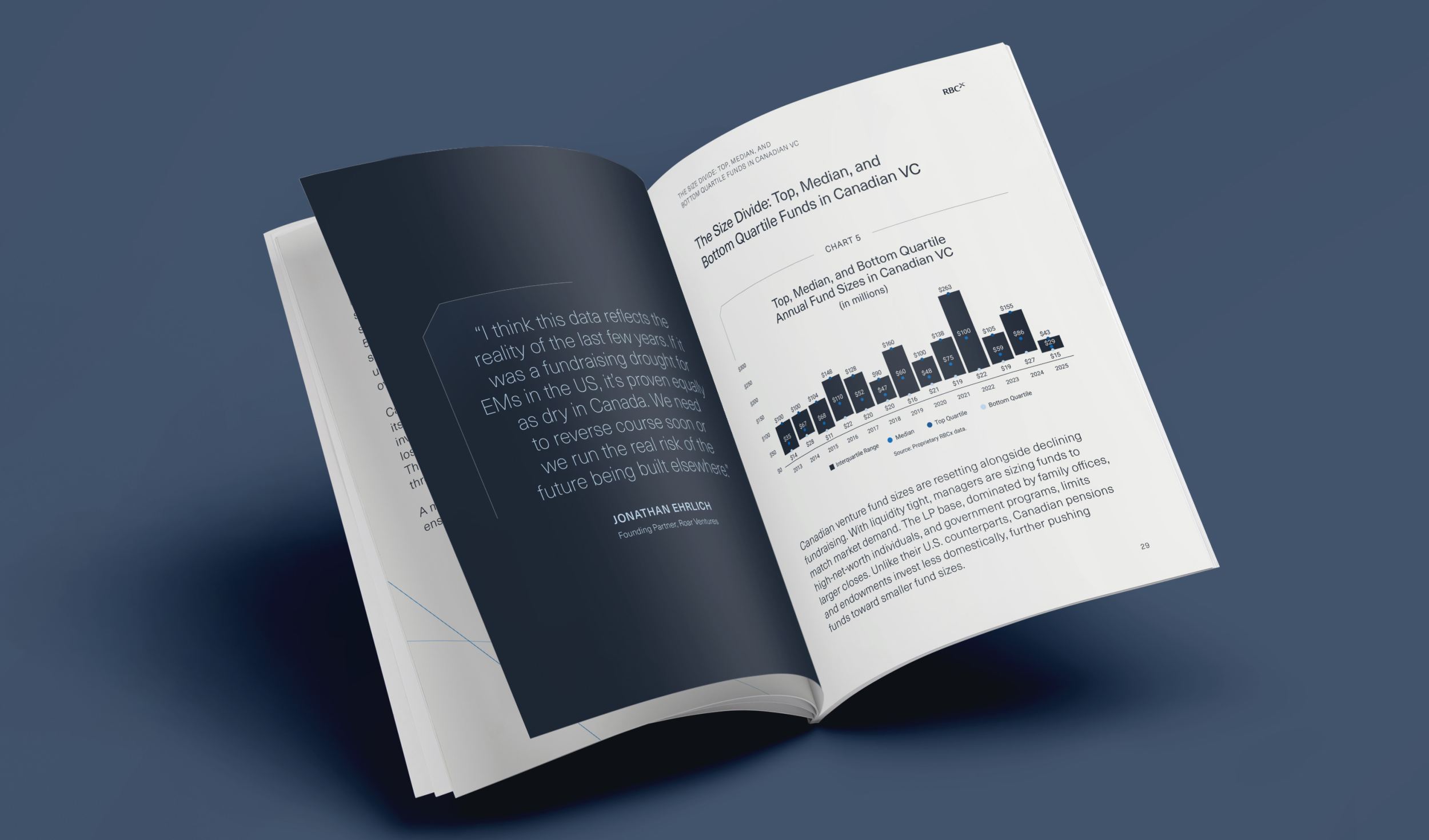
He is also candid that the failure that comes before that gap, at seed, is just as real [12]. BetaKit's related coverage notes RBCx found Canadian early-stage funding in sustained decline [13]. So the assertion that "the capital exists, and the founders are building" is doing considerable work [2]. The consequence he sketches is the part worth taking seriously: unfunded companies disappear, get acquired before scale, or move south with the jobs and the intellectual property, and the pension funds the Senate banking committee flagged as an underused source of capital are the same funds that lose when they go [14][15].
The exhibits are three. Portfolio company Nicoya Lifesciences bought British instruments maker Applied Photophysics last year, making the British firm its European hub [16]. StackAdapt was started in Toronto a decade ago by three Russian immigrants with $750,000 of seed capital, raised no significant outside money again for years, and is now valued above $3.5 billion [17]. Carol Leaman, who built and sold Axonify, is now investing her own money alongside Graphite [18]. The Moneyball framing, borrowed from a Blue Jays run that took the Dodgers to seven games without the biggest payroll, only holds if the mispricing is real [19].
Watch whether other Canadian pension funds write seed-stage cheques rather than growth ones, whether that unnamed $45 million closes with named institutions [7], and whether RBCx's early-stage decline reverses [13].