Invest1 publisher3 min readPublished
Brookfield teams up with rivals Apollo, Blackstone and KKR in Nvidia's $500 billion AI consortium
Brookfield is pooling money with Apollo, Blackstone and KKR in a $500 billion Nvidia-arranged consortium, alongside its own $100 billion Nvidia venture. Fully raised, the two would cover under a tenth of the $7 trillion Brookfield expects the AI buildout to cost over the next decade.
The Investor · Invest desk
Drafted by a language model from the sources cited here and checked against its claim ledger before publication. How we use AISend a correction
What happened
- Brookfield CEO Connor Teskey told Semafor that rivals can share the AI deals because "there's enough to go around for all of us."
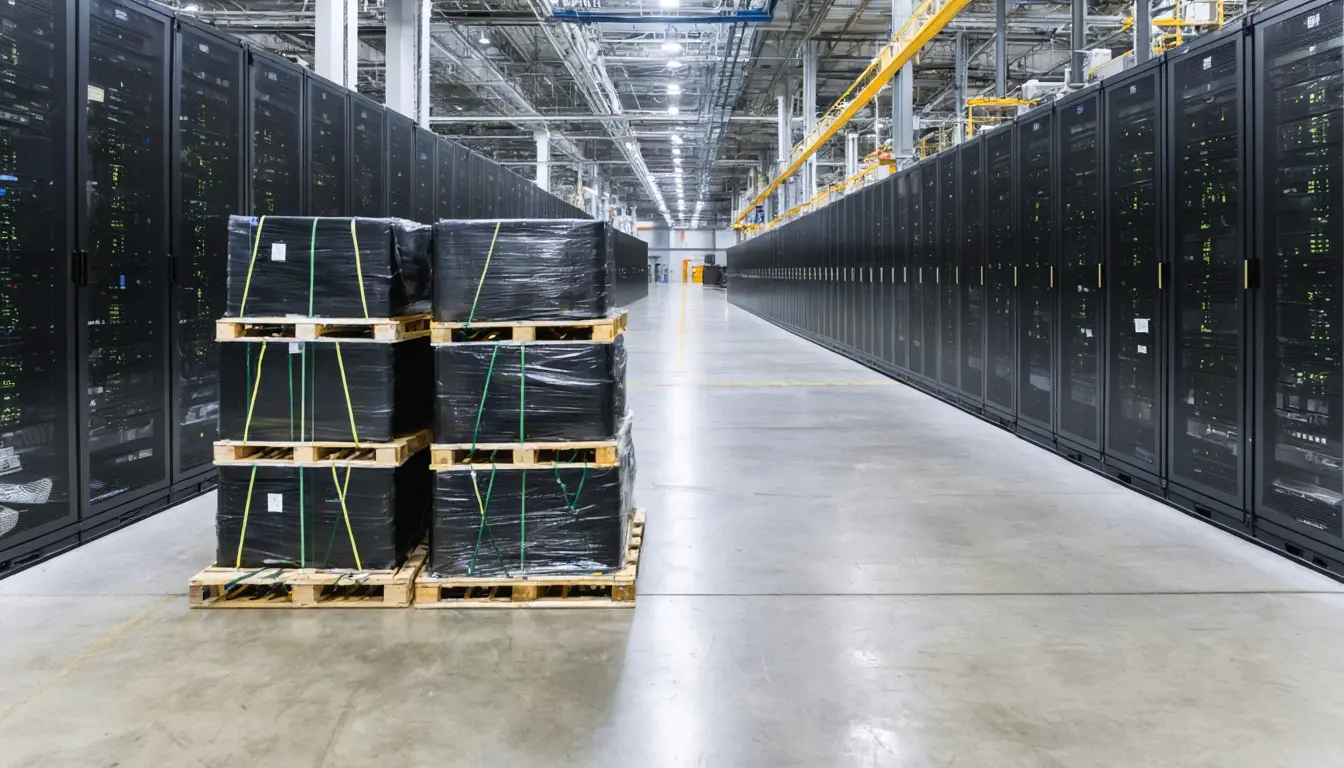
- Teskey said data centres, their hardware and the power plants feeding them are basically the same as bridges and ports, only larger and built faster.
- He named power as the biggest bottleneck for digital infrastructure "by a very large margin" and expects the energy shortfall to last beyond this decade.
- Teskey said there will still be plenty of losers among the firms financing data centres.
Compiled by The InvestorSomething wrong?How this is made
Why it matters
- exposure With Apollo, Blackstone, KKR and Brookfield in one $500 billion vehicle, a slowdown in AI demand would land on all four managers at once, leaving fewer independent buyers to take assets off a struggling partner.
- cost Teskey's own rule that crowded markets produce range-bound returns applies to a table of five or six leading managers, so each pays for access to scale with a thinner slice.
- contradiction Semafor's interviewers cast Nvidia as propping up the buildout while Teskey calls the same money the normal path of a maturing asset class, and the two readings put the risk in different places.
- decision Brookfield's wariness of slow-to-deploy gas steers its power capital toward fuel cells, onshore renewables, batteries and nuclear, leaving gas-fired supply for data centres to other financiers.
Brookfield puts the bill at $7 trillion over the next decade [2], or about $700 billion a year if it were spent evenly [20]. The venture and the consortium together come to $600 billion [18], or rather up to $600 billion: the venture can buy "up to" $100 billion of assets, and the consortium's $500 billion is money it has set out to corral [4][5]. Fully raised, the pair would cover about 8.6% of Brookfield's estimate [19]. The consortium's target is roughly seven-tenths of one average year [21].
Semafor describes the deal-sharing as part of a race to move that cost from the hyperscalers to outside money managers [3]. Teskey's explanation comes down to the size of the bill. "These are mega-trends that require far more capital than what has traditionally been available from both governments and even the public markets," he said [15]. So Brookfield is not bidding against Apollo, Blackstone and KKR for these assets [5]. Semafor's interviewers named the price of that when they asked how Brookfield weighs keeping a deal to itself against sharing it, returns included, with competitors [16].
Teskey says the money is following a familiar sequence. "Initially it's done by independent capital providers who look to build and hold the assets," he said. Banks then syndicate the financing, and private credit and insurers follow. "That is exactly what's happened within AI infrastructure," he said [13]. Semafor's account does not include return targets, leverage, or how the $500 billion splits among the managers.
His own description of power markets is the strongest case against his optimism about crowded data-centre deals. Mature onshore wind, solar and battery storage have the most growth and the most participants, he said, adding: "So maybe your return outcomes are more range-bound" [11]. Nuclear has "far fewer people who have the expertise," and so it has different return requirements [12]. A table that seats "five or six of the leading players" [17] looks more like the first market than the second.
If demand holds and banks and insurers take on part of the financing, as his sequence predicts [13], the vehicles behave like the ports he compares them to [7]. A second reading came from Semafor's interviewers, who said Jensen Huang "has been propping up a huge chunk of the AI buildout" [14]. On that view the consortium is a chipmaker arranging the capital that buys AI infrastructure, the hardware inside the buildings included [5][7]. In a third, demand stays firm but crowding thins the returns, and the losers Teskey expects among data-centre financiers [8] could sit inside the same consortium.
I think the second and third readings fit the evidence better. The chipmaker arranged the consortium, and the managers inside it would otherwise bid against each other [5]. Teskey rejects the premise. "If there's a single narrative that is most starkly divorced from the fundamentals we're seeing on the ground," he said, "it's the idea that the demand for AI infrastructure and the energy and the supply chain that supports it is in some way fragile" [1]. I would be wrong if banks and insurers finance these assets on terms that do not depend on Nvidia's sponsorship. Teskey says AI infrastructure has already reached that stage [13].
What to watch
- How much of the $500 billion the consortium actually commits, and how it divides among Brookfield, Apollo, Blackstone and KKR.
- Whether banks syndicate and insurers or private credit buy into these assets on terms that stand without Nvidia's sponsorship.
- Where the losers Teskey expects among data-centre financiers turn up, and whether any are partners in the Nvidia vehicles.