Science1 publisher2 min readPublished
Construction machinery packed a Brandenburg agri-photovoltaic field past root-growth limits
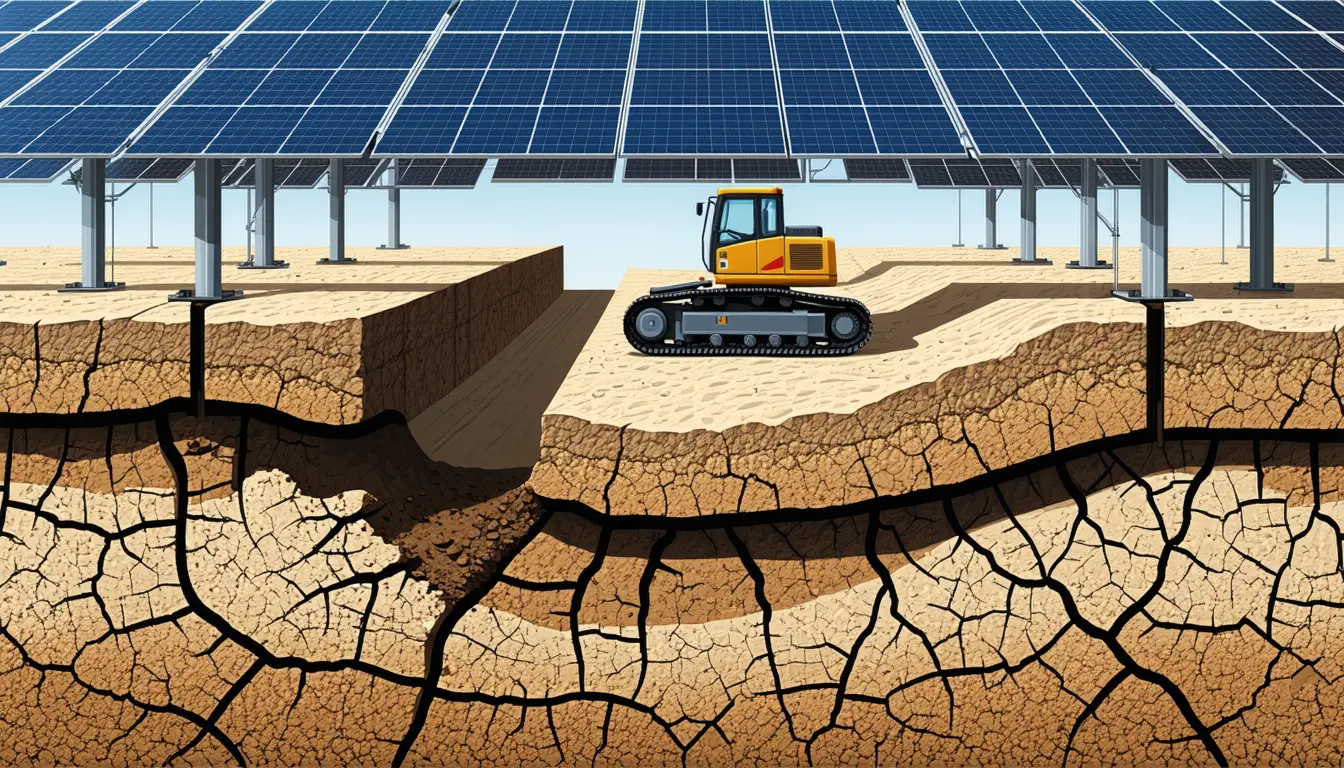
ZALF researchers found that building an agri-photovoltaic plant left subsoil at 1.67 to 1.69 g/cm3, against 1.14 to 1.34 on an uncompacted control plot. For sandy farmland under solar panels, that is dense enough to restrict root growth, so the farming half of the arrangement depends on how the site is built.
The Scientist · Science desk
Drafted by a language model from the sources cited here and checked against its claim ledger before publication. How we use AISend a correction
What happened
- At medium depths, the soil's resistance to root penetration reached 3.7 to 4.1 megapascals on the predominantly sandy field.
- Compaction extended beyond the panel supports across the whole cropped area between rows, and the team traces it to frequent passes by construction machinery.
- Heavy machinery worked damp autumn ground, with 32 millimeters of rain in the three weeks before construction and a further 83 millimeters during it.
- Designated tracks, ground-protection plates and dry-weather scheduling were not used, because of costly protection mats, installation delays and tight funder deadlines.
Compiled by The ScientistSomething wrong?How this is made
Why it matters
- cost Skipping protection pushed the cost into the farming years, since the site now needs mechanical loosening and two to three years of alfalfa to aerate the subsoil.
- exposure Crop output is what is at risk: other studies at similar compaction recorded winter rye yields 22% to 43% lower.
- decision Funders and developers setting agri-photovoltaic timelines now have to choose whether to leave room for dry-ground work and on-site soil supervision, as the ZALF team wants made standard.
Compared with the uncompacted control plot, subsoil in the construction zones is roughly 25% to 48% denser, depending on which ends of the two ranges you pair [1]. Some sampling points went further, to 1.86 to 1.99 grams per cubic centimeter [3]. Kathrin Grahmann of the Leibniz Centre for Agricultural Landscape Research (ZALF), the study's lead author, said: "These values are well above the thresholds known for these soil types, beyond which plant root growth is restricted. In the case of sandy soils, such as those examined in our study, this is particularly problematic because they find it difficult to recover on their own." [5]
The design is a single-site comparison. The team sampled one newly built plant on ZALF's research site in Brandenburg after work finished in fall 2024, and a control plot stood in for ground the machines never compacted [6][2]. According to the report on the study, published in Scientific Reports, it is the first measurement of how the construction phase of these installations affects soil structure [18].
Where the dense soil sits says the most about cause. The between-row compaction [7] points at vehicle routes, and routes can be confined to designated tracks [10]. With one build and one spell of wet weather, though, the study cannot separate the effect of machine traffic from the effect of working damp ground [8].
The ZALF team says targeted protection during construction can largely avoid this kind of compaction [9]. It also wants soil-science supervision made standard on future projects [10]. I think that recommendation follows sensibly from where the damage turned up. This build went without the measures [11], so the study has no protected plot against which to measure how much they prevent.
Crop losses the report cites come from other studies at similar compaction [13]. The thing this doesn't tell you is what happened to crops at this plant. Loosening and alfalfa now under way there [12] mean any later yield record will measure the repair along with the damage.
Sand is also slow to undo. It starts with weak structure and little carbon, and unlike clay it does not swell through freezing and thawing or loosen through the work of soil organisms [14]. Agri-photovoltaic plants are being built more often in Europe [17], and the report says the cost of soil-conserving construction is hard to quantify in general terms [16].
What to watch
- A build that uses designated tracks, protection plates and dry-weather scheduling, measured against a control plot the same way, to put a number on how much compaction the measures prevent.
- Recovery measurements at the Brandenburg plant once the alfalfa and mechanical loosening have run their two to three years.
- Results from clay or other heavier soils and from other panel configurations, which the team lists as the next research step.