Science1 publisher2 min readPublished
Aborting 87% of its seeds lets a Brazilian sedge hand its genome on unchanged
An international team reports in Nature that Rhynchospora tenuis has no meiotic crossovers in either sex, and that selection after fertilization kills off every seed that fails to rebuild the mother's exact chromosome pairing.
The Scientist · Science desk
What happened
- A team led by Andre Marques at the Max Planck Institute for Plant Breeding Research in Cologne reports in Nature that the Brazilian beak-sedge Rhynchospora tenuis makes pollen, fertilizes its egg cells and sets seed with no DNA exchange between the chromosomes it inherited from each parent.
- The group worked from genome assemblies of nine plants collected in Brazil, plus chromosome imaging, sequencing of individual pollen nuclei and controlled crosses.
- They found no crossovers in either male or female meiosis, a combination they say has not previously been documented in a species that otherwise reproduces sexually.
- About 87% of seeds abort, and only offspring that rebuild the mother's pairing of two different genome versions survive, so every survivor is genetically identical to her.
Compiled by The ScientistSomething wrong?How this is made
Why it matters
- capability Breeders have wanted a way to pass a high-performing hybrid genotype through seed unchanged, and there is now a living plant doing it. What was a design idea is now a genome that can be sequenced and dissected.
- cost In this sedge the fixed genotype and the seed loss come from the same process, so the trait a breeder wants cannot be lifted out separately from the losses a farmer could not accept.
- constraint The plant's route depends on chromosome features that crops do not have, so the paper narrows what is biologically possible without supplying a transferable recipe.
- precedent With one crossover-free sexual species on the record, the boundary textbooks draw between sexual and clonal reproduction moves, and other holocentric lineages can be screened the same way.
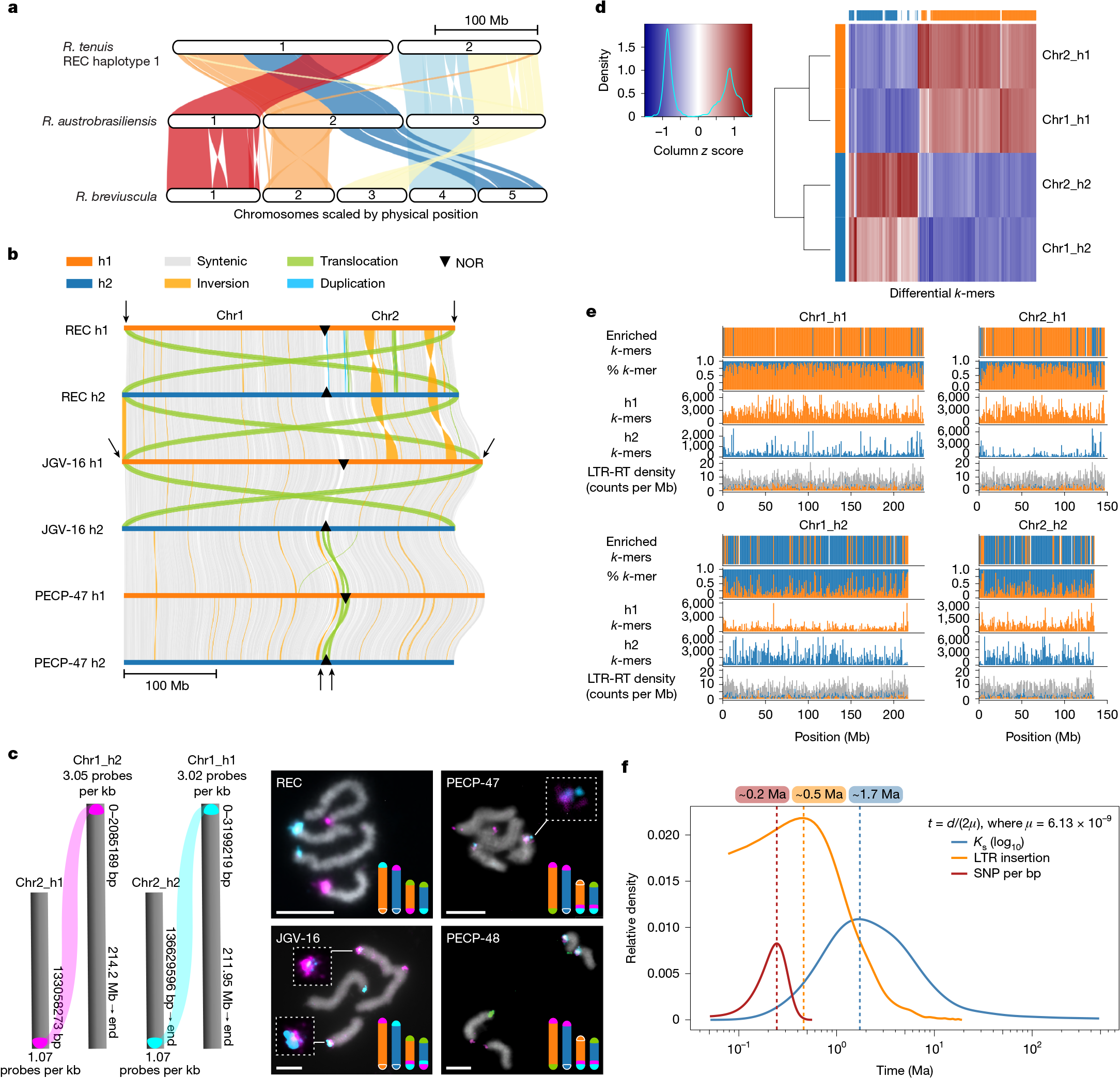
Crossovers do two jobs in an ordinary meiosis. They mix the genomes a plant received from its two parents, and they hold each pair of homologous chromosomes together long enough for the cell to pull one of each pair into a gamete. Take them away and fertility usually suffers [3]. *Rhynchospora tenuis* has a set of features that make the second job easier to do without them: centromere activity spread along the whole length of each chromosome [5], a meiosis run in reverse order, separating the duplicated copies of a chromosome before separating the matching partners [6], and the lowest chromosome number known in any flowering plant [4]. The authors put the connection as a possibility, writing that this architecture may allow reproduction to continue even without crossovers [7].
Two filters produce the clone. The first acts before fertilization: chromosomes that have grown larger by accumulating transposable elements are preferentially passed on through both pollen and egg cells [12], and exchanges of chromosome end segments have created structural differences that limit which combinations can contribute at all [13]. The second acts after fertilization, and it is blunt. If 87% of seeds abort, 13% survive [14][17], so the plant sets roughly eight seeds for every one that lives [18].
The crossover result comes with a denominator: zero events across more than 10,000 pollen nuclei [9]. For zero observations in n trials the standard 95% upper bound is 3/n, which puts the per-nucleus crossover rate under about 3 in 10,000, or 0.03% [19]. A single-cell assay can bound what it detects; it cannot prove literal zero. Earlier cytology had already pointed to a male meiosis without crossovers; the female side was the open question [11].
"Beyond the evolutionary question, controlling recombination is a long-standing goal in plant breeding: fixing a high-performing hybrid genotype so that it is passed on unchanged through seeds is exactly what R. tenuis achieves naturally, and understanding how it does may inform future breeding strategies," Marques said [15].
The goal is real, and so is the demonstration: this plant sets seed with no crossovers in either sex [10]. It gets there by discarding about seven seeds for every one that lives [18]. In a grain or oilseed crop the seed is the harvest, so a breeder would need the fixation without the discard. In this sedge the two come together.
The work is by Meng Zhang and colleagues in Nature [16]. It documents what one sedge does. What happens when crossovers are removed from a plant built like a cereal is still untested.
What to watch
- Identification of the genes that suppress crossover formation in R. tenuis; that is the part a breeding programme could act on.
- Whether other populations, or Rhynchospora relatives, run the same crossover-free meiosis with less than 87% seed loss.
- Any demonstration of fertility in a plant with conventional point centromeres after crossovers have been suppressed.