Science1 publisher2 min readPublished
XRISM clocks wind plasma falling onto the BP Crucis pulsar at 150 kilometres a second
A 16-hour look at the binary caught iron absorption lines sitting below their laboratory energies, and the team takes that shift as gas already on its way onto the neutron star. Rahin says nothing comparable is in the literature.
The Scientist · Science desk
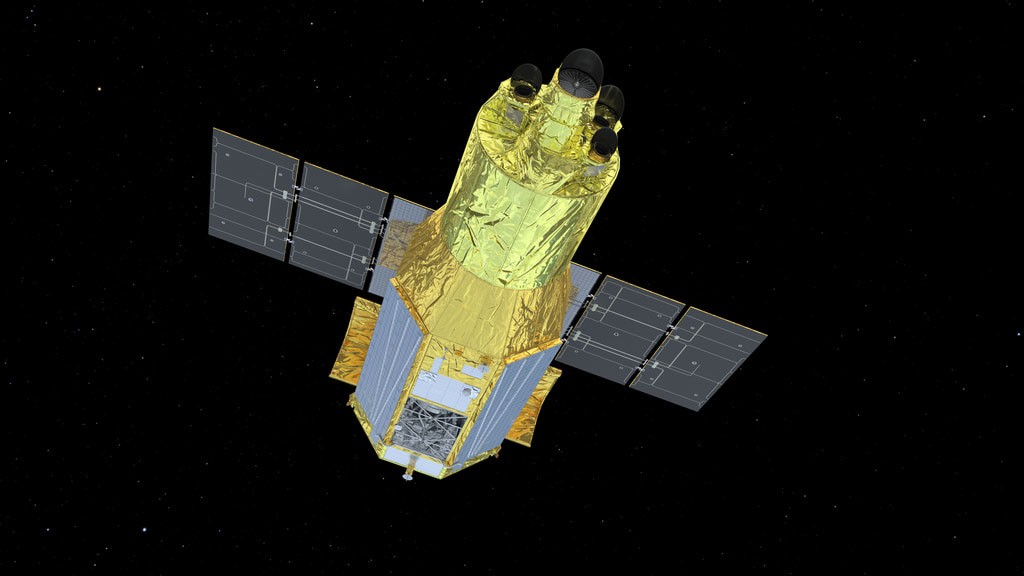
What happened
- XRISM observed BP Crucis on Feb. 1, 2025 for about 16 hours, timed near the end of one of the strong X-ray flares the system produces twice each orbit.
- The binary pairs the blue hypergiant Wray 977 with GX 301-2, a neutron star holding more than a solar mass in a ball roughly 20 kilometres across and rotating once every 11 minutes.
- Highly ionized iron absorption lines arrived at lower energies than their laboratory values, a redshift the team attributes to plasma moving away from Earth and toward the pulsar.
- NASA describes the result as a direct observation of a giant star's wind being captured by its compact companion and powering the flares.
- On the team's account the pulsar needs about four days to cross the dense stream, forming a turbulent disk, losing it, then briefly regrowing one that spins the other way.
Compiled by The ScientistSomething wrong?How this is made
Why it matters
- capability Wind-fed accretion models can now be tested against a measured infall velocity near a neutron star, a number Rahin's search of the literature did not turn up anywhere else.
- constraint The window sits in the one phase where the disk is thought to have already dissipated, so the disk formation and reversal steps of the model are not tested by these data.
- precedent Detecting these lines in a 16-hour Resolve pointing sets a feasible exposure for attempting the same measurement on other wind-fed binaries.
The spectrum yields a speed. NASA's account of the analysis puts the infalling gas at about 540,000 kph [14], which is 150 kilometres per second [1]. A Doppler shift records only the component of motion pointed along our sightline, so that figure is a lower bound, and the full speed depends on the angle between the flow and Earth [3].
The absorption came from highly ionized iron relatively close to the pulsar, and those lines carried both the speed and the direction of the plasma [12]. Emission and absorption lines changed rapidly across the observation [11]. "We've never before seen clear indications of wind plasma falling onto a compact object," said Roi Rahin, a researcher at UMBC and NASA's Goddard Space Flight Center [2][3]. He went through the published literature looking for something comparable and came up empty-handed [15]. The paper is in Science Advances [4].
The pulsar takes about four days to cross the dense stream of plasma [22]. Four days is 96 hours, and the observation ran 16 of them, one sixth of a single transit [2], placed near the end of the phase in which, on the team's picture, the disk has dissipated and plasma falls directly onto the neutron star [20]. That is where a clean infall signature should be easiest to catch. BP Crucis is a convenient case for this because the flares recur twice per orbit, so the phase can be targeted in advance [8].
"We could see how the dense stream of plasma acts very close to the neutron star," said Nazma Islam, a co-author formerly at UMBC and Goddard and now an assistant professor at the Manipal Centre for Natural Sciences in India [16][17].
The rest of the four-day sequence is reconstruction. NASA's account presents it as what the researchers think is going on: the pulsar enters the stream, sweeps gas into a thick, messy, turbulent disk, and that gas spirals down, heats up and emits the X-rays of the flare [19]. Astronomers suspect the disk then breaks down because the stream stops carrying the angular momentum needed to hold it together [20]. Near the far edge a messy disk briefly returns, spinning the opposite way, and it too disappears as the pulsar exits [21]. Two transits of about four days each fill roughly a fifth of the 41.5-day orbit [5].
What to watch
- Observations at the orbital phases where the model predicts a disk, which would test whether the reverse-spinning disk near the far edge of the stream exists at all.
- Whether the same redshifted iron absorption turns up with Resolve in other wind-fed high-mass X-ray binaries, moving this from one system to a class.
- Whether independent modelling of the absorber's ionization structure reproduces the 540,000 kph velocity from the same spectra.