Science1 publisher3 min readPublished
Strain gradients in bent nanoribbons tune diamond's light without doping
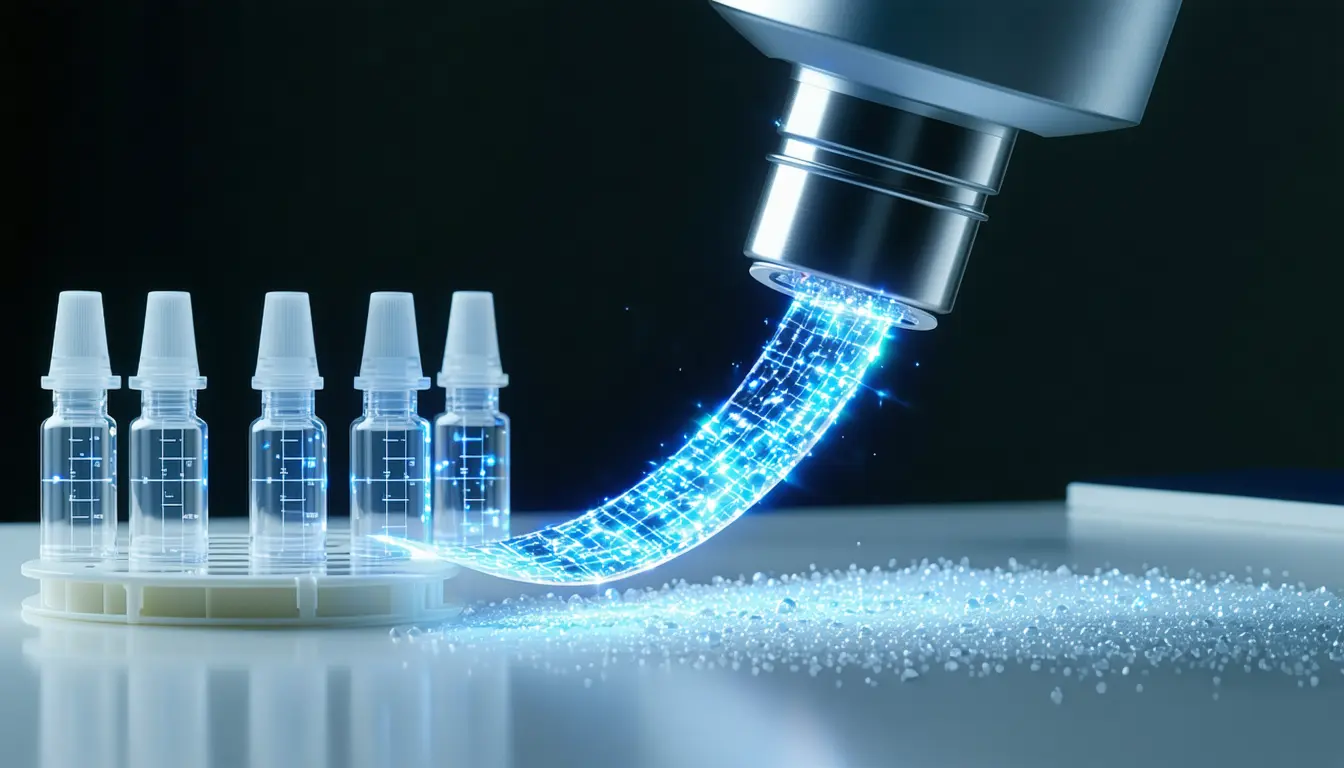
Researchers including Peking University's Lin Yang bent undoped diamond nanoribbons to a 1.49% peak strain and found the gradient tunes the light they emit. Strain could replace doping in diamond, where dopants trap charge carriers at room temperature, but the emitted light was measured at 80 K.
The Scientist · Science desk
What happened
- The team carved single-crystal, undoped diamond grown by chemical vapor deposition into nanoribbons with a focused ion beam, keeping the crystal continuous.
- A ribbon was bent with a microprobe and its ends fixed to supports with platinum so the bend could not spring back.
- Electron energy loss spectroscopy in a scanning transmission electron microscope mapped the local bandgap and phonon energies across the bent ribbon.
- Cathodoluminescence at 80 K, with an electron beam exciting the ribbon, measured the emitted light directly.
Compiled by The ScientistSomething wrong?How this is made
Why it matters
- capability One bent ribbon holds compression and tension side by side, so a single sample can test how strain moves both the bands and the phonons that diamond's indirect emission depends on.
- constraint Dopants fail in diamond at room temperature, and this emission was measured at 80 K, so strain has not yet been shown to outperform doping under the conditions a device would face.
- cost Each strained ribbon needs its own microprobe bend and platinum fixing, a per-device step that would need a manufacturable substitute before strain tuning reaches optoelectronic parts.
Diamond makes light the hard way. It is an indirect semiconductor: an electron crossing the bandgap must also change momentum, and a photon cannot supply that, so a lattice vibration called a phonon has to take part [7]. Lin Yang of Peking University, the paper's corresponding author [3], put it this way: "Phonons are packets of collective atomic vibration within a crystal ... These vibrations help determine which light-emitting transitions can occur," Yang said [8].
Doping is the usual way to tune a semiconductor, and it fails here. "Many dopants bind charge carriers so tightly that they cannot be readily released at room temperature," Yang said [4]. Strain is the alternative. Stretching or squeezing a lattice changes the spacing between atoms and so shifts the energy bands and the bandgap [9]. Uniform strain mainly moves the electronic bands. Less work has been done on how a gradient acts on both the bands and the phonons involved in emission [10].
Bending produces the gradient directly. "When a ribbon bends, the outer side stretches while the inner side compresses. This changes the spacing between atoms differently across the ribbon," Yang said [6]. Thin geometry keeps the strain modest. "A thin ribbon can bend sharply with relatively small stretching or compression across its thickness," Yang said [12]. The calculated peak was 1.49% [13]. Bulk diamond is brittle, but earlier studies showed nanoscale diamond withstanding elastic strains of about 10% [11]. By that measure this ribbon used roughly 15% of the available tolerance [1].
I think the measurement design is the strongest part of the work. The team read local bandgap and phonon energies from the energy electrons lose as they pass through the ribbon [16]. Those maps were then compared with first-principles calculations of diamond's bands under strain and with molecular dynamics simulations of phonons under strain gradients [17]. In one structure, compression and tension sit side by side, so a single sample covers a range of strains. Each strain level can be checked against a model of what it should do to the bands and the phonons.
The light itself came from cathodoluminescence: an electron beam excited the ribbon and the emission was collected [18]. Stable single-photon emission is one of the properties that make diamond a candidate for next-generation devices [2]. The available account of the study describes the cathodoluminescence setup but does not state how far the emission shifted, how many ribbons were tested, or any single-photon measurement.
Temperature matters for the doping comparison. Yang's objection to dopants concerns carriers that stay bound at room temperature [4]. The emission measurements described so far were taken at 80 K, or -193 degrees C [18].
What to watch
- The paper's cathodoluminescence figures: how far the emission shifted per percent of strain, and whether the shift tracks the STEM-EELS bandgap maps.
- A room-temperature emission measurement on a bent ribbon, the condition under which dopants trap carriers.
- Any method that sets strain gradients without a microprobe and platinum clamps, or that applies them to diamond's single-photon emitters.