Science1 publisher2 min readPublished
Sharing nitrogen upgrades across three Bay Area plants saves $268 million in a Stanford model
A Nature Water framework optimizes capital and operating choices across three neighboring treatment plants for 30 years and finds a 48% cut in total cost. Its authors say separate discharge permits are what keep utilities from coordinating.
The Scientist · Science desk
What happened
- Stanford researchers applied a multi-plant optimization framework to three Bay Area treatment plants a few miles apart and found that coordinating upgrades cut total capital and operating costs by up to 48%, or $268 million over 30 years.
- Regulators have ordered a 40% cut in nitrogen discharges into San Francisco Bay by 2035, after algal blooms and fish kills.
- The conventional route, in which each of the region's 37 plants upgrades its own facility, is projected to cost more than $10 billion.
- The framework, published in Nature Water, decides monthly capital and operating moves across several facilities over 30 years, seeking the cheapest portfolio for the watershed instead of for one plant's fence line.
- Several Bay Area utilities are discussing a regional effort, lead author Sinan Abi Farraj said, but most want regulators to approve an official coordination framework before committing.
Compiled by The ScientistSomething wrong?How this is made
Why it matters
- constraint Independent agencies issue separate discharge permits, so no single permit writer can authorize the multi-plant portfolio the model picks; the cheaper design needs a regulatory vehicle before it can be built.
- decision Any board that finances its own upgrade before a coordination framework exists commits decades of debt to the independent path, and the study puts a 32% penalty on starting in 2045 instead of now.
- cost Households pay for the default: roughly $200 a year in sewer increases, and coordination savings would reach them only as a smaller increase.
- exposure The 48% belongs to three neighbors whose implied baseline averages about $186 million each; a utility further from its neighbors, or larger, would be extrapolating to assume the same discount.
Construction costs for nitrogen removal do not rise in proportion to capacity. If a larger plant can strip nitrogen more cheaply, the cheapest regional answer gives that plant more of the load and has the smaller neighbor build less, or nothing at all [5]. "The coordinated solution reduces how much infrastructure gets built and how much that infrastructure costs," said Sinan Abi Farraj, the study's lead author and a doctoral student in civil and environmental engineering at Stanford [7][16].
The dollar figures describe a small case. If $268 million is 48% of the independent baseline for those three plants, the baseline is about $558 million over 30 years and the coordinated path costs roughly $290 million [1]. That works out to about $186 million per plant [3], against an average of at least $270 million per plant in the projection covering all 37 [2]. The 48% was measured on three facilities within a few miles of one another [2].
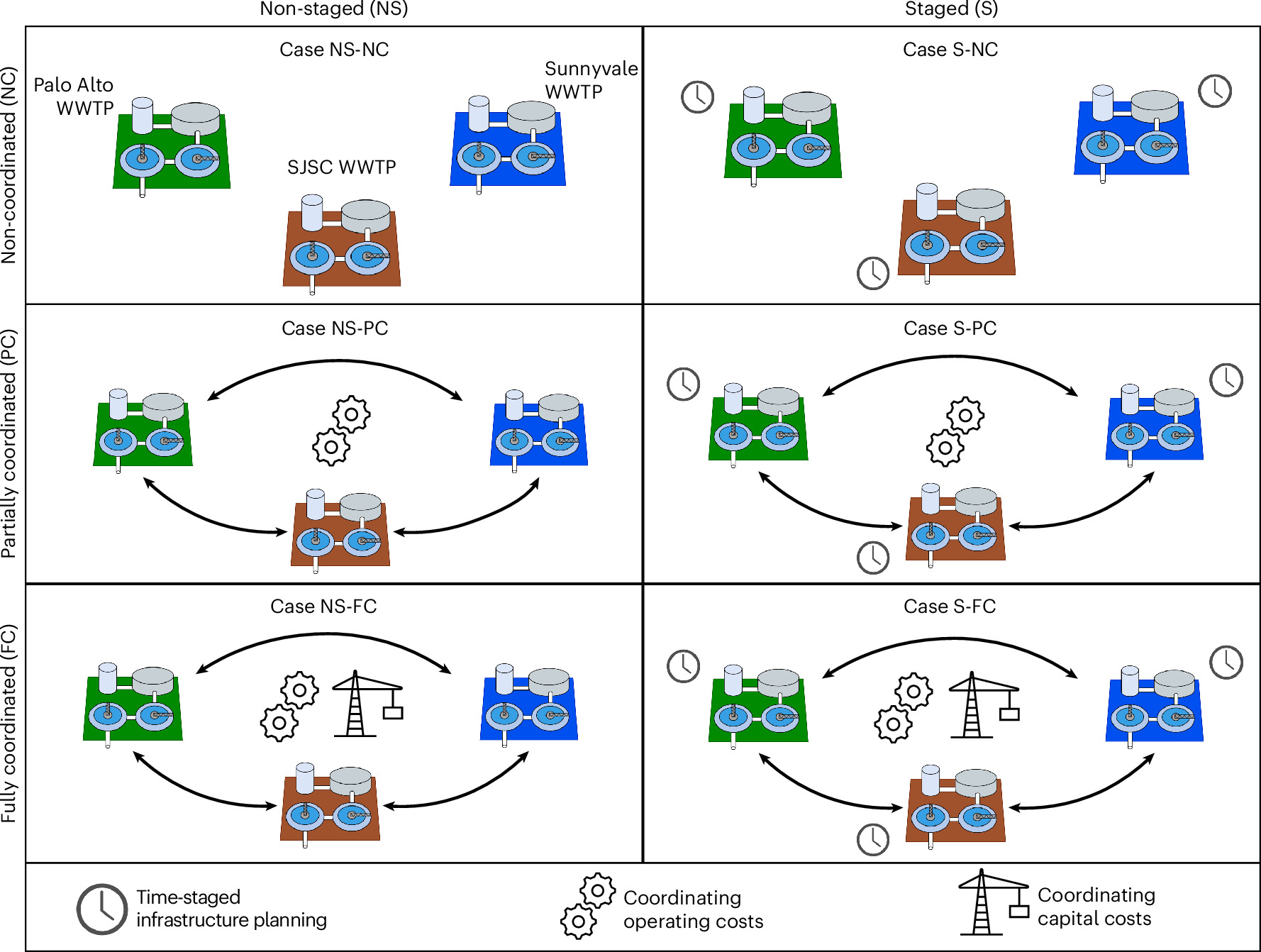
Tools before this one optimized upgrades inside a single facility. Utilities valuing cooperation were left with inconsistent models from consultants [10]. The study also found savings from staging construction until it is needed instead of building ahead of permit deadlines, and the largest gains came from staging combined with full coordination across all three plants [14].
Capturing any of it means deciding which plant builds and who is liable if a partner's equipment underperforms. "If you don't coordinate, each facility has to build and finance small infrastructure projects on its own," said Abi Farraj [6]. The authors put the obstacle in the permit files. "Regional facilities rarely coordinate their decadal capital improvement plans or monthly operations because independent agencies monitor them and issue separate discharge permits," said Meagan Mauter, the study's senior author and a Stanford professor of civil and environmental engineering [8][16].
So the model is aimed at a negotiation. Abi Farraj described what it has to do to work: "The only way you convince a plant to coordinate is to show them exactly how much their ratepayers will save and give them confidence that they will still be able to maintain regulatory compliance" [13].
What to watch
- Whether the regional water board publishes a coordination framework that separate dischargers can permit against, and what it requires of each plant.