Science1 publisher2 min readPublished
Return to Vulci excavators reach the Etruscan tomb inside a mound Gsell outlined in 1889
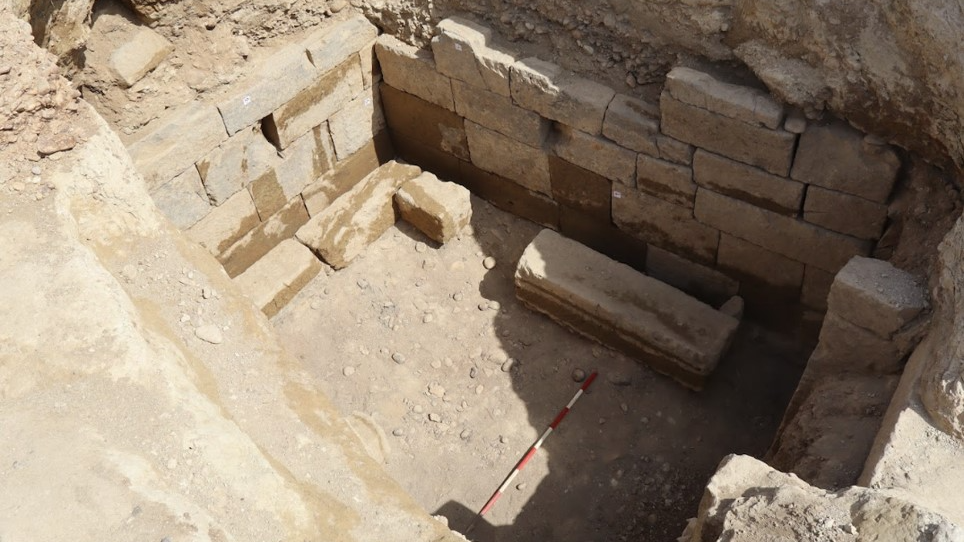
Return to Vulci archaeologists excavated a 2,700-year-old Etruscan tomb inside a mound Stephane Gsell outlined in 1889 before running out of time and money. Early calculations suggest the mound may be more than twice the 31-meter width he estimated.
The Scientist · Science desk
What happened
- In 1889 Stephane Gsell traced the circular enclosure of a burial mound at Vulci but never reached the tomb, having run out of time and money.
- The Return to Vulci project excavated the burial this summer and nicknamed it the Tomb of the Stone Chamber, according to the regional superintendency SABAP-VT-EM.
- Robbers had tried to loot it repeatedly, yet it still held weapons, gold and bronze plates, chariot parts, a rare pair of women's shoes and a complete banquet set.
- Its side chambers yielded a bronze tripod made on Rhodes and a nearly complete banquet set, some of its vessels still where they were placed.
Compiled by The ScientistSomething wrong?How this is made
Why it matters
- precedent An 1889 outline that picked the right mound, despite missing its size by more than half, makes old survey notes at Vulci a usable guide for where later teams should dig.
- constraint Any ranking of this mound against Cuccumella is a projection from initial calculations, so claims that it is the largest at Vulci have to wait for a measured diameter.
- capability For a people whose language is only partly read, a high-status tomb with its contents still in place adds exactly the kind of evidence most knowledge of the Etruscans depends on.
Gsell left a measurement along with his outline. He put the tumulus at about 31 meters across and called it a "new Cuccumella," after the largest burial mound then known at Vulci, which is roughly 70 meters in diameter [12]. According to Etruscan Times, the Return to Vulci team's initial calculations suggest the Stone Chamber mound may be similar in size to Cuccumella or larger [13]. If it is Cuccumella-sized, Gsell's figure was about 44 percent of the true diameter [1]. His circle would then take in roughly a fifth of the mound's footprint [2].
So the 1889 survey, which Gsell abandoned when he ran out of time and money, still pointed a later team to the right mound [4]. It also badly underestimated it. The excavators say the chamber is much larger than they, and Gsell, expected [5]. That supports a narrow claim about fieldwork shelved for lack of funds.
A broader claim would need more cases to compare against. Vulci's cemetery gave up thousands of wealthy tombs in the 19th century [10]. One mound shows that going back can pay off. The reporting does not say how many other outlines from that era were revisited, or how many led nowhere.
Robbers tried this burial repeatedly over the centuries [2]. Jewelry, clothing and shoes were still there, under the chambers' collapsed roofs, when the team reached them [8].
Christian Mazet, a British Museum archaeologist who co-directs the project, speaks without qualification. "This is the burial. We are absolutely certain of it," he told Etruscan Times [6]. He bases the rank on the finds. The weapons, chariot parts, gold objects and high-quality ceramics mean "there is no doubt that this is a tomb of the very highest rank," he said [7]. Live Science's own account is more guarded: it says the team "think they've finally found" the chamber [5].
For the Etruscans, objects carry most of the evidence. Their language is only partly understood, so most of what is known about them comes from sites such as Vulci [11]. A status judgement built on grave goods counts for more here than a single inscription might.
The size claim has the least behind it. "Everything tells us that it is one of the most monumental at Vulci," Mazet told Etruscan Times [14]. The identification and the rank rest on objects the team recovered [7]. The comparison with Cuccumella rests on the team's initial calculations [13].
What to watch
- The 2027 season on the covered tomb, and whether a measured diameter bears out the early estimate that the mound rivals Cuccumella's roughly 70 meters.
- A formal report or inventory from the Return to Vulci project or SABAP-VT-EM, including how the tripod was traced to Rhodes.