Product1 publisher3 min readPublished
The Senate Chancellery itemised four task forces, a housing crisis team, outside counsel and a contact point for staff, which tells any public body what the refusal path needs in people even though the price of it never appears.
The Product Desk · Product desk

Evidence-backed comparisons of source perspectives and observed adoption signals. Read the methodology
Which Builder, Operator, and Investor concerns the observed source mix emphasized—not a truth score.
Follow any of these and your For You feed starts watching them — no settings page required.
Evidence, demonstrated adoption, hype gap, incentives, and confidence are assessed independently, each on its own current evidence. How these are measured.
Firm on the response, attacker-sourced on the theft
Two kinds of sourcing sit side by side. Everything about Berlin's response traces to the Senate Chancellery's 3 September release, quotable unit by unit and checkable by anyone who opens the original. Everything about the theft itself, the 5.7 terabytes and the contracts, personnel files and passwords, is the sellers' own listing, screenshotted by Der Spiegel and relayed onward. No one outside the investigation has opened the files, and thenextweb.com says so rather than smoothing it over.
Machinery running, notifications still pending
Berlin's response is operating rather than drafted: the ICT task force meets until further notice, a staff contact point is open, police stations are briefed to take complaints and offer counselling, and two networks actually came offline on 14 August at the cost of several days of housing benefit processing. The commitment still outstanding is the one residents care about. Berlin says the Senate departments will contact identified individuals on a risk basis, and as of this reporting the central crisis unit was still verifying what had been published.
A list of bodies billed as a plan
Calling this a staffing plan stretches what Berlin actually published. The release names units, not posts: five standing bodies, an adviser and a contact point, with no headcount, no cost and no end date, a gap thenextweb.com concedes in the same breath as it draws the lesson. Where the reporting is tighter than most is on the numbers, tagging every quantity as the attackers' claim and knocking down the suggestion that a city-state's transport and housing files held national defence material.
Both primary sources are publishing for effect
Everyone supplying original material here wants an outcome. Rhysida's inventory and terabyte figure are a seller's pitch for an auction opening at 30 bitcoin, and its British Museum record shows the files go up after a refusal regardless of bids. Berlin's release went out the day before the threatened publication and fifteen days before a city vote, with Mayor Kai Wegner on 28 August and chief digital officer Florian Hauer on 3 September landing nearly the same refusal line, and the interior senator stating that election infrastructure was untouched.
One account, strongest where it reads documents
A single publisher carries this, and its best passages are close readings of material it did not gather: a press release, a Reuters dispatch, a Der Spiegel screenshot. Those readings hold up. The parts that would settle the story do not, since the volume claim splits between two published figures and the per-coin arithmetic on the Reuters conversion is thenextweb.com's inference rather than a correction anyone has confirmed.
security
Rhysida gives Berlin seven days before it auctions 5.79TB of city data1 publisher
product
The 825 million euro lesson: an automated suspension that stops earnings needs a human and an appeal3 publishers
security
Extortionists supply the only itemized count of what left Berlin's state network6 publishers
security
AI agents ran more than 50 ATT&CK techniques through one enterprise in under 10 hours2 publishers
Compiled by The Product DeskSomething wrong?How this is made
Berlin's press release tells police officers that support services exist for people who come in to report finding their own data in the dump [14]. That is a plan built around what people do when a leak is announced, which is turn up at a counter and ask a human being whether they are in it. Berlin's formal ask of those people is that they file a criminal complaint, online or at a station [15]. Someone has to sit at that counter, every day, for as long as the queue lasts.
Count the standing bodies. A special task force at the State Criminal Police Office, another inside the transport department, a joint one across the two departments that were hit [10], an ICT emergency task force meeting until further notice [12], and the housing department's crisis management team [11]: five bodies with recurring meetings, plus outside counsel and a contact point for staff [27]. Berlin says it sees no current evidence that the attackers still hold the state network, and forensic work continues on whether more was taken than anyone yet knows [13]. Those meetings run on the timetable of the notification work, not of the intrusion.
The only figure in the story with a currency attached belongs to the sellers. The auction opened at a minimum bid of 30 bitcoin, which Berlin puts at roughly 2 million euros [18]. Reuters gave that minimum as $77,622 [19]. Thirty times $77,622 is $2,328,660, which sits alongside Berlin's euro number, and thenextweb.com reads the dollar bracket as the price of one coin rather than the total [20][30]. Taken as a total instead, it understates the opening bid by a factor of thirty [31].
Berlin says Rhysida asserts it holds 5.7 terabytes, while Reuters and the BBC both print 5.79, and nobody outside the group selling the files has confirmed either [17]. The inventory of contracts, non-disclosure agreements, personnel files and passwords comes from the dark web listing Der Spiegel screenshotted in August [9]. Berlin's own account is narrower and duller: personal data on state employees, residents and businesses [8]. That follows from what the two hit departments actually hold [6], which for a city-state is bus operations and building permits, since German national defence belongs to the federal government and the Bundeswehr [7]. A central crisis unit is meant to verify the contents and tell the people affected [5], which means reconciling a seller's manifest against records the state does have.
Refusal has precedent and a known ending. Rhysida took around 500,000 files from the British Museum in 2023, the museum declined to pay, and the group published them [21]. Grafana Labs turned a ransom down in May, when the stolen code was already open source [23]. Rhysida has claimed hundreds of attacks since it emerged in 2023, with activity traced to Russia and eastern Europe [22]. State senator Iris Spranger says the Berlin attack did not reach election infrastructure [26], which is the one comfortable fact in a city that votes on 20 September [25].
The usable thing here is Berlin's list, read as a template. The test is whether you can write a different name against each box: who verifies contents against an inventory you cannot trust, who answers staff, who staffs the walk-in counter, who takes the legally sensitive call on a Sunday, who runs the ICT recovery. If one name lands in more than two boxes, what you have is a person rather than a structure, and that person takes holiday. The decision to refuse is made in an afternoon. The staffing it implies runs for months.
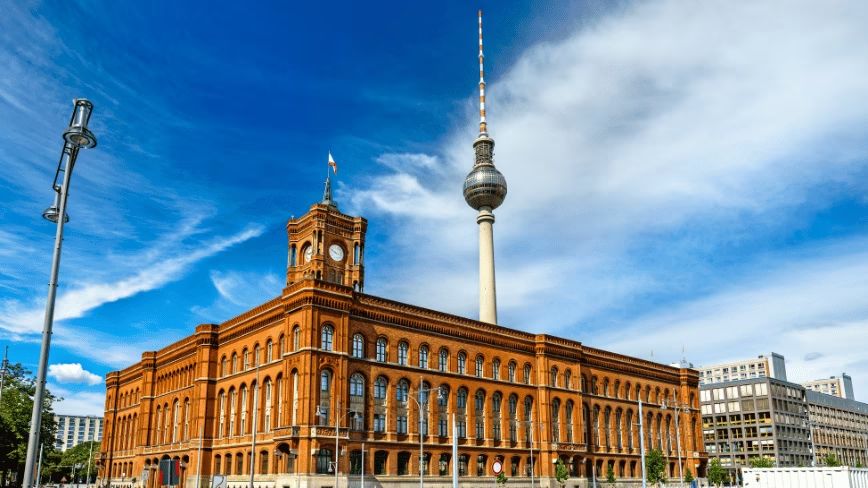
Ranked by verification strength, evidence, and original report placement.
Berlin refused to pay the ransom, and the stolen data went up on Friday.
The State of Berlin set out its response machinery itself, in a press release from its Senate Chancellery issued on 3 September, the day before the criminals said they would publish.
Berlin's state government said on Saturday that it was reviewing the material with the highest intensity, as reported by Miranda Murray for Reuters.
A central crisis unit will verify the contents of the published material and tell the people affected.
The attackers reached two Berlin Senate departments: one covering Mobility, Transport, Climate Protection and Environment, the other covering Urban Development, Construction and Housing.
Berlin is a city-state whose Senate departments run buses, building permits and housing benefit; German national defence belongs to the federal government and the Bundeswehr, not to a city administration.
Publishers with included, body-backed reporting in this cluster.
1 article · September 6, 2026