Product1 publisher2 min readPublished
Antigravity gives away five frontier models on a quota Google keeps trimming
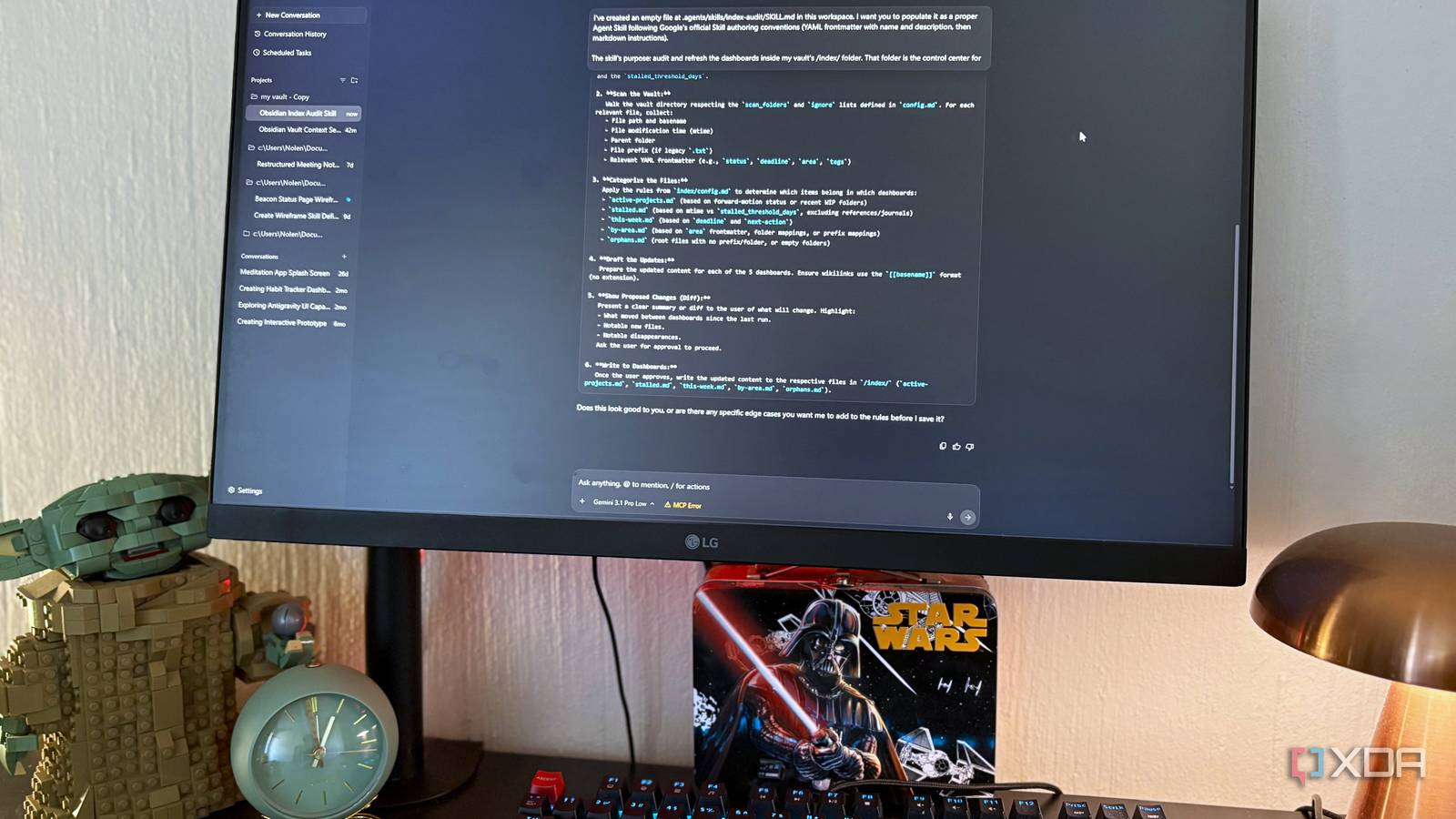
Antigravity's free tier includes Gemini 3.1 Pro and Claude Opus 4.6 with unlimited tab completions. XDA reports Opus burns credits about four times faster than Gemini, and Google moved the free tier onto credits in March 2026.
The Product Desk · Product desk
What happened
- Antigravity's free tier serves Gemini 3.1 Pro, Gemini 3 Flash, Claude Sonnet 4.6, Claude Opus 4.6 and GPT-OSS 120B on Windows, macOS and Linux, with no credit card required.
- Codex is available on ChatGPT Free, which OpenAI frames as suitable for quick coding tasks, and free users cannot buy more credits once they have run out.
- On Terminal-Bench 2.0, Codex CLI scores 77.3% against Claude Code's 65.4%, and Antigravity has no published result in that category.
Compiled by The Product DeskSomething wrong?How this is made
Why it matters
- constraint Any rollout plan built on the free allowance inherits a dependency on Google's next quota decision, and the team that sized its sprint on today's number will resize it.
- decision Model routing becomes a budget question: whichever agent gets Opus is the one spending the day's allowance.
- capability One developer can split a single ticket across two vendors' models at once without buying a seat from either. That changes what a proof-of-concept costs to staff.
- cost Standardising on Claude Code means paying per seat per month before anyone opens a file, and finance carries that line whether or not the developer used it that week.
Route Opus 4.6 with extended thinking at the hard debugging job, walk away, and the credits drain about four times faster than Gemini's, according to XDA's comparison of the three tools [16]. XDA puts that at maybe one serious session before the lockout [16]. Five models sit on the free list [1]; Gemini is the one a developer can leave running through an afternoon.
Antigravity's free tier lists Opus 4.6 [1]. Claude Code has moved on: XDA says Opus 5 is the default there now, with thinking on natively and a million-token context standard [11].
What the free tier supports is roughly one agent-heavy Opus session per developer per day [16]. Tab completions and command requests come on top, unlimited by XDA's description, on a full orchestration stack [2].
Compare that with what the paid tools cost. Claude Code sits behind a paid plan, so the floor is Pro at $20 a month or an API key on pay-per-token billing [4]. Ten developers on Pro is 10 x $20 x 12, or $2,400 a year [19]. For that money XDA rates both paid tools higher at the coding itself. Claude Code caught a race condition Codex missed entirely in one Express.js refactor [12]. Codex CLI scored 77.3% on Terminal-Bench 2.0 against Claude Code's 65.4%, a gap of 11.9 points, and Antigravity has no result in that category [13][18]. Codex also finished the same refactor on roughly a quarter of the tokens Claude Code used [14]. The price of Antigravity's paid tier is missing from XDA's comparison.
The thing Antigravity does that neither of the others can is watch the app run. Its built-in Chrome lets an agent open the running app, click through a flow and come back with a recording or screenshots [7]. Claude Code and Codex can compile and run tests, but confirming that the OAuth screen renders correctly is beyond both of them [8]. Each task also leaves artifacts a person can comment on inline, Google Docs style, and the agent folds the feedback in without stopping [9].
Sorted by job, the allocation is simple. Work whose output a human has to see in a browser goes to Antigravity, paid or not [7][8]. Work that touches a dozen files and a dependency graph goes to Opus and its million-token context [10]. Shell scripting, system administration and CI/CD work goes to Codex, which also ships as Apache 2.0 with kernel-level sandboxing [13][15]. Keep work with someone else's deadline off the free quota. Google has cut that quota several times since launch and converted it into a credits system in March 2026 [3][17].
What to watch
- Whether Google cuts the credit allowance again, or changes what one credit buys, after the March 2026 switch.
- Whether Antigravity's model list picks up Opus 5, and whether it lands on the free tier or behind payment.
- Whether Antigravity posts a Terminal-Bench 2.0 result, which would test Codex's lead in shell and CI work.