Product1 publisher3 min readPublished
Two years of jobs data invert the AI risk rankings: clerks shrink, managers grow
Economist Gad Levanon checked task-based AI risk models against government employment data. The occupations rated most exposed grew, and the ones rated safe contracted.
The Product Desk · Product desk
Drafted by a language model from the sources cited here and checked against its claim ledger before publication. How we use AISend a correction
What happened
- The standard approach to predicting AI's impact on jobs involves building rankings based on how many of an occupation's tasks could theoretically be handled by technology.
- Such rankings consistently placed managers, financial analysts, and lawyers near the top of the risk list, often above clerical positions like data entry or filing.
- Economist Gad Levanon tested the task-based theory using government employment data from the past two years and published his findings last week.
- Levanon found that roles long flagged as high risk, including management, engineering, science, and law, continued expanding and in some cases picked up speed.
- Occupations not considered especially vulnerable, including records clerks, bookkeepers, and customer service staff, are contracting rapidly.
Compiled by The Product DeskSomething wrong?How this is made
Why it matters
The standard way to predict which jobs AI will hit is to rank occupations by how many of their tasks a machine could theoretically do [1]. Those rankings consistently put managers, financial analysts, and lawyers near the top of the risk list, often above clerical work like data entry and filing [2].
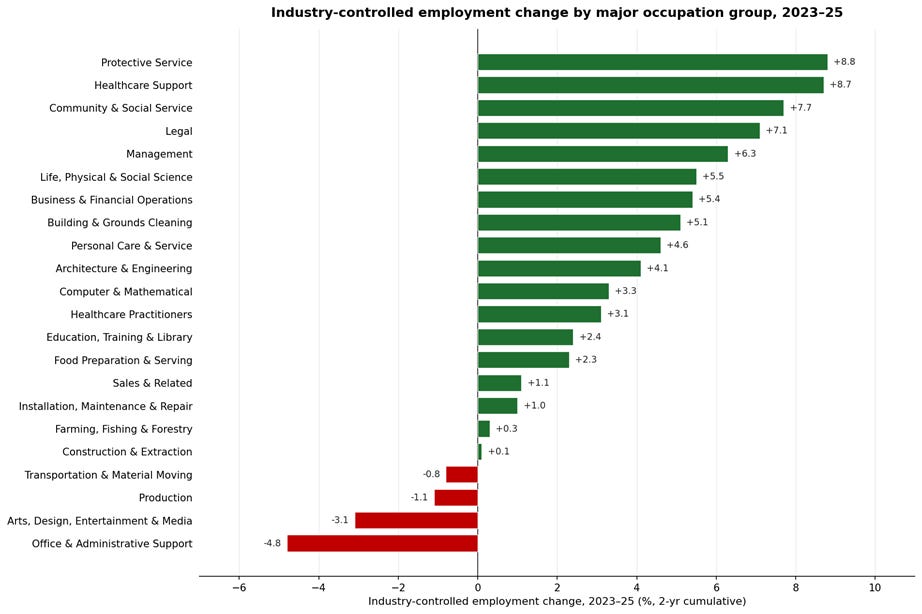
Last week economist Gad Levanon tested that ranking against government employment data from the past two years and published the result [3]. It ran the other way. Roles long flagged as high risk, including management, engineering, science, and law, kept expanding, and in some cases sped up [4]. Meanwhile occupations that the models did not treat as especially vulnerable, such as records clerks, bookkeepers, and customer service staff, are contracting quickly [5].
The obvious objection is that clerical roles might be shrinking only because they sit in shrinking industries. Levanon addressed it directly, measuring each occupation's growth against the average growth of the industries where it appears, which isolates the occupation's own trend from its surroundings [6]. The finding held: clerical work is declining inside sectors where managerial roles are growing [7].
Several people who deploy these tools say that is consistent with how AI is actually used. Rudy DeFelice of Harbor Global told Inc. there is a difference between the tasks a professional performs and the responsibility attached to them, and that AI automates portions of the work but not the responsibility [8]. Sheldon Arora, CEO of StaffDNA, told Inc. that clerical roles involve standardized, rules-based processes that are relatively easy to automate end to end, and that firms will not scrap whole professions just because AI can do part of the job [9].
That is the practical distinction the task-counting method misses. A model that scores an occupation on task overlap treats a lawyer whose research can be partly automated the same as a filing clerk whose entire routine can be. The employment data suggests the second case is what employers actually act on.
Looking further out, administrative work, customer support, documentation, and back-office functions are expected to keep bearing the brunt, with steady, incremental declines projected over the next three to five years [10]. Jeff McMillan of McMillanAI told Inc. that the resulting job-security anxiety is concentrating heavily in the middle-management layer [11], even though that layer is, so far, growing. Kelly Heuer of the Project Management Institute said managers, analysts, and lawyers rely on critical thinking, stakeholder management, and human judgment that do not erode with automation [12].
What to watch is whether the middle-management growth Levanon recorded survives the next two years, or whether the anxiety McMillan describes turns out to be early. The data so far measures headcount, not workload, and a role can hollow out well before it disappears from the count.