Invest1 publisher3 min readPublished
Former Morgan Stanley AI chief recasts Apollo's agent bank-run warning as deposit repricing
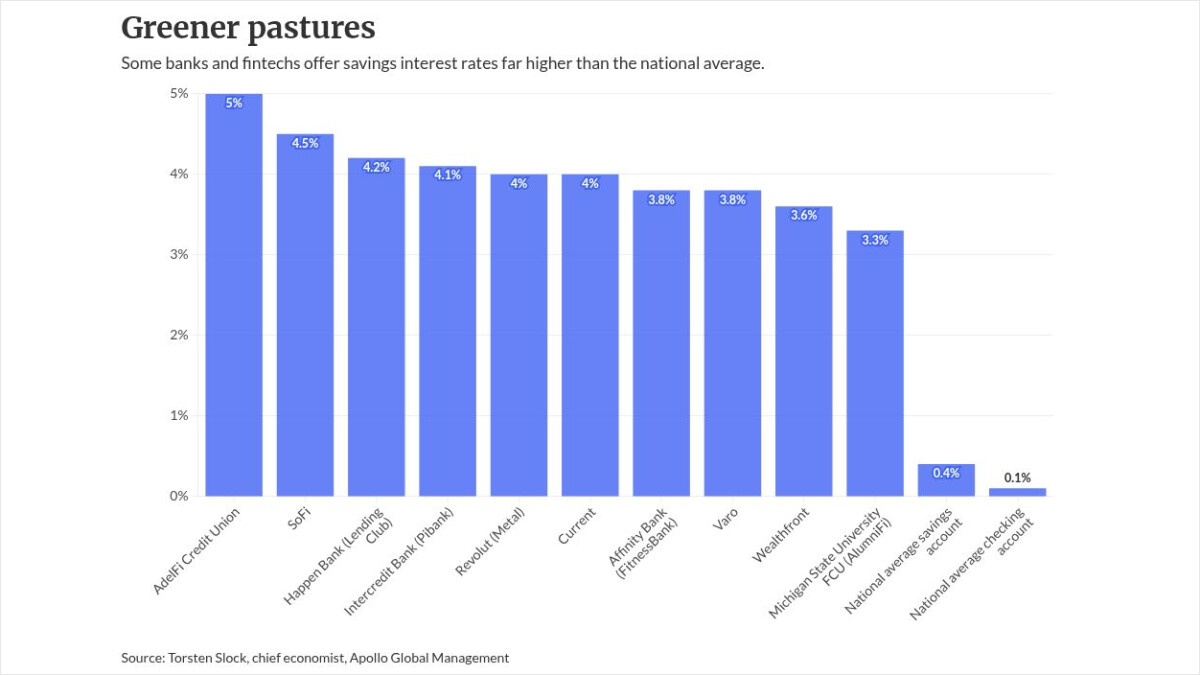
Apollo economist Torsten Slok warns AI agents could sweep cash from 0.1% bank accounts into fintech accounts paying 3.3% to 5%, even causing bank runs. Bank AI veterans call a run a long way off, yet expect agents to make deposit moves faster and more coordinated than banks have seen.
The Investor · Invest desk
Drafted by a language model from the sources cited here and checked against its claim ledger before publication. How we use AISend a correction
What happened
- Jeff McMillan, Morgan Stanley's head of firmwide AI until March, called an agent-driven bank run theoretically possible but unlikely, and a long way off if it happens.
- Mint, the best-known personal finance aggregation app, had only 3.6 million monthly active users before Intuit shut it down, according to American Banker.
- Erin Hennessy, chief member experience officer at PSECU, disagreed, saying an agentic AI bank run is absolutely coming and could arrive sooner than people expect.
- Derek White, CEO of Primitive and a former U.S. Bank chief digital officer, said people now use ChatGPT and Claude to find savings accounts instead of Google or Bankrate.
Compiled by The InvestorSomething wrong?How this is made
Why it matters
- cost In McMillan's repricing case the cost lands on bank margins: deposits stay put, but only at rates closer to what fintech accounts pay, up to 4.9 points above today's average.
- contradiction McMillan's case depends on yield chasing being slow enough for banks to respond, while Rajwani describes agents acting on news and social media signals, which can move money within hours.
- decision Because each bank sets its own limits on third-party automated actions, each bank decides how much friction stays between an outside agent and its deposit base.
A household keeping $10,000 at the 0.1% average Slok cites earns $10 a year in interest. The same balance at 3.3% to 5% earns $330 to $500 [1]. The fintech account pays 33 to 50 times as much [3]. For the bank the same spread is 3.2 to 4.9 percentage points [2], or $32 million to $49 million a year in extra interest on every $1 billion of deposits it would have to reprice to keep [4]. Those are the deposits Slok had in mind when he wrote: "If every household used AI agents to optimize the return on their cash balances, banks could lose a large share of the cheap deposits they rely on to make loans, which would be a problem for the entire financial system" [2].
Jeff McMillan, who ran firmwide AI at Morgan Stanley until March and now runs McMillan AI [8], takes the version that is cheapest for the system. "What Torsten describes is repricing, not a run," he told American Banker [9]. Runs are driven by fear of losing money, he said, while chasing yield happens more slowly and banks can respond to it [10]. If he is right, the $32 million to $49 million per billion is the bill, paid in higher deposit rates to keep money that would otherwise leave [4].
Rhea Rajwani, head of AI and emerging banking solutions risk at M&T Bank, speaking for herself and not the bank [4], puts the risk in speed. "The real question is not whether AI causes a run, but whether AI removes the friction that traditionally slows customer behavior," she said [5]. Customers can already move money quickly through online and mobile banking, she noted [16]. "Agentic AI could take this a step further by continuously monitoring rates, account balances, economic news and even social media signals, then executing transfers automatically based on predefined objectives," she said [6]. Rates are a repricing input. Economic news and social media are what move money in a panic, and an agent with a fixed objective would react to them at the same moment as every other agent set up the same way.
The third outcome is that adoption stalls. Rajwani listed the obstacles: weak interoperability across financial institutions, consumer distrust of AI agents, missing authentication and authorization controls, regulatory and liability questions, and banks' restrictions on third-party automated actions [7]. About half of Americans have linked a bank account to an app, McMillan said, mostly to fund a single payment or brokerage account, and far fewer have given any tool a full view of their finances [11]. "Giving an agent standing authority to move your money on its own is a much bigger step, and nobody has done it at scale," he said [13].
I think McMillan has the trigger right and Rajwani has the speed right. An agent does not create fear, so a run still needs a reason to panic. A funding plan that assumes deposits leave at the pace of a customer comparing rate tables is a different matter, and it is the assumption agents would break first. That assumption sits in each bank's own liquidity model and can be changed before any agent holds standing authority over a deposit. The view is wrong if that authority stays where McMillan puts it, with nobody using it at scale [13].
What to watch
- Whether any bank or fintech grants AI agents standing authority to move deposits at scale, the step McMillan said nobody has taken.
- Whether banks loosen or tighten their restrictions on third-party automated actions, the one adoption barrier on Rajwani's list each bank sets for itself.
- Whether Meta's Muse or other assistants add automatic cash sweeps into higher-yield accounts of the kind Slok described.