Product1 publisher3 min readPublished
Generative music is now disclosed studio practice, and the metadata is the unfinished part
Tyga's admission, Timbaland's AI signing and a Hot 100 entry move licensing, credit and provenance from roadmap items to shipping requirements.
The Product Desk · Product desk
Drafted by a language model from the sources cited here and checked against its claim ledger before publication. How we use AISend a correction
What happened
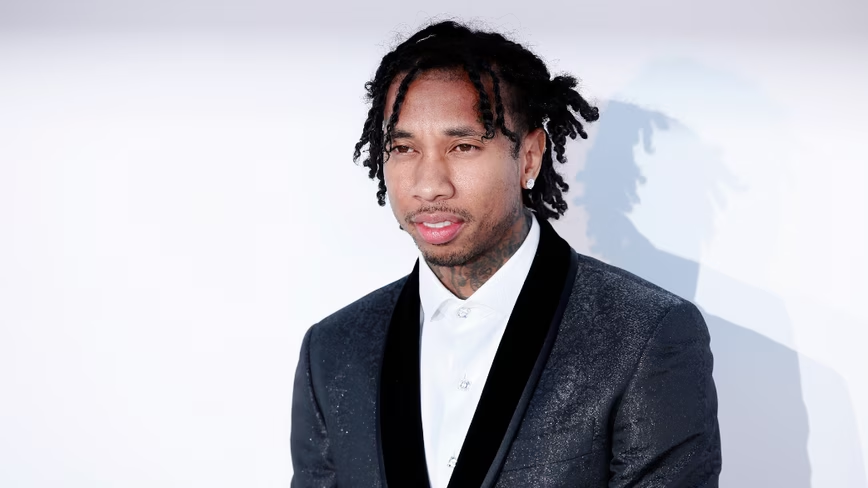
- Tyga admitted that AI generated the retro/period synths on his eighties-styled ninth album "$tarface", though he says he wrote the lyrics and sang the vocals himself.
- Tyga framed the use of AI as another studio tool, telling interviewers it was "no different than when Auto-Tune came out".
- Timbaland has launched an "A-Pop" venture called Stage Zero and signed its first act, TaTa, which he describes as "a living, learning, autonomous music artist built with AI".
- A machine-assisted summer hit has already reached the Billboard Hot 100.
- A hack of the AI generator Suno revealed millions of scraped songs, illustrating that generated music is trained on the recorded output of human artists who were never asked.
Compiled by The Product DeskSomething wrong?How this is made
Why it matters
Tyga has said that artificial intelligence generated the period synths on his eighties-styled ninth album "$tarface", while he wrote the lyrics and sang the vocals himself [1]; Timbaland has launched an "A-Pop" venture, Stage Zero, and signed a first act, TaTa, which he describes as "a living, learning, autonomous music artist built with AI" [3]; and a machine-assisted summer hit has already reached the Billboard Hot 100 [4]. The disclosure has arrived before the plumbing: according to The Next Web, the industry still has no agreed way to label machine-made music, which leaves listeners guessing [13].
Tyga's defence is that this is tooling, "no different than when Auto-Tune came out" [2]. The same piece supplies the disanalogy that matters for anyone building the systems underneath: Auto-Tune did not train itself on other singers without asking [11]. That is a licensing problem with a paper trail. A hack of the generator Suno exposed millions of scraped songs [5], and a German court recently found that Suno had broken copyright, a first for Europe, with similar suits accumulating on both sides of the Atlantic [6].
Across the practices described in the source, only one includes a pre-agreed payment to the human whose material is used: Grimes has for years let fans make songs with a licensed clone of her voice in return for a royalty split [7][8]. Everything else is either a studio input with no published provenance [1][3] or a training set assembled without permission [5]. For a rights administrator, that distinction is the whole product: a royalty split needs an identified counterparty, a rate and a recording-level flag, and none of those exist as standard fields for a synth patch conjured by software [13].
Disclosure has the same gap. A viral band on Spotify turned out to be AI with nothing on the platform to say so, and several acts have admitted using the technology only after first denying it [9]. A label field that only honest actors populate is documentation, not a control, which is why frank admissions like Tyga's remain the exception [10]. The reputational cost of being honest is currently high: Pitchfork gave "$tarface" a 0.0, its lowest score in years, with the reviewer noting that so little effort had gone into the record that "the margins on this thing must be amazing" [12], and Doja Cat criticised Tyga publicly [14]. Meanwhile an entirely synthetic act, Tilly Norwood, has drawn hundreds of thousands of views without ever having existed [15], and Nick Carter of the Backstreet Boys has used AI for videos [16].
The volume question outranks the celebrity ones. Streaming platforms are being flooded with AI-generated tracks uploaded at a pace no human catalogue could match, each competing for the same finite pool of listening time and royalties [17]. That is a payout-allocation and ranking problem, arriving on catalogues that went from novelty to charts in barely two years [18].
Watch whether any major platform ships a disclosure field with enforcement behind it rather than self-attestation [9][13]. Watch how the German Suno finding is cited in the pending cases elsewhere [6]. And watch whether Stage Zero publishes training provenance for TaTa, since a signed AI act is the first case where the rights chain is a contractual asset rather than an embarrassment [3].