Invest2 publishers3 min readPublished
Universal and Sony sue Suno again over 60,202 recordings they say still shape v6
The labels answer Suno's from-scratch claim for v6 by arguing the model learned from the outputs and preference data of earlier models trained on 60,202 of their recordings. The statutory ceiling reaches $9.03bn.
The Investor · Invest desk
What happened
- Universal and Sony's second complaint against Suno accuses the company of copying 60,202 of their sound recordings without a licence and using them to build the models that run its service.
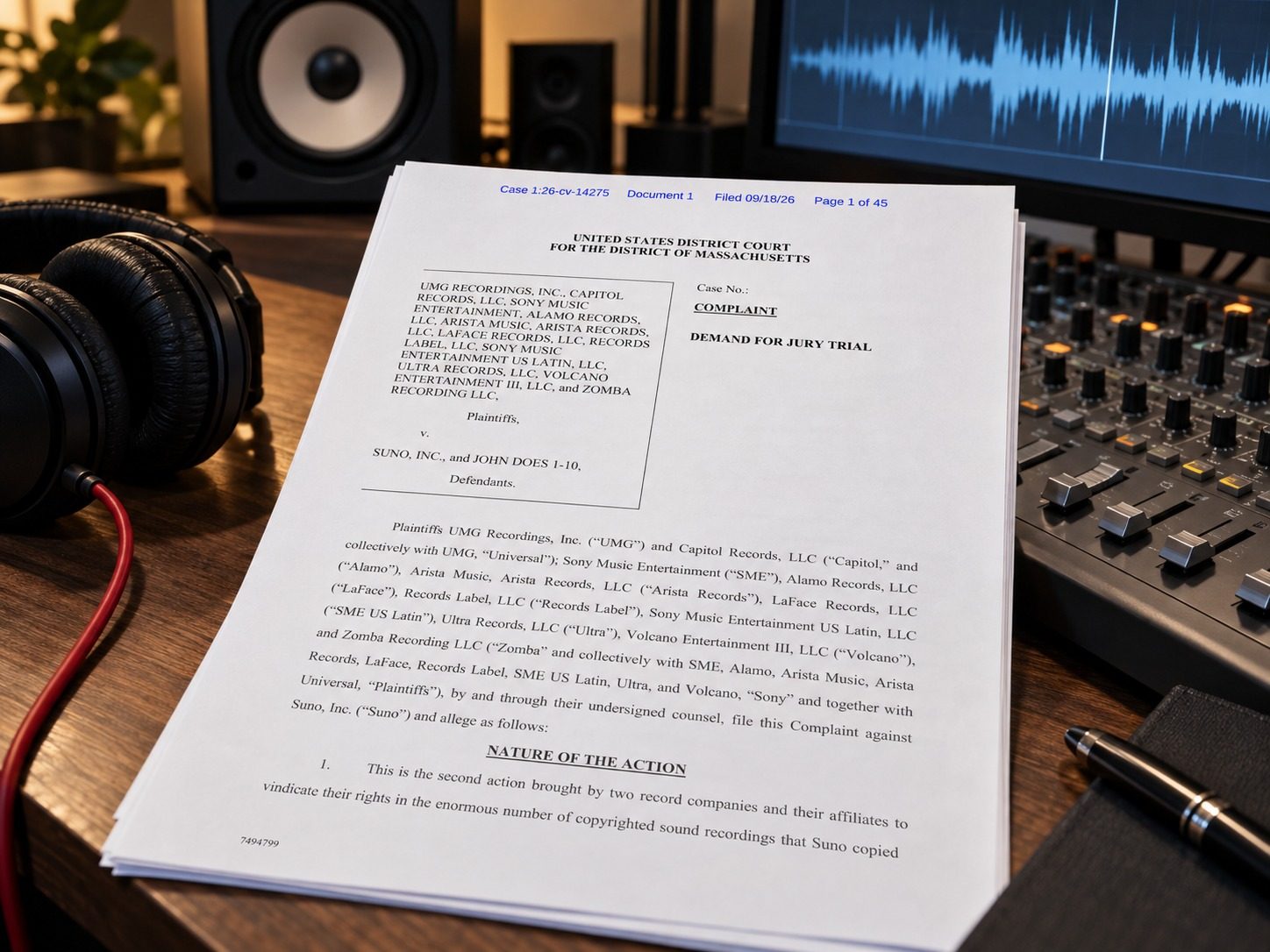
- The joint filing landed on Friday, September 18 in Boston federal court, and is the two labels' second suit against the AI music company.
- The new allegation targets v6, the model suite Suno launched on September 9 and says it built in partnership with Warner Music Group, BMG and Believe.
Compiled by The InvestorSomething wrong?How this is made
Why it matters
- cost Suno is the party exposed: at the ceilings the labels cite, the two claims top out at $9,180,805,000, and any negotiated settlement is discounted from there.
- exposure Warner, BMG and Believe are commercial partners in the model at the centre of the case, and their deals do not answer for copies the complaint says Suno still holds.
- constraint If outputs and preference data inherit a corpus's licensing status, retraining stops being a clean exit from an infringement claim without proof of where the new data came from.
- precedent Distillation lineage becomes a discovery target: a plaintiff who wins this reading can ask any student model to account for what its teacher was trained on.
Suno generates two tracks for every prompt, and the record of which one the user keeps is the preference data the company fed back into development [11]. The complaint says Suno has admitted it trained v6 using "user interactions" with previous iterations of its models [10]. It adds that no such interaction is clean: "every such signal has been a judgment about audio outputs generated using Suno's unlicensed models," the filing states [12].
The filing also alleges v6 was built through knowledge distillation, which it describes as a process "whereby a new 'student' model is trained to reproduce the learned behavior of a predecessor 'teacher' model" [13]. It names v4, v4.5, v4.5+, v5, v4.5-all and v5.5 as trained on the same copied corpus [15]. Its conclusion is that "every model Suno has ever released ... is the product of, and continues to exploit, Suno's unauthorized copying of the Copyrighted Recordings" [21]. The filing also says Suno has never stated that it destroyed the copies [16].
The 45-page complaint asks for two kinds of money [3]. At the willful-infringement ceiling of $150,000 a work [4], 60,202 recordings come to $9,030,300,000 [1]. The circumvention claim at $2,500, applied once to each recording, adds $150,505,000 [2], for $9,180,805,000 [3]. Music Business Worldwide, which obtained the filing, gives those as just over $9 billion and roughly $150 million [19][20]. The statute prices acts of circumvention, not works [5], so that second line moves with the download logs.
Warner Music Group settled with Suno in November 2025, BMG signed on August 12, and the Believe partnership was announced on September 8 [17]; v6 launched the next day [7]. Universal and Sony filed nine days after the launch [4]. Suno did not have an immediate comment, Variety reported [18].
Jack Brody, Suno's chief product officer, said at launch that "v6 was trained entirely from scratch, from the ground up," on data that "doesn't include data from Universal or Sony" [8]. The labels answer that the lineage carries the liability. "Training a 'new' model on the outputs of an infringing model does not eliminate the infringement; it launders it," the complaint states. And: "v6 is not a fresh start; it is the fruit of the same poisoned tree" [9].
A court can read a model's outputs as new expression. Then the lineage argument fails, and the two labels are back to the original copying claim that brought them to Boston the first time [1]. It can instead hold that what a teacher model transmits carries the licensing status of what that teacher learned from [13]. On that reading, a licence signed this year buys future use and leaves the copies Suno is alleged to still hold unpriced [16]. Or Suno settles, and the negotiation begins by discounting $9,180,805,000 [3]. I think the third is likeliest. The fact that would undercut the labels is a screening record: if Suno can show v6's preference data excluded outputs traceable to the 60,202 recordings, the laundering theory loses its factual basis [2].
What to watch
- Whether Suno moves to dismiss on the ground that model outputs are new expression, or answers with a screening record for v6's preference data.
- Whether Warner Music Group, BMG or Believe restate or amend their Suno deals now that v6's training lineage is in dispute.
- Whether the court consolidates this complaint with Universal and Sony's earlier case against Suno.