Science1 publisher3 min readPublished
Blinded tasters confirm a bitterness model on 25 of 31 newly designed peptides
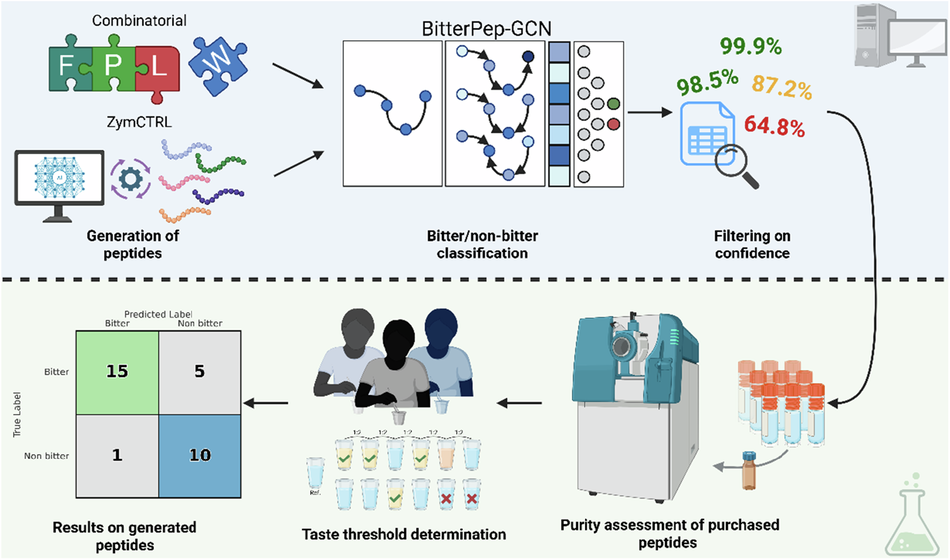
A Leibniz Institute pipeline learned from roughly 500 known bitter peptides, invented 161 more, and sent the most distinctive 31 to a blinded trained panel that agreed with the model on 25. The scoring was bitter or not bitter.
The Scientist · Science desk
What happened
- A team led by the Leibniz Institute for Food Systems Biology at the Technical University of Munich, working with Pompeu Fabra University, built an AI pipeline that predicts peptide bitterness and designs new peptides from scratch.
- Its protein language model was pre-trained on a curated set of roughly 500 known bitter-tasting peptides, and was paired with a graph convolutional network called BitterPep-GCN that handles molecular structure.
- The combined system generated 161 peptide sequences that had never been produced or characterized, then screened and ranked them by how likely each was to taste bitter or neutral.
Compiled by The ScientistSomething wrong?How this is made
Why it matters
- capability About 500 curated examples were enough to rank an invented library, so sensory work of this kind can spend panel time on a synthesized short list of 31 instead of the full design space.
- constraint The output is a bitter or non-bitter label, so a company reformulating a plant-protein product still needs tasting sessions to learn intensity and threshold in the finished food.
- decision Anyone funding in-silico sensory screening on the strength of this work is pricing it against a 31-peptide validation in which six calls went the other way.
- precedent Because bitter receptors sit in hormonal signaling for appetite and satiety, a generator that makes bitter peptides deliberately has a target well outside flavor correction.
Two representations of the same molecule do different jobs in this pipeline. The protein language model reads a peptide as a string and learns which orderings of amino acids tend to taste bitter [3]. BitterPep-GCN reads the same peptide as structure, mapping the three-dimensional, spatial and topological relationships inside it [4]. Sequence and shape both matter to a taste receptor, so building one model of each and combining them is a sensible design.
The validation set is small, and it was not drawn at random. The system produced 161 sequences that had never been made or characterized [5]. Thirty-one of them, the most distinct candidates, were synthesized and tasted in blinded sessions by a calibrated panel [6][7]. That is about 19 percent of the generated library [17]. Agreement on 25 of 31 is roughly 81 percent, with six peptides the panel scored against the model [15][16]. Because those candidates were picked for being distinct, the figure says how well the generator's clearest cases hold up, not how it would perform across all 161.
The institute's announcement reports 25 correct out of 31 without saying how many the model called bitter and how many it called non-bitter [19]. Without that split, a reader cannot work out what always guessing the larger class would have scored on the same 31 peptides.
What the team demonstrates is design, including design of peptides that taste bitter on purpose. "Our results show that not only can the bitterness of peptides be predicted, but that our new AI-based method can also be used to specifically design new bitter-tasting peptides," said Alexandra Steuer, the first author and a doctoral researcher in Antonella Di Pizio's Molecular Modeling laboratory [11][12].
Di Pizio, the principal investigator, put the motivation in the opposite direction. "To make plant-based protein sources more attractive for food production and to use them more sustainably, we need to better understand which peptides taste bitter and what structural features characterize them. AI-based methods can also make an important contribution here," she said [13][14].
The panel's task was binary: bitter or not bitter [18]. A formulator needs to know how bitter, at what concentration, and in what finished food. Bitter peptides in products are not designed. They appear when proteins are broken down enzymatically or chemically, and they are a standing complaint in kefir and aged cheeses as well as protein hydrolysates and plant-based alternatives [9]. Going from a validated classifier to a less bitter hydrolysate means controlling which peptides a protease releases, and what the study reports is prediction and de novo design [1].
The screening argument survives all of this. About 500 curated examples were enough to rank a library of invented sequences well enough that most of the tested ones behaved as predicted, and the study also turned up bitter and non-bitter structures nobody had described [8]. I would treat the 81 percent as a promising first read on a hand-picked 31, not as an accuracy figure to plan a product around.
What to watch
- The peer-reviewed paper's breakdown of the 31 tested peptides by predicted class, and whether the six misses were false bitters or false non-bitters.
- Whether the same roughly 500-peptide reference set supports intensity and threshold-concentration prediction, not just a binary call.
- A test on peptides actually released by hydrolysis of pea or soy protein, rather than on de novo designed sequences.