Invest1 distinct publisher3 min readPublished
Shell construction is running at a $75 billion annual rate and is up 717% since 2021, which is an impressive number right up to the point where the binding constraint turns out to be a permit and a grid connection rather than money.
The Investor · Invest desk

Compiled by The InvestorSomething wrong?How this is made
Start with the schedule, because schedule is what the engineering in this buildout is actually buying. According to a Wall Street Journal survey of suppliers relayed by Wolf Street, 3M's fiber connectors take six months out of a build [11], the modular electrical and mechanical rooms from Clayco and Turner's xPL Offsite take out several months [12], August Robotics' rack-anchoring drill takes out six weeks [13], and Amrize's modelled concrete mixes take out several weeks [14]; sum them generously, ignore the fact that some of them run in parallel, and you get roughly eleven months of compression [6]. New York's moratorium is twelve [3].
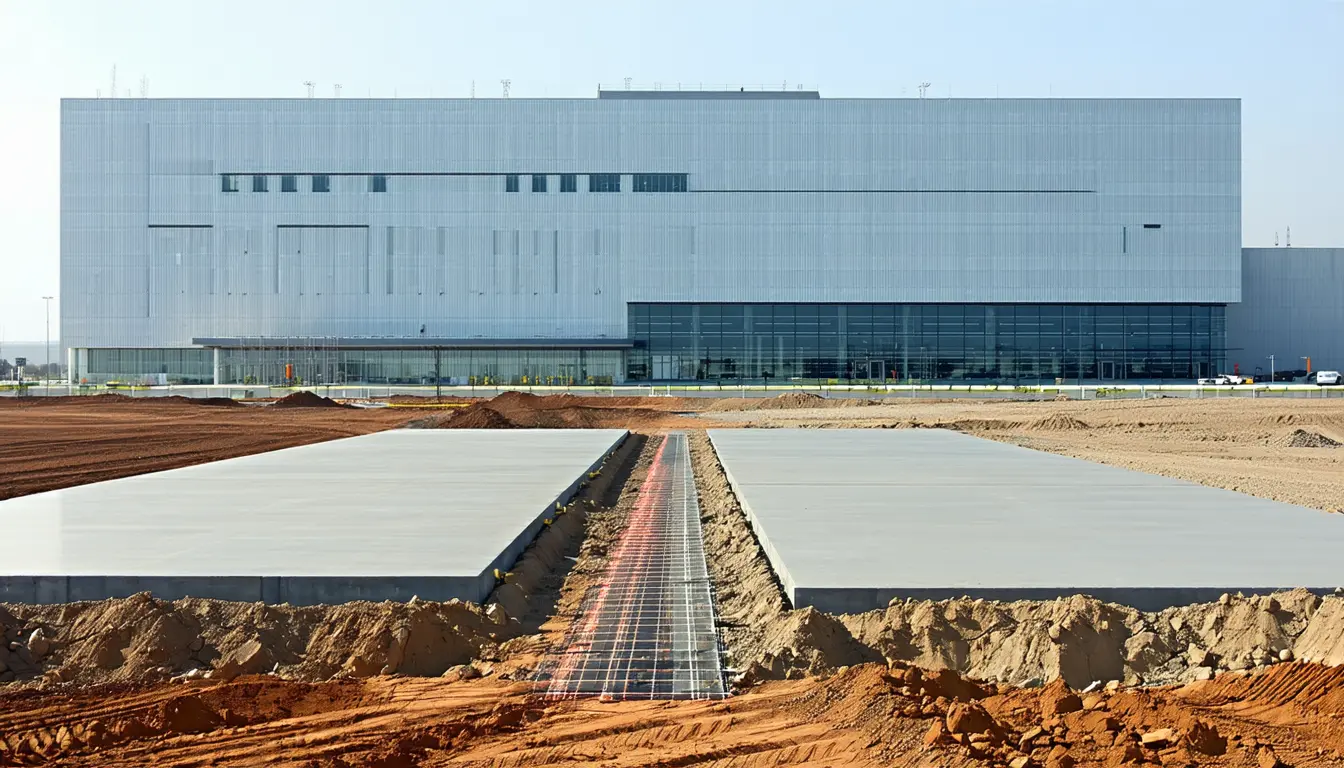
The capital has not noticed. July's shell spending ran at a $75 billion seasonally adjusted annual rate [7], which puts the same month a year earlier near $47.8 billion [1] and January 2021 near $9.2 billion [4], a compound rate of about 46% a year across five and a half years [5]; the single step up from June added roughly $4.4 billion to the annual rate [2], and twelve more steps that size would double the line [3]. That series counts the buildings, the improvements around them and integrated systems such as HVAC [9], so at about 7.5% of the announced $1 trillion program per year [7] it is measuring the cheap end of a bill whose expensive end is some multiple of it.
Which is where interconnection stops being a permitting matter and becomes an accounting one. Campuses specified at multiple gigawatts cannot be served by a grid asked to produce that power all at once [5], so speed in the shell buys an earlier depreciation start against a revenue date set by somebody else's queue. This is probably wrong, but the more interesting version of the thesis is that what gets stranded is not the building, it is the schedule, and a year of finished empty concrete is valued very differently by an equity market that has been paying for growth. The industry's own hedging tells you what time costs: the gas turbine bottleneck narrows to blades and vanes [15], retired jet engines are being repurposed into on-site generators [16], Musk bought APR Energy in July for its turbine gensets [17], and electricians are now scarce enough to be a constraint of their own [20]. Wolf Richter, who compiled the construction figures, asks where the trillions of dollars in matching revenue are supposed to come from and answers that no one knows [6].
The counter-thesis is that consent is local rather than binding: pauses and bans across dozens of states [2] move projects to permissive counties, and the aggregate print keeps stepping regardless. That is testable within a few releases. If the national number holds something near a 6% monthly cadence [7] straight through New York's year off, then consent is a siting tax and I am wrong about the ceiling; if the prints flatten while the cost of a delivered megawatt keeps climbing, the adjustment arrives in valuations well before it arrives in concrete.
Ranked by verification strength, evidence, and original report placement.
New York has already implemented a one-year data-center construction moratorium until it gets its regulations sorted out.
The local opposition cites soaring electricity costs, blackouts, water shortages and the issues caused by onsite gas-turbine or diesel power generators.
Construction spending on data centers rose 6.2% month-over-month and 57% year-over-year to a seasonally adjusted annual rate of $75 billion in July, according to Census Bureau construction data.
Since the beginning of 2021, monthly construction spending on data centers has risen by 717%, along a near-exponential curve.
The construction figures reflect only the construction costs of the buildings, the improvements around the buildings, and the equipment integrated into the buildings such as HVAC systems.
The figures do not include the most expensive parts of a functioning data center: servers, racks, the electronic and optical connection equipment, the electrical equipment for power and cooling, power generators and transmission lines.
Distinct publishers with included, body-backed reporting in this cluster.
1 article · September 1, 2026
Follow any of these and your For You feed starts watching them — no settings page required.
invest
The July retail miss is a Prime Day artifact, not a consumer crack1 distinct publisher
invest
Harvard's $2.2 billion SpaceX position is half its disclosed US equity book1 distinct publisher
invest
Real spending grew 2.1%. Healthcare services took about a third of the gain.1 distinct publisher
build
Grok 4.6 lands in Copilot two days after launch, and the model picker becomes a procurement problem1 distinct publisher
Evidence-backed comparisons of source perspectives and observed adoption signals. Read the methodology
Which Builder, Operator, and Investor concerns the observed source mix emphasized—not a truth score.
Evidence, demonstrated adoption, hype gap, incentives, and confidence are assessed independently, each on its own current evidence. How these are measured.
Hard series, soft scaffolding
Two very different grades of number sit side by side. The spending path — $75 billion annualised, up 6.2% on the month and 57% on the year — comes from Census Bureau data released that same day, and any reader can pull the series and check it. Everything the headline actually turns on is softer: the construction time savings are quoted second-hand from a Wall Street Journal roundup, the New York pause arrives with no statute or order behind it, 'dozens of states' is never itemised, and the $1 trillion program size has no provenance at all. One publisher, no second desk, and the weakest sourcing sits under the most consequential assertions.
Concrete is being poured; restraint is one named state
The build side is not a projection. Money is landing at an annualised $75 billion, materials prices are moving with it, named suppliers are shipping schedule-compression products onto live sites, and Musk has bought a genset manufacturer rather than queue for turbines. The restraint side of the story is thinner as observed fact: exactly one jurisdiction is named with a specific measure, and the wider wave of moratoriums is asserted rather than counted. So adoption of the buildout is well evidenced here; adoption of the brake is mostly one data point.
The framing outruns the sourcing
The neat move — roughly eleven months of engineered savings against a twelve-month pause — is a juxtaposition, not a measurement. Those savings belong to different trades and phases and would overlap in any real schedule, and nobody has shown they apply to the same building, in the same state, as the moratorium. Stack that on an unsourced trillion-dollar denominator, an uncounted wave of bans, and a shortage-to-inflation chain asserted without a figure, and the story is running warmer than its evidence. What keeps the gap modest is that the number doing the most work, the Census series, is genuinely as large as advertised, and the reporting volunteers the scope caveat that undercuts its own headline figure.
A view for sale, and vendors selling speed
Wolf Street's product is a stance — 'investment mania,' curves that end 'with a pop' — and the piece closes by asking readers to donate, which is a more transparent incentive than most but still one that rewards the dramatic reading. Underneath it, every firm credited with saving time is selling the thing it is credited for: 3M, Clayco and xPL, DeWalt, Amrize all appeared in a Journal roundup where speed is the pitch. Musk's blades announcement serves his own supply problem. The Census series is the only input in the story with nobody behind it.
Trust the series, verify the statute
I would stand behind the spending arithmetic without hesitation and behind almost nothing else at the same level. A single outlet supplies both the facts and the reading; the two assertions that decide whether the headline holds — New York's pause and the trillion-dollar program — are precisely the two with no citation. Until someone reads the New York order and counts the states, this is a well-argued hypothesis resting on one strong public dataset.