Invest1 publisher3 min readPublished
A 10% premium to buy Korean stock in New York is not diversification
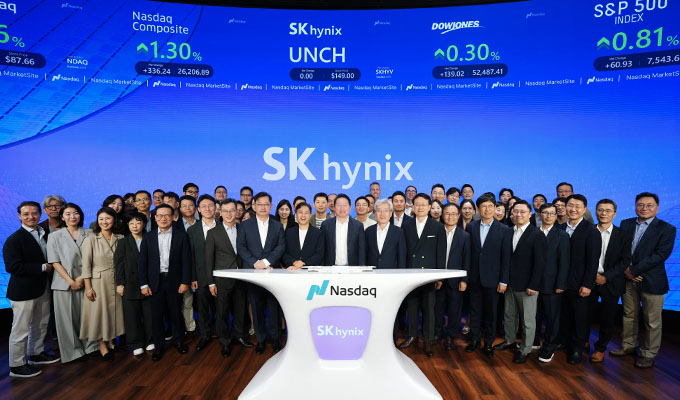
Korean retail investors put about $840 million into SK Hynix's U.S. depositary receipts in July, part of $4.5 billion of net U.S. buying. The receipts have traded around 10% above the Seoul shares.
The Investor · Invest desk
Drafted by a language model from the sources cited here and checked against its claim ledger before publication. How we use AISend a correction
What happened
- Korean retail investors net bought around $4.5 billion in U.S. stocks in July, according to Korea Securities Depository data, a sharp pickup from June and near January's net purchases of $5 billion.
- Of the $4.5 billion in U.S. stocks Korean investors net bought in July, around $840 million went into SK Hynix's U.S.-listed depositary receipts, the second most net-purchased U.S. security, even though Korean investors can buy the same company directly at home, according to Korea Securities Depository data.
- The U.S. receipts have traded at a premium to the Korean shares, which Owen Lamont, senior vice president of Acadian Asset Management, said was about 10% recently.
- The U.S.-listed receipts are also exhibiting greater volatility than the Korean shares.
- Lamont said of Korean investors buying SK Hynix's U.S.-listed shares: "That's absolutely crazy... There's no reason for a Korean investor to buy ADRs of Korean stocks in the U.S."
Compiled by The InvestorSomething wrong?How this is made
Why it matters
Korean retail investors net bought roughly $4.5 billion of U.S. stocks in July, according to Korea Securities Depository data, and about $840 million of that went into the U.S.-listed depositary receipts of SK Hynix, a company they can buy directly at home [1][2]. Those receipts have recently traded about 10% above the Korean shares, according to Owen Lamont, senior vice president at Acadian Asset Management, which makes this flow something other than a reallocation decision [3].
The concentration is the first thing worth sitting with. One Korean company's ADRs absorbed close to a fifth of the entire month's net U.S. buying by Korean retail, and ranked as the second most net-purchased U.S. security [2][1]. If the whole tranche had been transacted at a 10% premium, the arithmetic implies about $76 million paid above the home-market value of the same shares, for a security that is also more volatile than the Seoul line [2][4]. Lamont's assessment was blunt: "That's absolutely crazy," he said, adding that "there's no reason for a Korean investor to buy ADRs of Korean stocks in the U.S." [5] He called such price discrepancies unusual and a possible warning sign of speculative excess, "a symptom of the bubble," pointing to similar dislocations involving Taiwanese and Indian companies around the dot-com boom [6].
The surrounding behavior fits. Four of the ten most net-purchased U.S. securities in July were leveraged products, led by the Direxion Daily Semiconductor Bull 3X Shares ETF, with ProShares UltraPro QQQ fourth and ProShares Ultra QQQ sixth [7]. Ultra QQQ ranked seventh this month [8]. Meanwhile Korean retail net sold domestic stocks for most of last week even as the benchmark entered bull market territory, and foreign investors turned net buyers, per Korea Exchange data [9]. Domestic margin loan balances stood near 37 trillion won, about $26 billion, at the end of June, then fell to 27 trillion won earlier this month, the lowest level this year [10] - a roughly 27% unwind [3].
So the leverage came out at home and the same bet went back on abroad. Phillip Wool of Rayliant Global Advisors said the purchases are "largely shares tied up in the same AI hardware theme that's been selling off in the local market" [11]. Jung In Yun of Fibonacci Asset Management said traders bruised by Korean semiconductor and leveraged-ETF losses may be moving to U.S. AI names they see as higher quality or more liquid, and "are not necessarily reducing their exposure to the AI theme" but "changing the geographical vehicle through which they express the same view" [12]. Lamont noted July's buying was strong but not unprecedented, and that the interesting part is that it rose while the Korean market was plunging [13][14].
For anyone carrying Korea exposure, the practical read is that the domestic retail bid is not returning, it is being exported, and it is being exported at a cost. On spillover, the two views diverge: Wool sees little risk to overall U.S. volatility given institutional dominance of turnover, while Lamont expects distortion in individual names and retail-favored corners, citing the late-2024 rush into U.S. quantum stocks and leveraged ETF proliferation across Korea, Hong Kong and the U.S. [15][16].