Product1 publisher3 min readPublished
American Supercritical raises $8M to generate power from data center turbine exhaust
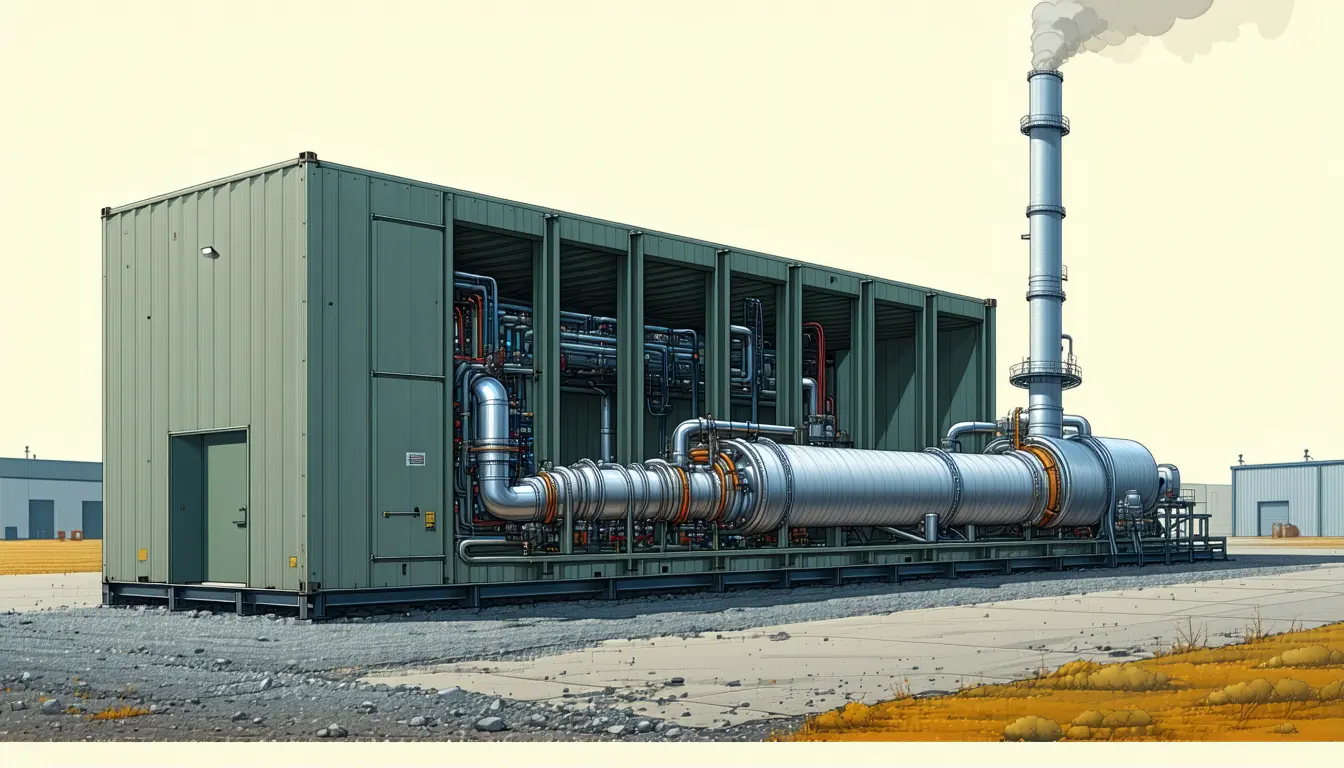
The company left stealth on Wednesday with a plan to attach supercritical CO2 units to the simple-cycle turbines data centers chose, making electricity from exhaust heat those turbines now throw away.
The Product Desk · Product desk
What happened
- American Supercritical came out of stealth on Wednesday with $8 million in funding and a plan to retrofit the gas turbines many data centers rely on for power.
- Simple-cycle turbines, the kind data centers have chosen for onsite power, convert only about 35 percent of fuel energy into electricity, and the rest escapes as exhaust.
- The company's units make additional electricity from that exhaust by transferring the heat directly into pressurized CO2, skipping the water-and-steam loop of a conventional bottoming cycle.
- By American Supercritical's own math, attaching its units raises a turbine's efficiency by up to 50 percent without adding any greenhouse gas emissions.
- An Amazon data-center power plant under construction in Texas, built with simple-cycle turbines only, is permitted to emit more than 33 million tons of greenhouse gases a year.
Compiled by The Product DeskSomething wrong?How this is made
Why it matters
- decision An air permit written as an absolute tonnage cap limits how much gas a site can burn, not how many megawatts it can sell, so recovered output from exhaust does not eat into permit headroom.
- cost The operator pays for a box and gets more output from the same gas; Wired is explicit that retrofitting the country's inefficient turbines would not bring emissions to zero.
- capability Because the CO2 circulates in a closed loop that never needs refilling, a water-constrained campus can add generating capacity without adding to the water demand it is already being scrutinised for.
The operator who would buy this already owns the turbines. American Supercritical's unit attaches to a simple-cycle machine that is already burning gas, and it makes electricity from the exhaust, with pressurized CO2 carrying the heat directly instead of boiling water into steam [7]. Wired reports that data centers across the US chose simple-cycle turbines for a variety of reasons, without saying which ones [3]. The exhaust carries the other 65 percent of the fuel energy [1].
The company says its units can raise turbine efficiency by up to 50 percent [8]. Taken as a relative gain on 35 percent, that lands at 52.5 percent [2]. Combined-cycle plants convert 60 to 65 percent of their fuel [5], and reaching that band from 35 percent takes a relative gain of 71 to 86 percent [3]. A retrofitted simple-cycle turbine therefore closes part of the distance to the plant the site could have built in the first place. Wired credits the 50 percent figure to American Supercritical's own math and does not say whether it is a relative or an absolute gain.
Cofounder Simon Shuham said, "We're essentially building miniature combined-cycle plants" [10]. A large combined-cycle plant puts a second engine behind the turbine to make steam from the hot exhaust [19]. The first product here is a 10-megawatt unit, relatively small by gas plant standards, according to Wired [9]. If those 10 megawatts are the increment and the increment is the full 50 percent, the host turbine is around 20 megawatts [4].
Wired does not give a price for the unit, name a first customer or set an install date, and it does not compare retrofit lead time against building a new combined-cycle plant. Supercritical CO2 power has been studied in US national labs for more than 50 years, and the past two decades of research have moved from theory toward practical use [15]. Doug Hofer, an adviser to the company who spent two decades at GE as a turbine engineer, says the important recent change is that heat exchangers have become more compact and more affordable [14]. Cofounder Matthew Carlson, who researched supercritical CO2 for more than a decade, likens the loop to refrigeration systems that circulate CO2 for cooling [13].
What decides whether this is worth a meeting at a given site is whether anything already takes the exhaust: where a steam bottoming cycle is installed, that heat is already making power [19]. The other factor is machine size, since the first product comes in one size and by the company's own numbers it suits a turbine around the 20-megawatt mark [9][4]. Shuham said, "We want to start with gas turbines but eventually expand beyond that" [11].
What to watch
- A named first customer, an install site and a date for the 10-megawatt unit.
- A published price or heat-rate guarantee that lets a buyer compute payback on one turbine.
- Whether air permits for data center turbine fleets start capping output as well as absolute tonnage.