Science1 publisher2 min readPublished
KAIST's NUDGE searches gene-network models for the smallest temporary stimulus that redirects cell fate
Kwang-Hyun Cho's group decomposes logic models of gene regulation to enumerate every minimal transient intervention that reaches a target cell state. The evaluation reported so far runs inside those models.
The Scientist · Science desk
What happened
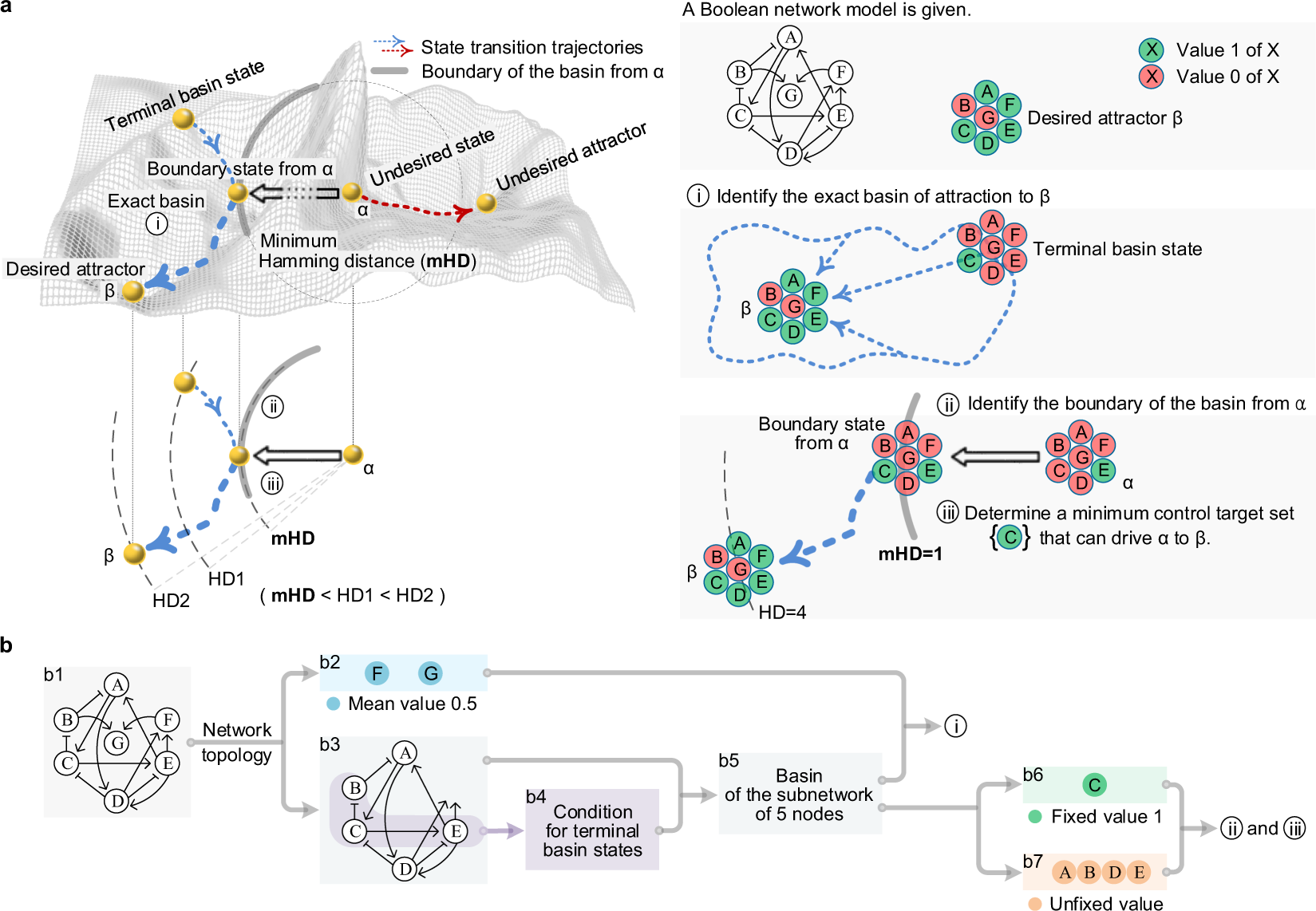
- A KAIST team led by Kwang-Hyun Cho has built NUDGE, a computational framework that identifies the minimal temporary intervention needed to steer a cell toward a target state using the gene regulatory dynamics already inside it.
- Instead of holding a gene on or off, the strategy applies a single temporary stimulus and lets the cell's own regulatory dynamics carry it the rest of the way to the desired state.
- In 63 published network models where fixing one node was enough to reach the target phenotype, 55 showed reduced plasticity or attractors that the uncontrolled network did not have.
- The framework's approximation method held average intervention error below 0.01 on more than 90% of 552 control problems drawn from 69 large biological networks.
Compiled by The ScientistSomething wrong?How this is made
Why it matters
- capability Because the framework also scores the route a stimulated cell takes and how stably it holds the endpoint, a designer can throw out candidate targets that pass through unwanted intermediate states before any cells are ordered.
- constraint The completeness guarantee holds inside the curated logic model, so a network with a missing edge will still yield a confident list of minimal interventions, and the list will be wrong in the dish.
- decision A lab that currently locks a gene on or off to fix a cell state now has a competing prediction to test against that practice, and the cost it is being asked to weigh is lost plasticity.
Why a stimulus can be switched off and still work is a property of the model. NUDGE writes gene interactions as logical functions and asks which state the network ends up in once those functions play out, so an intervention only has to move the network into the region that ends at the target [3]. The exact algorithm in the group's PNAS paper decomposes those functions to enumerate the minimal combinations of control factors that do it, and the authors report a mathematical guarantee that it finds all of them within the model [2][4][5].
The comparison with the two rival methods rests on a pooled denominator. For each control problem, the authors collected the minimum-sized, error-free interventions that the three methods found between them, then scored each method on the share of that pool it recovered [12]. The pool is the union of three imperfect searches. If a fourth method turned up valid minimal interventions that none of the three found, every one of those shares, NUDGE's included, would come down.
Error, in the large-network test, counted the fraction of simulated converged states carrying the undesired phenotype [10]. Fewer than about 55 of the 552 problems fell short of the 0.01 threshold [11]. The metric does not measure dose, how long a pulse has to be held, or whether a molecule exists that hits the node the algorithm picked.
The case against permanent control comes out of the same kind of simulation. Locking a single node produced reduced plasticity or attractors absent from the uncontrolled network in 87% of the 63 models tested [8]. Both of those are properties of a controlled network on a computer, and the alternative that existing methods offer is exactly this permanent on-or-off control, which the authors describe as capable of producing cell states that do not exist in nature [6].
For biology, the researchers applied the framework to cardiomyocyte differentiation, fate determination in mast cells involved in allergic responses, and the conversion of macrophages into an anti-inflammatory state [15]. The stated purpose of that section was to assess how well NUDGE explains real biological phenomena [15]. Testing whether a NUDGE-designed transient stimulus redirects a live stem cell population toward a cardiomyocyte fate would be a separate experiment.
What to watch
- A wet-lab test of a NUDGE-designed transient stimulus in stem cells, with the pulse duration and dose the model never specifies.
- Whether the approximation holds on gene-regulatory networks curated by groups other than the authors, since the 69 networks and 552 problems came from published models.
- Release of the code and problem set, which would let someone enumerate minimal interventions exhaustively on small networks and check how complete the three-method pool really was.