Science1 distinct publisher3 min readPublished
Twenty-six risk regions, about half of them near genes for nerve cell growth and pain sensitivity, give the condition the biological footing that decades of clinical dismissal lacked, though none of them can diagnose a patient.
The Scientist · Science desk

Compiled by The ScientistSomething wrong?How this is made
The case fraction does a lot of the work here. Nearly 55,000 diagnoses inside 2.5 million genomes is about 2.2 percent of the cohort [21], and that denominator is why the scan resolves anything at all: 26 regions pulled from that many cases is the pattern expected when many common variants each nudge risk slightly, the fingerprint of a complex trait rather than a single broken gene.
The phenotype makes that harder, not easier. Jonathan Aebischer, a chronic pain researcher at Oregon Health & Science University, says he has never seen two cases of fibromyalgia that look exactly alike, with widespread pain and fatigue sometimes joined by anxiety, depression and disrupted sleep [17]. Kristal Kent, a patient advocate with Veteran Voices for Fibromyalgia in Cleveland, describes seeming fine one day and being flattened by a flare the next, with fatigue and brain fog as her worst symptoms [18]. A case label assembled from clinical diagnoses across that much variation is noisy, and noise in the label costs statistical power rather than manufacturing it. The regions that survive are the ones robust to a fuzzy definition.
Which leaves the other half of the list unaccounted for. If about half of the 26 regions sit near genes with neural roles [4], roughly 13 do not [22], and that is where Nasa Sinnott-Armstrong of Fred Hutchinson Cancer Center places his caution: the study reads as primarily neurological, but the immune system may still matter in how the disease develops [15]. Some earlier evidence pointed toward an autoimmune condition [16]. Nothing in a locus count adjudicates between those two mechanisms; it only says the pain machinery is where most of the signal landed.
What the study cannot do is identify who has the condition. Hanna Ollila, the genetic epidemiologist at the University of Helsinki who co-led the work, says the variants are not the kind of indicator a doctor can use for diagnosis [8]. There is still no blood test to screen for fibromyalgia, and it is still misdiagnosed as other diseases [11]. Roughly 4 million adults in the United States have it, and Ollila suspects the real figure is higher [10]. That workup stays exactly where it was this week.
What has shifted is the standing of the argument. Michael Wainberg, a geneticist at the University of Toronto, says biological evidence has been accumulating for years and now strikes him as essentially beyond dispute [14], against a history in which the condition was treated as psychological [13]. But Gerard Limerick, a pain medicine doctor at Johns Hopkins who was not involved in the study, notes that there are physicians who still do not believe fibromyalgia is real [12], and that is a fact about clinical culture, not a hypothesis a genome scan can refute. Kent's own hope is narrower and more plausible: that the finding makes conversations between patients and providers more productive [19].
My read: the biology question is settled enough to stop relitigating, the diagnostic question is untouched, and the near-term value of 26 loci is as a target list for people designing experiments [20].
Ranked by verification strength, evidence, and original report placement.
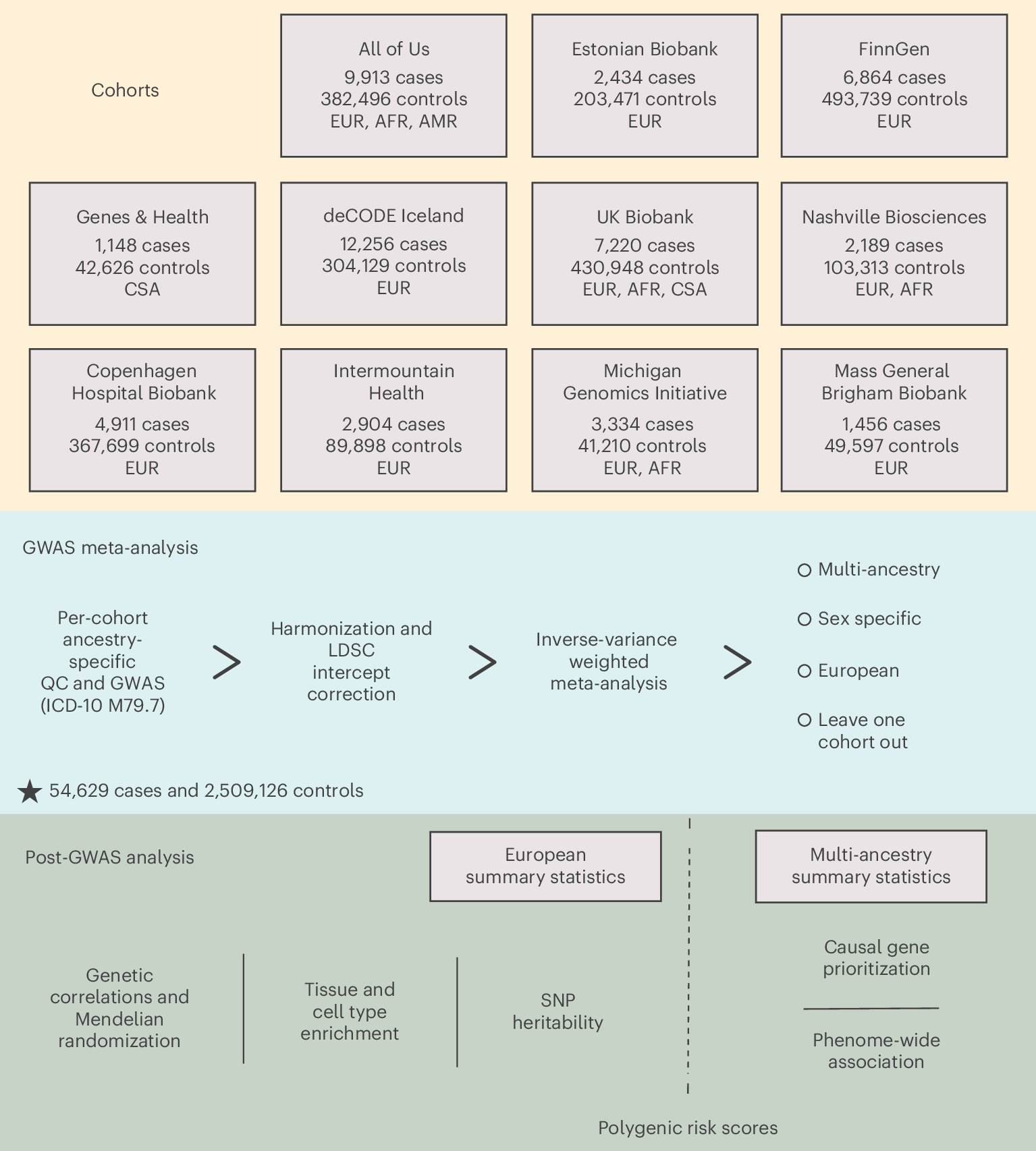
Scientists analyzed the genomes of 2.5 million people and reported the results July 28 in Nature Medicine.
Nearly 55,000 of the 2.5 million people analyzed had been diagnosed with fibromyalgia; the team looked for genetic variants occurring more or less often in people with the disorder than in the general population.
The team uncovered 26 regions of the genome that might enhance a person's risk of fibromyalgia.
About half of the 26 fibromyalgia-linked variants occurred near genes with neural roles, such as regulating nerve cell growth and controlling pain sensitivity.
The variant most strongly linked to fibromyalgia appeared in the gene responsible for Huntington's disease, which Michael Wainberg of the University of Toronto called extremely surprising; no such link had been reported before.
The mutation responsible for Huntington's disease is not the same as the variant found in people with fibromyalgia, and the researchers do not yet know what role, if any, the new variant plays in fibromyalgia.
Distinct publishers with included, body-backed reporting in this cluster.
1 article · September 2, 2026
Follow any of these and your For You feed starts watching them — no settings page required.
product
Geologic hydrogen's firmest numbers come from mine vents, not reservoirs1 distinct publisher
science
Columbia says depression stalls new neurons. The subtype it implies has no test yet2 distinct publishers
science
A rare neuron-like cell may spare dogs a jaw resection1 distinct publisher
science
Oxford's Zostavax-to-Shingrix switch closes the healthy-vaccinee loophole, and opens another2 distinct publishers
Evidence-backed comparisons of source perspectives and observed adoption signals. Read the methodology
Which Builder, Operator, and Investor concerns the observed source mix emphasized—not a truth score.
Evidence, demonstrated adoption, hype gap, incentives, and confidence are assessed independently, each on its own current evidence. How these are measured.
One paper, one outlet, three unaffiliated voices
Every number in this story — 2.5 million genomes, 55,000 cases, 26 regions — reaches us through Science News from one Nature Medicine paper, and no second outlet has checked it. What keeps it above stenography is that three of the experts quoted had nothing to do with the work, and one of them, Johns Hopkins' Gerard Limerick, is used to shrink the claim rather than sell it. What is absent is anything quantitative a reader could weigh: no effect sizes, no named cohorts, no replication.
Nothing a clinician can order
Unusually, the reporting itself closes the door: Ollila says the variants are not markers a doctor can use, there is still no blood test for fibromyalgia, and the cohort did not cover all ancestries. The only thing that has actually happened is that a paper appeared in a journal. Any uptake — a test, a target, a shifted clinical attitude — is still hypothetical, including the patient advocate's hope that conversations improve.
The framing leads the findings, slightly
"Unveils the genetic underpinnings" and Wainberg's "absolutely indisputable" run a step ahead of a result whose single strongest signal sits in a gene the authors cannot yet connect to the disease at all. The overreach stays small because the same piece supplies the brakes — not diagnostic, not the Huntington's mutation, not all ancestries — and lets Limerick reduce the whole finding to smoke seen from a distance.
Authors set the tone; the skeptics are borrowed
The two lines that will travel — biology now indisputable, and a shock hit in the Huntington's gene — both come from the paper's own authors, who gain from each. Against that, Science News imports three researchers with no stake in the work, and the patient advocate's interest is transparent: legitimacy is the point of her advocacy. The gap worth noticing is structural rather than rhetorical — no funder, biobank or competing-interest detail appears anywhere.
Firm on what was found, loose on what it means
We can be fairly sure the paper says what Science News says it says; the caveats are too specific and too unflattering to be invention. Confidence drops on interpretation, where a single outlet, a single study, an unresolved neural-versus-immune argument and a top hit of unknown function all sit unchallenged by a second account.