Science1 publisher3 min readPublished
Stickney Crater's age splits Phobos' two origin stories by 1.6 billion years
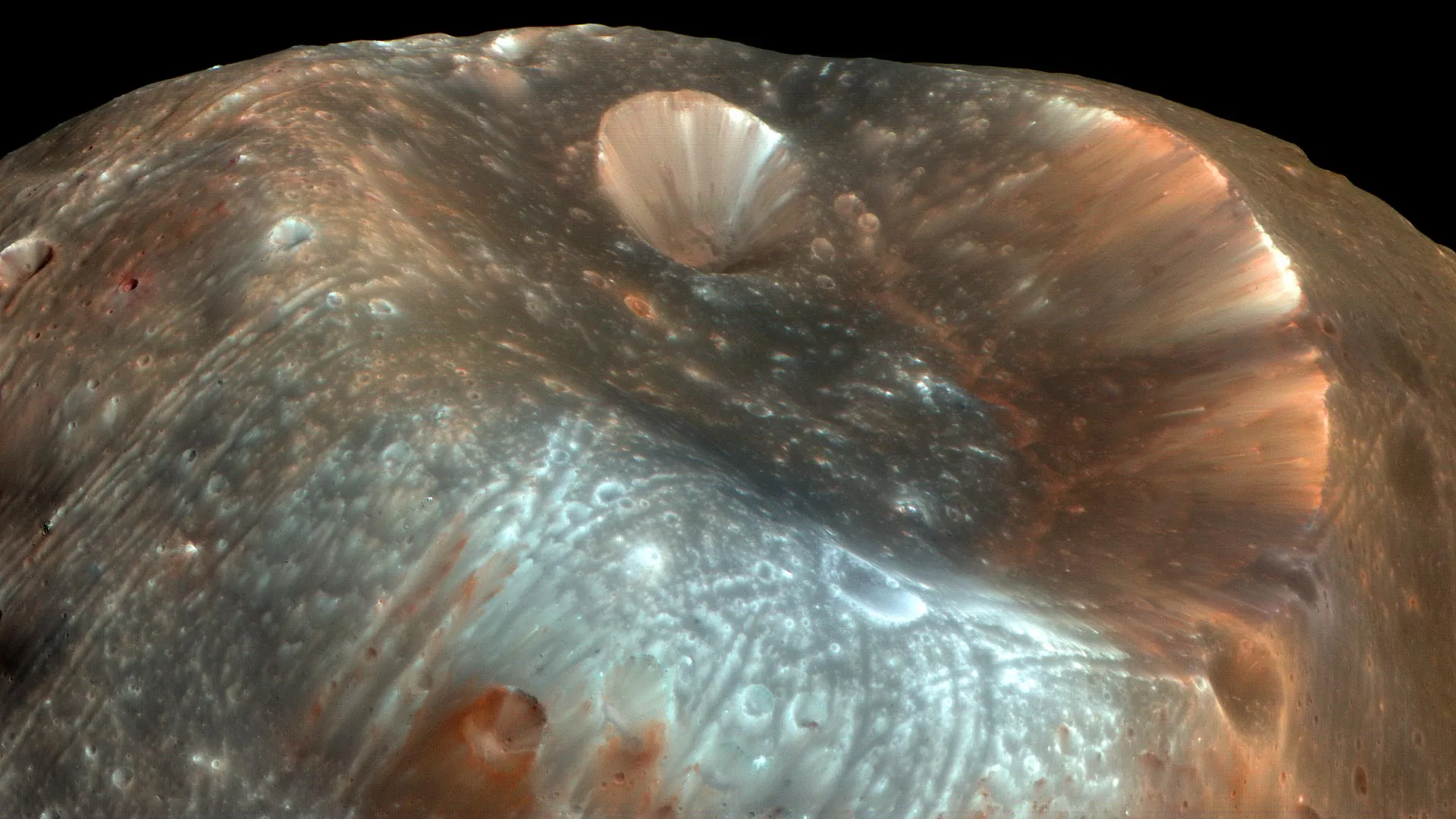
Work presented at the European Geosciences Union assembly in Vienna models whether compressed rock sits beneath Phobos' largest crater, part of an effort to read the little moon's interior before Japan's MMX mission goes there to sample it.
The Scientist · Science desk
What happened
- Scientists presented modeling of Phobos' gravity and motion in the region of Stickney Crater at the European Geosciences Union general assembly in Vienna, according to an account published by Universe Today.
- Two explanations for the moon compete: it began as an asteroid captured by Mars, a case supported by spectral properties and capture models, or it condensed from a debris disc thrown up by a giant impact on the planet.
- Japan's upcoming MMX sample return mission could supply the measurements and physical evidence needed to settle the origin question, according to the ScienceDaily summary.
Compiled by The ScientistSomething wrong?How this is made
Why it matters
- constraint Gravity measured from orbit cannot date an impact, and the two origin scenarios differ mainly in when Stickney formed, so better orbital data sharpens the interior model without closing the provenance argument.
- contradiction Haser's account of how Phobos survived the impact needs a low, nearly uniform density, while the same team's interior estimates include denser material near the equator; any single interior model has to hold both.
- decision The gravity field cannot settle the age, so sample selection does that work: material traceable to the Stickney event would give a laboratory age, and the two hypotheses split on that age.
Both origin stories include the Stickney impact. A collision big enough to leave a crater 9 km across [2] would melt and compact the rock under it whether the target was debris from Mars or a captured asteroid, so a buried density contrast by itself does not say which. The scenarios disagree about when. If Phobos formed from material blasted off Mars, the Stickney collision may date to roughly 4.2 billion years ago [7]; if Phobos was captured, it could have come much later, around 2.6 billion [8]. The gap is about 1.6 billion years [9].
The gravity modeling is aimed at the interior instead. Haser and Andert's 2026 paper in Monthly Notices of the Royal Astronomical Society reports current estimates of a porous interior that may contain water ice [10], and Haser's EGU paper adds a denser concentration of material near Phobos' equatorial region [11]. What the team wants to know is whether the Stickney event left a concentrated region of denser material beneath the crater [12]. Haser, a doctoral student in planetary science at Germany's Universitat der Bundeswehr Munchen, told Universe Today in Vienna that the Stickney event is one of the most important episodes in Phobos' history [16].
Scale is the problem the interior model has to solve. Stickney's 9 km diameter is about 41 percent of the moon's 22.2 km mean diameter [19], and an impact large enough to cut that scar would be expected to destroy a body that small [20]. Haser's explanation for survival runs against a lumpy interior. "You would assume that such an impact would have shattered Phobos, unless it has a very low homogeneous density, like a sponge that can absorb that kind of impact," he said [13]. He also described the heat at the site: "And at that impact region, there must be very high temperature that melted and compressed the stone beneath it" [14]. That compression would leave a denser zone below Stickney and a subtle gravitational signature [15].
The published account of the work does not include a predicted amplitude for that signature [21]. The amplitude is what would decide whether an orbiter's tracking data could pull the anomaly out of the rest of the field. This was a conference presentation of a model [1].
Japan's upcoming MMX sample return mission could provide the measurements and physical evidence needed to settle the question, according to the summary of the work published by ScienceDaily [17]. The part of that package which bears on the 4.2-versus-2.6 split is the returned rock, because ages come from laboratory dating rather than from gravity. Haser and Andert write that spectral properties, together with models of asteroid capture, support the capture scenario [6]; the competing account has a large object striking Mars, feeding a debris disc, and producing both Phobos and Deimos [5].
So the gravity work can deliver a better interior: porosity, ice, where the mass sits. The date the two hypotheses dispute will have to come from the returned rock.
What to watch
- A peer-reviewed prediction of how strong the sub-Stickney gravity anomaly should be; that number decides whether orbital tracking can resolve it.
- MMX sampling site selection, and whether the chosen material can be tied to the Stickney event.
- Any laboratory age for returned Phobos material, which would test the 4.2 against 2.6 billion year split.