Science1 publisher2 min readPublished
Isotope bonds in two fossil teeth measure T. rex's body temperature at 36 C
The number comes from carbon-oxygen bonds in two teeth of a museum's best tyrannosaur, released for sampling only after UCLA spent a decade shrinking how much enamel the method destroys. Eagle expected roughly that value.
The Scientist · Science desk
What happened
- UCLA researchers measured the body temperature of Tyrannosaurus rex at about 36 degrees Celsius, or 97 Fahrenheit, from chemical bonds preserved in fossilized tooth enamel, in a paper published Sept. 16 in Science Advances.
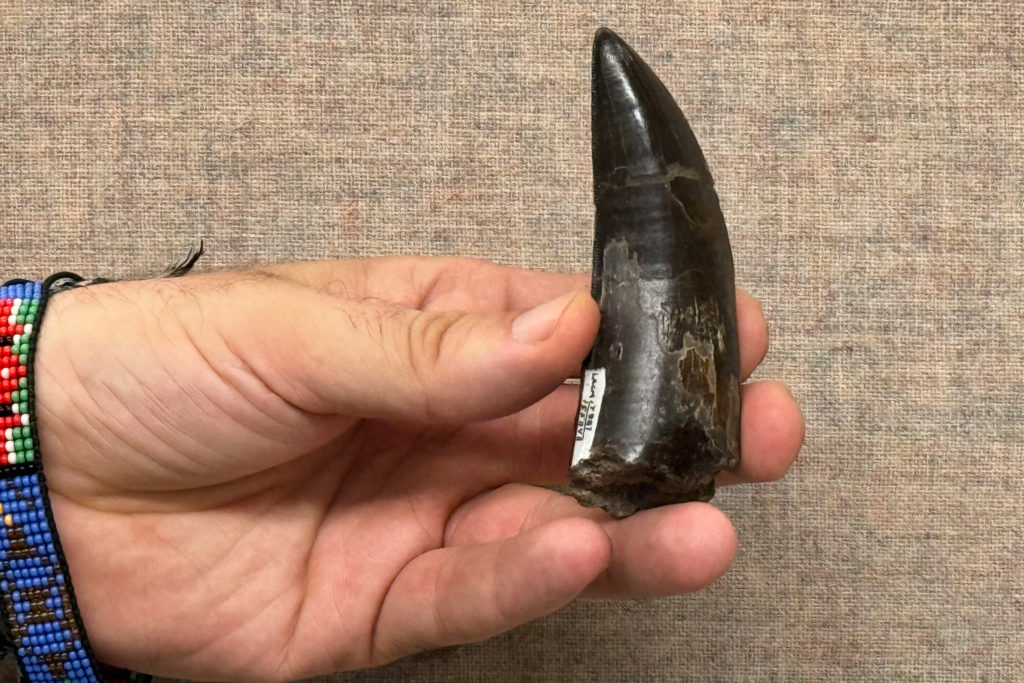
- The enamel came from tiny portions of two teeth belonging to Thomas the T. rex, the most complete tyrannosaur skeleton on display in the dinosaur hall of the Natural History Museum of Los Angeles County.
- The team built a first version of the method about a decade ago on skeletal material, then cut the amount of material a test on ancient teeth consumes by roughly 90 percent.
Compiled by The ScientistSomething wrong?How this is made
Why it matters
- capability Named, irreplaceable skeletons on public display are now plausible candidates for destructive isotope sampling that curators had good reason to refuse when the method needed roughly ten times as much enamel.
- constraint One individual's teeth fix one individual's temperature, so this measurement covers that one animal; how tyrannosaur temperature varied with size, age or season is still a matter of inference.
- precedent Warm-bloodedness in T. rex now has a measured value attached to it, and the next physiological claim about a dinosaur will be asked why it has only bones and footprints behind it.
Rare isotopes of carbon and oxygen bond to each other inside tooth enamel, and how often they do depends partly on temperature. Cooler mineral holds more of those bonds, warmer mineral fewer [10]. So a warmer animal leaves fewer of them behind [10]. "That's the basis of using the isotopes as a thermometer," Eagle said [13].
Eagle said the measurement could in theory be made on any part of the skeleton, but that bones in the body are constantly remodeled and dissolved [14].
The obstacle was mass. The first version of the method, built about a decade ago on skeletal material to sort warm-blooded extinct animals from cold-blooded ones [6], needed more fossil than a museum would reasonably give up from an important and irreplaceable specimen [7]. Bringing the requirement down to roughly a tenth of what it had been [22] persuaded the Natural History Museum of Los Angeles County to release enamel about 66 million years old [9][25].
Thirty-six degrees sits 6 to 8 degrees above the range Eagle gives for modern cold-blooded reptiles and 4 to 7 degrees below the range he gives for most birds [20][21]. It is a middling number, and it is close to where he expected to land. "We found T. rex was 36 Celsius (97 Fahrenheit), about the same as humans. The temperature is about what I would have guessed -- higher than a reptile or a slow mammal like a sloth, but lower than an avian," Eagle said [12].
The enamel gives a temperature. Metabolic rate is a separate quantity, and UCLA argues from the first toward the second: the university says the result supports a picture of an active predator or scavenger with a relatively fast metabolism, not an animal that relied on basking in the sun [16]. Other evidence already pointed that way, including tyrannosaur fossils found as far north as Alaska [17]. The animal was still a scaly, egg-laying reptile [18]. And two teeth from one skeleton fix one animal's temperature [23]; this sample says nothing about variation between individuals, between juveniles and adults, or across seasons.
For more than a century, T. rex biology has been reconstructed from bones, teeth, footprints and other traces [19]. "No one's been able to make a temperature measurement like this before," Eagle said [11].
What to watch
- Whether the group measures additional tyrannosaur individuals and juveniles, since one skeleton cannot show variation across growth stages.
- Whether other museums approve destructive sampling of display specimens now that the material demand has fallen.
- Whether an independent lab reproduces 36 C on separate enamel from Thomas or from another tyrannosaur.