Invest1 publisher3 min readPublished
The 81% Problem: AI's Star CEOs Are Polling Badly With The People They Need To Hire
A CNBC and Generation Lab survey of 1,088 Americans aged 18 to 34 puts distrust of Palantir's Alex Karp at 81% and Anthropic's Dario Amodei at 76%. The best-liked AI chief executive still loses 65-35.
The Investor · Invest desk
Drafted by a language model from the sources cited here and checked against its claim ledger before publication. How we use AISend a correction
What happened
- About 45% of young Americans believe artificial intelligence will have a negative impact on their careers.
- The survey was conducted by CNBC and Generation Lab among 1,088 Americans aged 18 to 34, and was reported by Forbes on the 16th.
- Palantir CEO Alex Karp topped the distrust list, with 81% of respondents saying they did not trust him.
- Palantir chairman Peter Thiel followed Karp at 79% distrust.
- Anthropic CEO Dario Amodei drew 76% distrust.
Compiled by The InvestorSomething wrong?How this is made
Why it matters
A CNBC and Generation Lab survey of 1,088 Americans aged 18 to 34, reported by Forbes on the 16th, found that 81% do not trust Palantir chief executive Alex Karp and 76% do not trust Anthropic's Dario Amodei [2][3][5]. Those are not public-relations numbers. They are labour-market numbers, produced by the exact age band that supplies research hires, forward-deployed engineers, enterprise sales and the site staff for the data centres the sector is building.
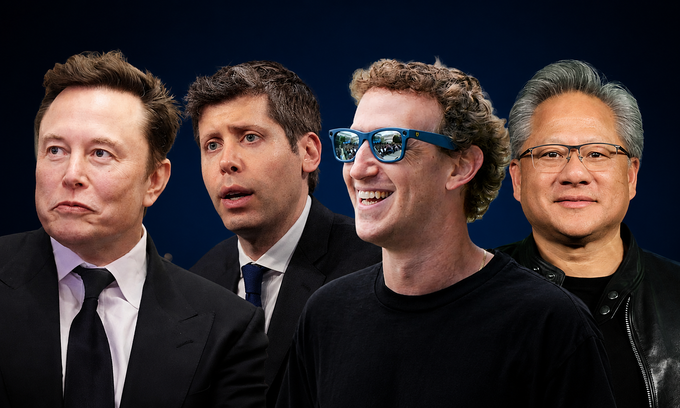
The more instructive figure is the floor. The most trusted AI entrepreneur in the survey was Microsoft's Satya Nadella, and even he was trusted by only about 35%, with 65% saying they did not trust him [9]. That puts the entire distribution inside a 16-point band between the best and worst result [10], which is the signature of a sector-level discount rather than a set of individual reputational problems. Palantir chairman Peter Thiel came in at 79% distrust and Alphabet's Sundar Pichai at 74%, with Mark Zuckerberg, Sam Altman, Jensen Huang and Elon Musk clustered around 70% [4][6][7]. No amount of founder-brand management moves a company out of that band, because the band is the industry.
The Huang data point is the one worth pinning to a wall. According to the source, one survey recently put his support among his own employees at 99%, while the assessment from young people outside the company runs the other way [8]. Internal legitimacy and external legitimacy have come apart. That is survivable while you are retaining people you already hired at strike prices they like. It is more expensive when you are competing for a first-job cohort that has not yet been paid anything.
The underlying reason is not abstract. About 45% of respondents believe AI will have a negative effect on their careers, and they also reported worrying that AI would weaken their thinking skills and core competencies [1][15]. Analysts cited in the report point to a growing concern that the economic gains from AI will accrue to a handful of companies and executives while young people's own footing gets less secure [16]. That is a story about distribution, and no product demo answers it.
The same survey suggests where the cost lands first. On data centres, 60% said new construction should be slowed and only 15% said it should be sped up, a four-to-one margin against the sector's core capital plan [11][12]. On the economy, 45% called conditions "bad," 27% "very bad" and 6% said things "couldn't be worse," which is 78% describing conditions as bad or worse [13][14]. Gallup put favourability toward capitalism at 54% in 2025, its lowest since the survey began, with socialism at 39% [18]; in this cohort, 46% viewed democratic socialism favourably against 23% negative [17].
What to watch: the reported items measure trust, career expectations, infrastructure and economics, not stated willingness to take a job at any of these firms [23], so treat this as a leading indicator rather than a hiring forecast. Watch graduate-offer acceptance rates and the compensation premium AI labs have to pay against non-AI employers. Watch local permitting fights, where the four-to-one number becomes a schedule. And watch whether the politics translate cleanly: a Reuters-Ipsos poll in August had Democrats at 37% on economic issues against Republicans at 36%, the first such lead since 2017 [19], yet DSA-backed Francesca Hong lost the Wisconsin governor's race narrowly on the 11th to the more centrist David Crowley [22].