Science1 publisher2 min readPublished
RIKEN modelers derive 3I/ATLAS's extreme heavy water from a metal-poor birth cloud
A RIKEN group simulated water ice chemistry at 10 kelvin and found that a single property of a metal-poor birth cloud can produce both of the strange isotope ratios measured in interstellar comet 3I/ATLAS.
The Scientist · Science desk
What happened
- 3I/ATLAS, the third known interstellar visitor, was discovered in July 2025 and drew major observatories, several of which measured isotope ratios unlike anything seen in our own solar system.
- Its carbon-12 to carbon-13 ratio measured between 123 and 191, where solar system objects sit near 90 and the interstellar medium averages about 68.
- Kenji Furuya of RIKEN and co-authors simulated water ice from its formation in an interstellar cloud through the cloud's collapse toward a star, and attribute both signatures to a low-metallicity nursery.
Compiled by The ScientistSomething wrong?How this is made
Why it matters
- capability Isotope ratios measured on one passing comet become a usable constraint on the gas chemistry of a star-forming region nobody can sample directly.
- constraint The simulation fits the ratios but leaves the parent cloud's metallicity unpinned, so a future object's isotopes cannot yet be converted into a number for its birthplace.
- precedent If reviewers accept that one cloud property explains two independent anomalies, the low-metallicity story stops being a carbon-only argument and becomes the default first check on any interstellar object's water.
The deuterium was locked in at about 10 kelvin, in gas too cold for most reactions to proceed [12]. Cosmic rays ionize the gas into H3+, which occasionally collides with an HD molecule and comes away as H2D+, leaving H2 and a little excess energy [13]. The reaction normally runs both ways. At 10 K the gas cannot supply the energy to push the deuterium back into inert HD, so it stays in H2D+ until an electron breaks that molecule apart, and the freed deuterium atoms meet oxygen [14].
Low metallicity helps at two points in this chain. Carbon monoxide destroys H2D+, and a metal-poor cloud has less CO, so H2D+ survives longer and yields more atomic deuterium [16]. In metal-rich clouds, ultraviolet photons split water into OH and H, flooding the gas with ordinary hydrogen and diluting the D/H ratio; a metal-poor cloud produces no such flood [17]. The paper gives three effects of this kind, all consequences of the same low metallicity [15].
Dividing the measured 1% by the 0.03% top of the cometary range gives 33, and by the 0.015% bottom gives 67, so the comet's water is tens of times richer in deuterium than anything comparable here [9]. The carbon anomaly is milder, between 1.4 and 2.1 times the solar system value [10]. It also sits above the interstellar medium average, higher than anywhere the object has traveled through in the past few billion years [6]. That points to formation as the source of the signature.
The economy of the result is its strength. One property of the birth cloud accounts for both anomalies, and low metallicity was already the accepted explanation for a high C-12 to C-13 ratio, so the paper extends a familiar idea to water [18][3]. The simulation demonstrates compatibility and does not measure the metallicity of the nursery; the case rests on a single object, the third interstellar visitor known [1][11]. The paper has been submitted to The Astrophysical Journal Letters and posted as a preprint, so no referee has passed on it yet [2].
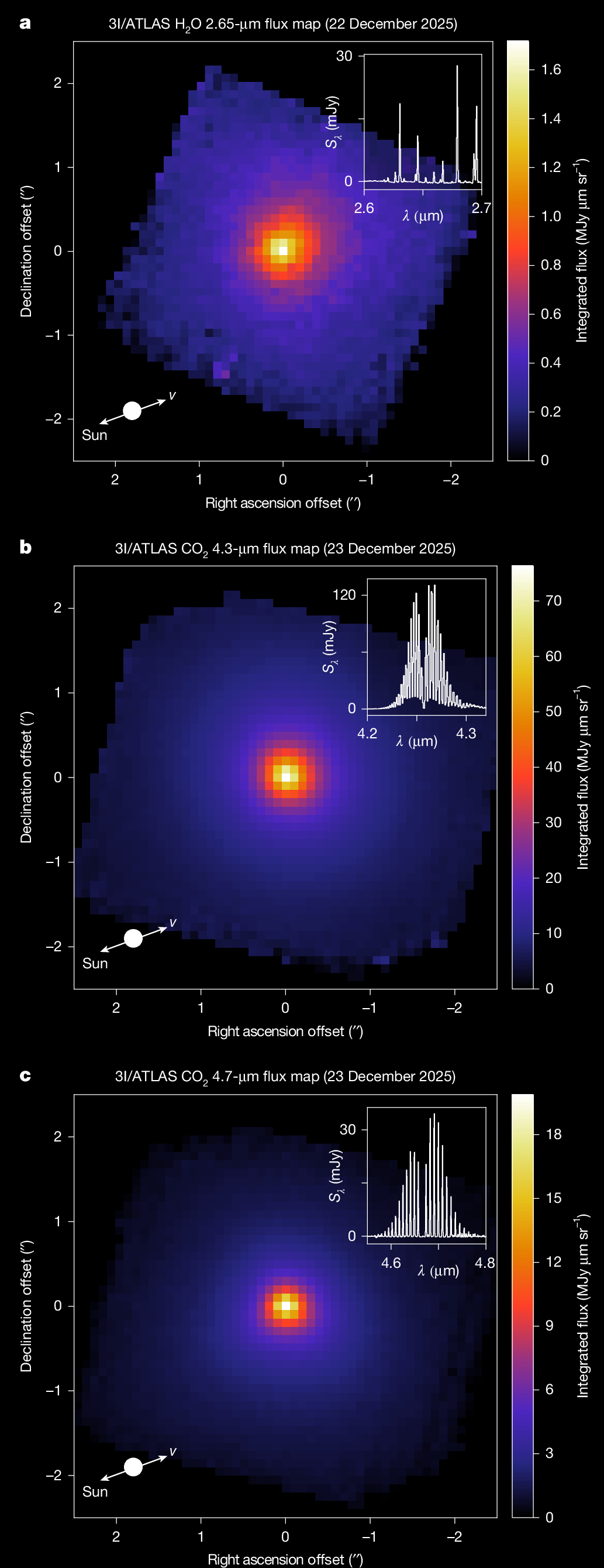
The phys.org account credits the isotope measurements to observatories that turned to 3I/ATLAS after its July 2025 discovery, and it does not name the instruments or the teams [19]. Uncertainties matter for a result built on ratios, and the deuterium figure is given as around 1%, with the carbon ratio arriving as a range from 123 to 191 [7][6].
What to watch
- Whether ApJL referees accept that one cloud property can explain both the carbon and the water anomalies.
- Independent D/H measurements of 3I/ATLAS's water from other groups, with uncertainties attached to a figure now given only as 'around 1%'.
- A fourth interstellar object with both isotope ratios measured, which would give the coupling a second test case.