Science2 publishers2 min readPublished
Webb's spectra of IC 348 pin the lightest known brown dwarf at two Jupiter masses
Two years after the same team stopped at three to four Jupiter masses in this cloud, deeper Webb imaging and spectroscopy reached 0.19 percent of a solar mass, below where models of cloud collapse sit comfortably.
The Scientist · Science desk
What happened
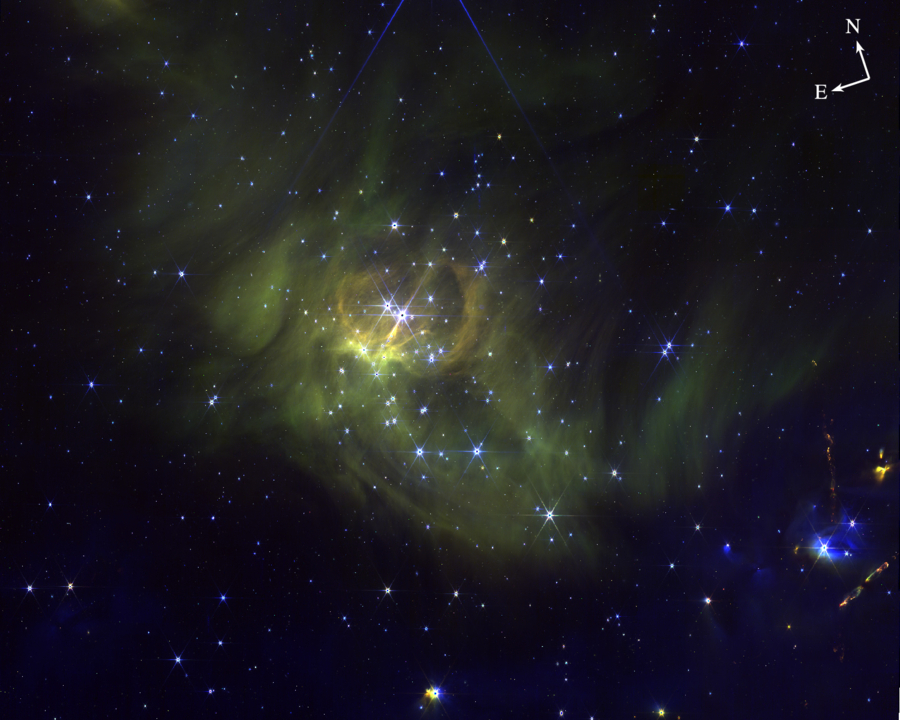
- Astronomers imaged the star-forming region IC 348, about 1000 light-years away in Perseus, with Webb's NIRCam in 2024 and picked out candidate brown dwarfs by their colours and brightness.
- NIRSpec spectroscopy in 2025 was used to estimate the masses of those candidates.
- The spectra put the lightest objects at twice the mass of Jupiter, or 0.19 percent of the Sun's mass, which ESA calls the least massive brown dwarfs known.
- The same region, observed with Webb in 2022, had yielded brown dwarfs down to three to four Jupiter masses.
- The team also reports a spectral feature attributed to hydrocarbons, which has been seen only in the atmospheres of the lowest-mass brown dwarfs.
Compiled by The ScientistSomething wrong?How this is made
Why it matters
- constraint Any account of cloud fragmentation now has to deliver bound objects two orders of magnitude below the stellar mass limit, and cannot place its cutoff above two Jupiter masses.
- capability Planet formation becomes an observational question around hosts that are themselves of planetary mass, since one of the lightest objects has a disc.
- precedent If the hydrocarbon feature holds up elsewhere, the classification scheme for cool objects needs a category below its current sequence, and other clouds become the test.
A hydrogen-fusing star needs about 8 percent of the Sun's mass to work [1]. The objects at the bottom of this survey sit at 0.19 percent [2]. That puts a factor of about 42 between the lightest star and the lightest brown dwarf now confirmed in this cloud [13]. The two figures ESA gives are consistent with each other: if two Jupiters come to 0.19 percent of a solar mass, the Sun holds roughly 1,050 Jupiters [14].
Photometry alone could not get there. Colour and brightness produce a candidate list [5]; the spectrograph follow-up is where the mass estimates come from [6].
The release reports the masses. It does not state uncertainties, and it does not say how many objects were confirmed [17]. That omission matters more at two Jupiter masses than it would at twenty, because the lowest mass a survey reports is also the lowest mass it was able to detect. Whether two is where cloud collapse stops or where Webb's sensitivity stops is what a deeper pass on the same field would separate, and ESA frames the underlying question in those terms: how small are the smallest objects star formation makes [16].
A mass does not fix a history either. Brown dwarfs form through the collapse of molecular clouds, as stars do, and their cores never get hot enough to fuse hydrogen, though many briefly fuse deuterium early on [8]. ESA says the existence of the new objects poses a challenge to models of how stars form [3]. In my view the pressure falls on fragmentation: a collapsing core has to reach two Jupiter masses in the first place.
Both the 2022 masses and the new ones come from the same team working the same region [11]. The reported floor has moved down by between a third and a half [15].
What to watch
- A peer-reviewed paper giving mass uncertainties for the two-Jupiter-mass objects and the number confirmed.
- The hydrocarbon feature turning up in brown dwarfs in other star-forming clouds; one region cannot establish a spectral class.
- Independent observations of the disc reported around one of the lightest objects.