Science1 publisher2 min readPublished
Glycerol thickened graphene oxide enough to draw fibers at 5.9 gigapascals
Fifteen years after KAIST reported that graphene oxide sheets align themselves in water, a Nature Materials commentary from Sang Ouk Kim's team traces the line from that phenomenon to fibers spun for heat.
The Scientist · Science desk
What happened
- Sang Ouk Kim's team at KAIST published a commentary in Nature Materials reviewing recent work on high-performance graphene fibers made from graphene oxide liquid crystals.
- Earlier spinning routes broke the liquid filament during drawing and left sheets loosely packed, and the resulting voids and defects held back strength and thermal conductivity together.
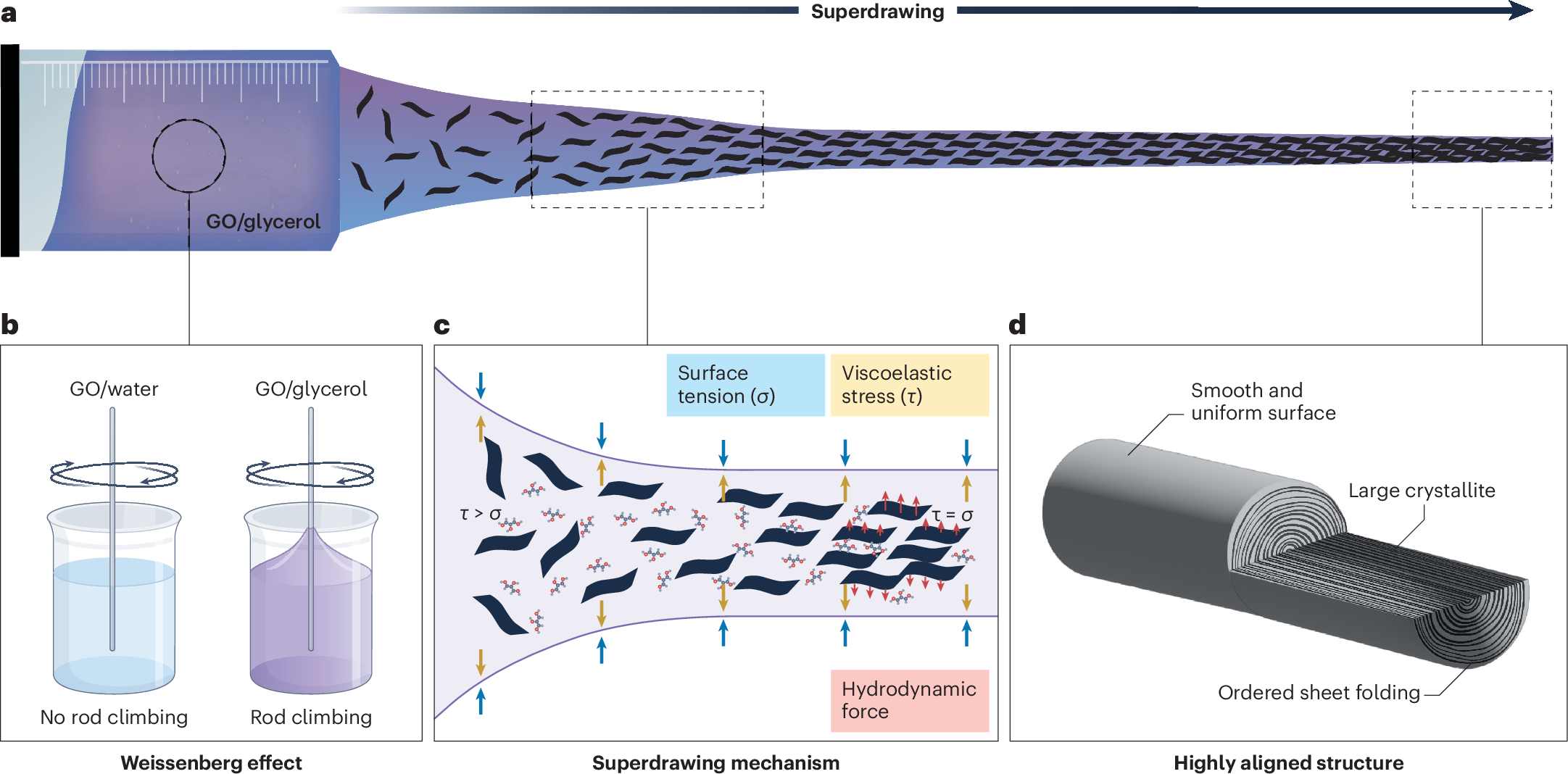
- Researchers at Zhejiang University dispersed graphene oxide in highly viscous glycerol, giving it polymer-like viscoelasticity and allowing ultrahigh-ratio drawing during wet spinning.
Compiled by The ScientistSomething wrong?How this is made
Why it matters
- constraint Both headline figures are best-case values for a single drawn filament, so a thermal designer choosing this material still has to establish what a bundle or a fabric of them conducts.
- decision Anyone funding a graphene fiber line is backing a laboratory trajectory; the revenue on record from this chemistry belongs to a toothbrush coating.
- precedent If the glycerol route holds up, the target customer becomes a thermal-management buyer who specifies conductivity per part, a stricter test than an antibacterial coating ever faced.
Commentaries in Nature Materials review other people's experiments. The 5.9 gigapascal tensile strength and the 1,720 watts per meter per kelvin came out of a Zhejiang University study, and the account reports both as peaks [8].
Graphene oxide disperses in water because of the oxygen groups attached to its sheets [4], and above a certain concentration those sheets line up on their own, which is what Kim's group reported in 2011 [2]. That gives a spinnable liquid crystal. But earlier routes broke the liquid filament while pulling it, and the sheets ended up loosely packed, leaving voids and defects inside the fiber [5]. Glycerol is far more viscous. Graphene oxide dispersed in it behaves viscoelastically, like a polymer solution, and the filament tolerates what the Zhejiang work describes as ultrahigh-ratio drawing [6]. The long draw aligns the sheets along the fiber axis and reduces the voids, and a high-temperature heat treatment afterwards grows large, aligned graphitic crystallites [7].
Strength and thermal conductivity had resisted being raised together, because the same voids and misalignment cost both [5]. These fibers are reported high on both [8]. The alignment runs along the fiber axis [3], so 1,720 watts per meter per kelvin describes heat travelling lengthwise down a filament, not across a fabric woven from many of them. The commentary does not give a production rate or say how many fibers were tested.
The commercial record for this chemistry so far is a consumer coating. Antibacterial toothbrushes built with technology from Sojaechangjo, a faculty startup Kim founded, have sold more than 14 million units since their 2023 launch [10], an average of roughly 4.7 million a year [13]. The same research line reached market in functional sportswear [11].
KAIST says that research is now advancing into materials for thermal management [11]. In my view that is a research trajectory with one strong data point on it, and the distance from here to a thermal-management order is measured in reproducibility outside the originating lab and in cost per kilogram of fiber. The commentary's own framing helps explain why the trajectory is plausible: the field learned to process a two-dimensional material through flow and stretching, much like a polymer solution [9]. Viscosity and draw ratio are variables a spinning line already controls. Fifteen years passed between the liquid crystal report and this stocktake [12].
What to watch
- Whether the glycerol route's 5.9 GPa and 1,720 watts per meter per kelvin peaks reproduce outside the lab that reported them, and at what fiber length.
- Any published production rate or cost per kilogram for ultrahigh-ratio wet spinning.
- Whether Sojaechangjo or the GrapheneTex textile line moves from coatings and sportswear into fiber products for heat.