Science1 distinct publisher3 min readPublished
Theory predicted an in-plane anomalous Hall effect and no experiment had shown one, until a few-layer tantalum iridium telluride flake borrowed magnetism from the layer beneath it and produced the signal.
The Scientist · Science desk

Compiled by The ScientistSomething wrong?How this is made
Splitting the problem in two is the part of this worth copying. A single crystal that has the right symmetry and also orders magnetically is hard to come by, which is why the in-plane anomalous Hall effect sat in theory without an experiment behind it [7][8]. The Carnegie Mellon group took the two requirements separately. TaIrTe4 was chosen because its crystal structure permits a multidimensional Hall effect [9], and the magnetism was borrowed from a layer of Cr2Ge2Te6 pressed against it, close enough that the normally nonmagnetic TaIrTe4 acquires magnetic properties while keeping its own electronic character [10]. Jyoti Katoch, who fabricates the group's two-dimensional devices, describes atomically precise heterostructures as a way to obtain electronic and magnetic properties on demand [15].
Simranjeet Singh's own claim is narrower than the headline sitting above it. He says the Hall effect is not confined to a field applied perpendicular to the film, and that a response also appears with the field in-plane [5]. The release text says the findings expand scientists' understanding of the Hall effect, while the ScienceDaily headline says a century-old assumption has been overturned [19]. Edwin Hall's 1879 measurement stands as described [2]; what this work adds is a magnetization-linked Hall response along a second direction [6], 147 years after the original (2026 minus 1879) [18].
For sensing, everything rests on one element reporting more than one axis [12], which is why Singh points to vector magnetometry built from out-of-plane and in-plane anomalous Hall signals measured in the same device [13]. The Carnegie Mellon release goes further, raising the prospect of magnetic sensors that are simpler and more flexible, with possible use in electronics, transportation, and medical imaging [16]. The thing this doesn't tell you is whether any of that leaves a cryostat: the release gives no operating temperature and no magnitude for the in-plane signal [17]. Nor does it set the signal against the Hall sensors already working in cars and computer keyboards [4][17]. Proximity-induced magnetism is the load-bearing piece here. Because that magnetic order is borrowed from a neighboring layer rather than native to TaIrTe4, it is the part most likely to weaken first, and the second axis would go with it [10].
For now, this result matters most to researchers running the measurement, and only later, if ever, to a product line. A Hall response that reports on more than one component of magnetization is a probe of multidimensional magnetic and topological structure in condensed matter systems [6], and that is worth having in a lab whether or not the signal ever grows large enough for a keyboard. I would treat the sensor case as conditional on three numbers the release does not print: signal size, temperature range, and how well it reproduces from device to device. They should be in the Nature Materials paper [1], and they decide which of the two stories this turns into.
Ranked by verification strength, evidence, and original report placement.
Carnegie Mellon University researchers identified an unusual magnetic response that overturns a long-standing assumption about the Hall effect, with findings published in Nature Materials.
"For a long time, people thought the Hall effect only worked when the magnetic field was applied perpendicular to the plane of the film. We've shown that that's not true -- you can also get a response when the field is in-plane."
Scientists had previously predicted an in-plane anomalous Hall effect in theory, but no experiment had successfully demonstrated it before this work.
Singh said the ideas had been proposed but "it's very difficult to make a magnetic material with the right symmetry to do it"; the team found a material with the right symmetry and made it magnetic.
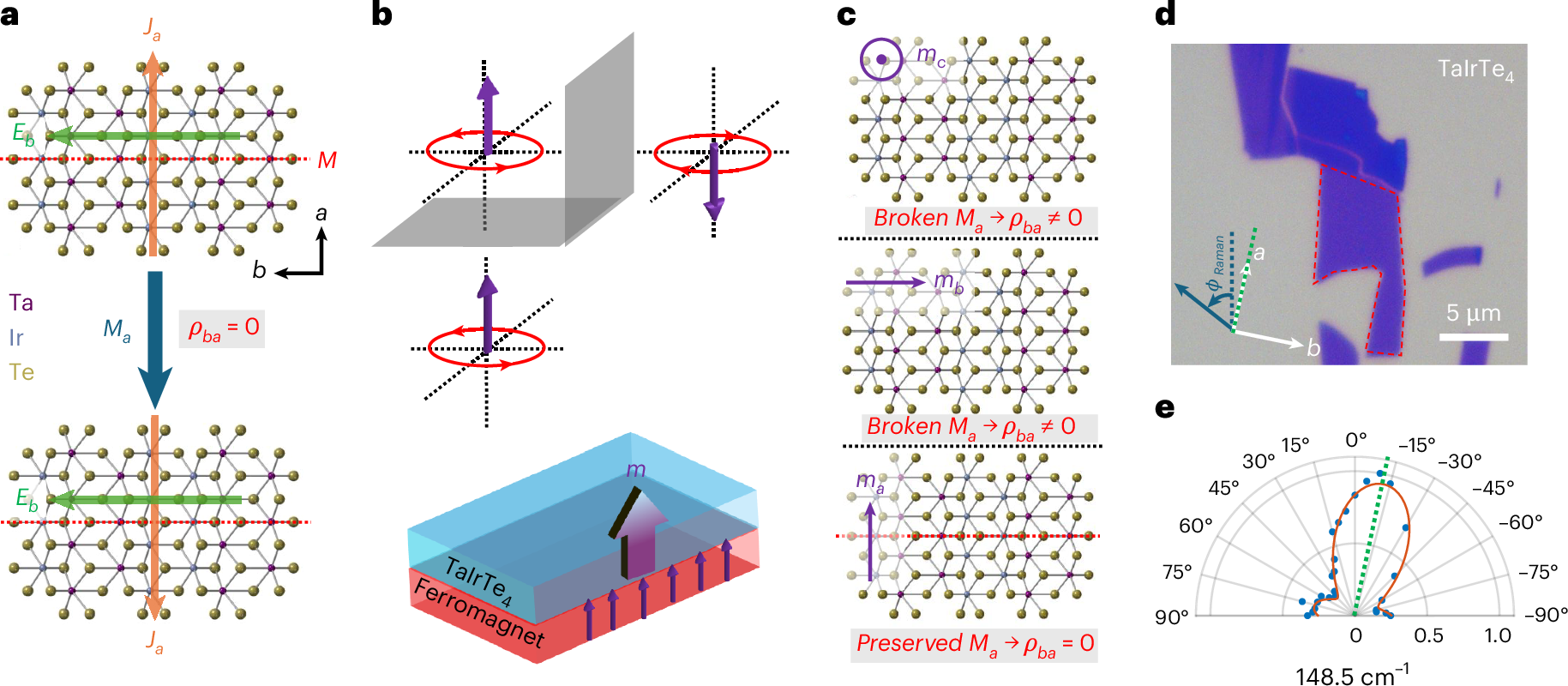
The team began with tantalum iridium telluride (TaIrTe4), whose crystal structure has the symmetry needed to support a multidimensional Hall effect, and reduced it to only a few atomic layers in thickness before placing it next to a magnetic layer of Cr2Ge2Te6.
Because the two layers sit so closely together, magnetic behavior from the Cr2Ge2Te6 influences the normally nonmagnetic TaIrTe4, giving it magnetic properties while allowing it to retain its underlying electronic characteristics.
Distinct publishers with included, body-backed reporting in this cluster.
1 article · September 3, 2026
Follow any of these and your For You feed starts watching them — no settings page required.
science
ASTRID runs 166 billion particles all the way down to redshift zero1 distinct publisher
science
Two social features, opposite results: a diet app trial argues against "add engagement"1 distinct publisher
science
The sharp crystal seed was never there: 8,000 nuclei imaged atom by atom, all gradients1 distinct publisher
security
Akrites switches on in September with 20-odd members and a one-to-10 engineer donation band1 distinct publisher
Evidence-backed comparisons of source perspectives and observed adoption signals. Read the methodology
Which Builder, Operator, and Investor concerns the observed source mix emphasized—not a truth score.
Evidence, demonstrated adoption, hype gap, incentives, and confidence are assessed independently, each on its own current evidence. How these are measured.
One release, paper cited not read
Every load-carrying detail — the first-ever in-plane signal, the TaIrTe4-on-CGT stack, the two-axis sensing consequence — comes from a single Carnegie Mellon release that ScienceDaily reprints with the university's own writer credited. The Nature Materials paper is named but never quoted back to us, and the release withholds exactly the quantities a reader would need to judge the claim: how large the new signal is, and at what temperature it appears. What raises this above the floor is specificity, materials, lab and authors are all named, so the account is checkable by anyone who wants to.
Lab flakes, no users
There is nothing to measure yet, and the reporting does not pretend otherwise. The only event on the record is the announcement itself; the devices are atomically thin flakes whose unconventional signal depends on the magnetic layer ordering at low temperature, and room-temperature testing is described as ongoing. Commercial Hall sensors appear in this story as historical context, not as anything being displaced.
Headline outruns its own release
ScienceDaily's headline says a century-old assumption was just overturned; the paragraph beneath it says the findings 'expand scientists' understanding' of the Hall effect. Both descriptions are defensible, but only one travels. The stretch widens in the summary block, where simpler sensors for electronics, transportation and medical imaging are promised without the condition Chatterjee states plainly further down, that the effect emerges once the magnetic layer becomes ferromagnetic at low temperatures. Strip the packaging and a genuine first measurement remains; it is the packaging that is running ahead.
The subject wrote the copy
Chain of custody is short and visible: a Carnegie Mellon writer produced the text, Carnegie Mellon's physics department is its subject, and ScienceDaily passed it on with the credit line intact. That is not concealment — the release even lets its own theorist say the mechanism is not nailed down and that room-temperature operation is still being tested — but every choice about what to lead with belongs to the institution being complimented. No outside physicist is asked whether the prediction was really realised.
Sure what was said, unsure what it's worth
We can be fairly firm about what was announced, by whom, using which materials — the naming is precise enough to be wrong in public. We can say much less about what it means outside a cryostat. With no signal magnitude, no operating temperature and no benchmark against the Hall sensors already in cars, any judgement of significance leans on a single institutional account that nobody outside Pittsburgh has yet checked.