Published · yesterdayScience2 min read
Cowpeas leave a message in the soil, and the next plant uses it to call wasps
A Cell Reports study says leafminer damage conditions soil bacteria that make later cowpeas emit a wasp attractant. The persistence everyone likes about it is the part nobody timed.
Written for builders.See today for builders
What happened
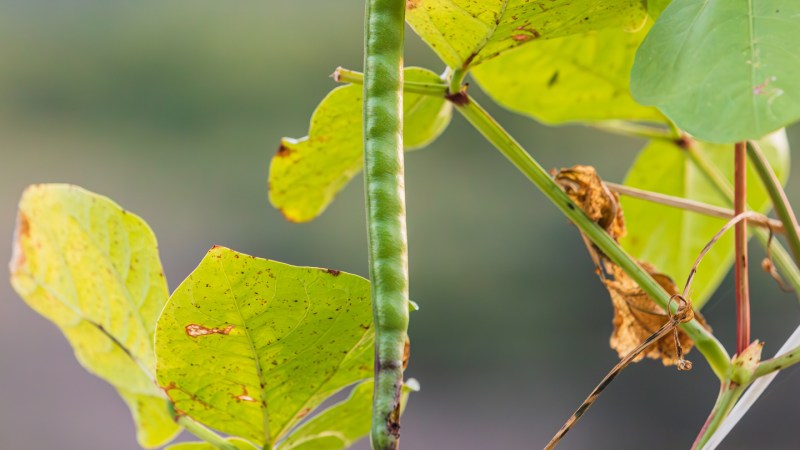
- Researchers reported August 21 in Cell Reports that gnawing fly larvae provoke cowpea plants to release chemicals into the soil that nurture a helpful community of microbes, and that these bacteria then prompt plants to release an airborne molecule drawing parasitoid wasps to attack the flies.
- Zeng-Rong Zhu, an insect ecologist at Zhejiang University in Hangzhou, China, says it is unclear how long the microbial protection lasts, or whether other kinds of plants lean on this type of defence.
- Soil and plant analyses showed the leafminer larvae triggered the release of chemicals into the dirt from the plants' roots; those chemicals cultivated bacteria that in turn directed new cowpeas to release a molecule called (Z)-3-hexenyl acetate.
- The American serpentine leafminer (Liriomyza trifolii) is native to the southeastern United States and the Caribbean and is an invasive fly now found in parts of Asia, Europe and Canada.
- Leafminer larvae tunnel through and consume leaves from all sorts of plants, and crops including cowpeas, eggplants and beans are at risk.
Compiled by The ScientistSomething wrong?How this is made
Why it matters
The mechanism runs in five steps [15]. A larva of the American serpentine leafminer tunnels into a cowpea leaf [5]. The plant changes what its roots put into the soil [3]. Those root chemicals cultivate bacteria [3]. The bacteria direct a later cowpea grown in that soil to release (Z)-3-hexenyl acetate [3]. A parasitoid wasp arrives [9]. Only the third step is portable in principle, and it is the one this account leaves anonymous: the bacteria are described by what they do, not by what they are [18].
The wasp's side of the deal is thinner than the plant's. Neochrysocharis formosa reproduces by laying eggs inside leafminer larvae, which the hatchlings then eat [7]. Here the volatile pulled wasps toward plants with no herbivore on them [10], so the recruits landed where there was nothing to parasitise [16]. The reported outcomes stop at attraction [19], and what a wasp does after an empty visit is what separates a control tactic from a redistribution of wasps.
Earlier work had already established that plants shape their root-zone microbes and that leaf-chewing insects alter those communities [12]; the new part is the return trip, soil back to leaf to wasp [1]. Michelle Afkhami of the University of Miami, who was not involved, reads the result as soil partners keeping alive a protection that would otherwise fade [13], the contrast being aboveground alarm chemistry, thought to dissipate once the pest stops eating [11]. Zeng-Rong Zhu of Zhejiang University, who led the work, says it is not known how long the microbial protection lasts or whether other kinds of plants use it [2]. The durability claim, in other words, rests on a soil transfer with no clock on it [17].
Demand is not the missing piece. Liriomyza trifolii is native to the southeastern United States and the Caribbean and is now found in parts of Asia, Europe and Canada [4]; its larvae tunnel through the leaves of cowpeas, eggplants and beans among others [5]; Zhu says leafminers can "destroy all the leaves if we don't use any measures to control them" [6]. Afkhami's other example of microbial defence, fungi that coat leaves with toxic alkaloids, works where the damage is [14]. This one works from somewhere else entirely [14], which is both the reason it is interesting and the reason it is hard to sell. Until someone isolates and grows the bacteria, the deliverable is a volume of dirt with a history, and dirt does not ship.
Claim ledger
Ranked by verification strength, evidence, and original report placement.
- [1]
Researchers reported August 21 in Cell Reports that gnawing fly larvae provoke cowpea plants to release chemicals into the soil that nurture a helpful community of microbes, and that these bacteria then prompt plants to release an airborne molecule drawing parasitoid wasps to attack the flies.
ReportedView cited source - [2]
Zeng-Rong Zhu, an insect ecologist at Zhejiang University in Hangzhou, China, says it is unclear how long the microbial protection lasts, or whether other kinds of plants lean on this type of defence.
- [3]
Soil and plant analyses showed the leafminer larvae triggered the release of chemicals into the dirt from the plants' roots; those chemicals cultivated bacteria that in turn directed new cowpeas to release a molecule called (Z)-3-hexenyl acetate.
ReportedView cited source - [4]
The American serpentine leafminer (Liriomyza trifolii) is native to the southeastern United States and the Caribbean and is an invasive fly now found in parts of Asia, Europe and Canada.
ReportedView cited source - [5]
Leafminer larvae tunnel through and consume leaves from all sorts of plants, and crops including cowpeas, eggplants and beans are at risk.
ReportedView cited source - [6]
Zhu says leafminers can "destroy all the leaves if we don't use any measures to control them."
Sources & coverage · 1 publisher
The reporting this story was synthesized from, earliest first. Every link goes to the original.
- sciencenews.orgErin Garcia de Jesús2d agoPlants under attack leave behind a surprising call for backup
Additional citations
- Zeng-Rong Zhu, Zhejiang University
- Michelle Afkhami, University of Miami