Published · yesterdayScience2 min read
A bitten cowpea leaves instructions in the soil, and the next plant calls the wasps
Researchers report in Cell Reports that leafminer damage recruits root bacteria, which make later cowpeas emit a wasp attractant. How long the soil holds it is unmeasured.
Written for builders.See today for builders

What happened
- Researchers led by Zeng-Rong Zhu, an insect ecologist at Zhejiang University in Hangzhou, China, and colleagues reported the cowpea soil-microbe defence findings on August 21 in Cell Reports.
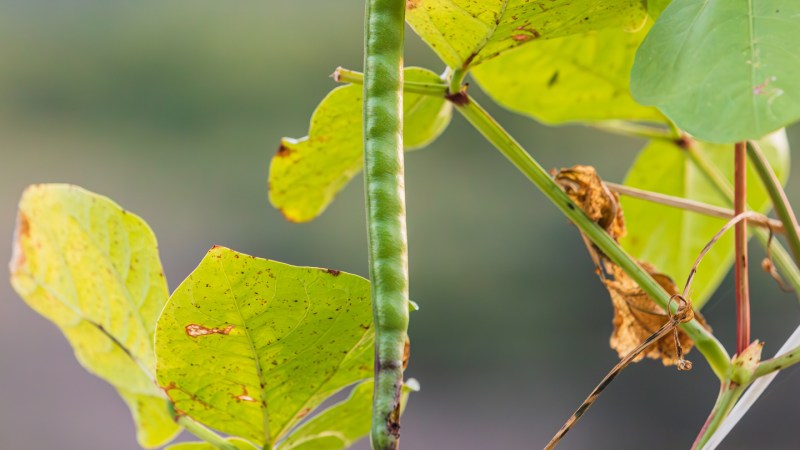
- Soil and plant analyses revealed that leafminer larvae feeding on cowpea leaves triggered the release of chemicals into the dirt from the plants' roots.
- The root chemicals released after leafminer feeding cultivated a community of bacteria in the soil.
- The bacteria cultivated by those root chemicals directed new cowpeas grown in the same soil to release a molecule called (Z)-3-hexenyl acetate.
- The (Z)-3-hexenyl acetate released by the new cowpeas pulled in parasitoid wasps even when there was no herbivore present to attack.
Compiled by The ScientistSomething wrong?How this is made
Why it matters
The plant that pays is not the plant that benefits. A cowpea under attack by leafminer larvae spends carbon exuding chemicals from its roots into the soil [2], and the return lands on a later cowpea grown in that same dirt, which emits the wasp attractant without having been chewed on at all [4][5]. That asymmetry is why the result reads as an agricultural finding rather than a physiological curiosity: the beneficiary is the next occupant of the bed.
The experimental design carries the durability argument. The team pulled the infested plants out and used their soil to grow fresh cowpeas [9], so whatever remembered the attack was in the ground and not in the plant [2]. Airborne distress calls are understood to fade once the chewing stops [8], which makes them a reaction to damage already taken. Two halves of an alternative were already known separately: plants shape the microbial communities at their roots, and leaf-feeding insects change what those communities look like [16]. This work joins them back up to the canopy.
Michelle Afkhami, an ecologist at the University of Miami who was not involved, says soil partners can hold protection that would otherwise be short-lived across to the next generation [11]. She contrasts it with fungi that defend by coating leaves in toxic alkaloids, and notes that in the cowpea case the long-term protection comes from a community that is not even in the area where the herbivory is happening [12].
The pest earns the attention. Liriomyza trifolii is native to the southeastern United States and the Caribbean and now appears in parts of Asia, Europe and Canada [14]; the larvae tunnel through leaves of many hosts, with cowpea, eggplant and bean among the crops at risk [15]. Zhu says leafminers can destroy all the leaves if no control measures are used [13], and his stated goal is to understand the mechanism well enough to dispatch wasps as pest control [17].
What sits between the two is a set of blanks. The reported endpoint is wasp attraction; there is no measurement here of leafminer mortality or of damage to the second-generation plants [3]. The bacteria are described by function rather than identity, and the account gives no density, no soil type and no number of plantings over which the effect holds [10]. Those are precisely the figures an inoculum would have to be sold on, and none of them exist yet.
Claim ledger
Ranked by verification strength, evidence, and original report placement.
- [1]
Researchers led by Zeng-Rong Zhu, an insect ecologist at Zhejiang University in Hangzhou, China, and colleagues reported the cowpea soil-microbe defence findings on August 21 in Cell Reports.
- [2]
Soil and plant analyses revealed that leafminer larvae feeding on cowpea leaves triggered the release of chemicals into the dirt from the plants' roots.
ReportedView cited source - [3]
The root chemicals released after leafminer feeding cultivated a community of bacteria in the soil.
ReportedView cited source - [4]
The bacteria cultivated by those root chemicals directed new cowpeas grown in the same soil to release a molecule called (Z)-3-hexenyl acetate.
ReportedView cited source - [5]
The (Z)-3-hexenyl acetate released by the new cowpeas pulled in parasitoid wasps even when there was no herbivore present to attack.
ReportedView cited source - [6]
Neochrysocharis formosa wasps were more attracted to cowpeas grown in dirt taken from leafminer-infested cowpeas, and fewer wasps visited control cowpeas grown in soil that originally hosted plants never exposed to the flies.
ReportedView cited source
Sources & coverage · 1 publisher
The reporting this story was synthesized from, earliest first. Every link goes to the original.
- sciencenews.orgErin Garcia de Jesús2d agoPlants under attack leave behind a surprising call for backup
Additional citations
- Science News
- Zeng-Rong Zhu, Zhejiang University
- Michelle Afkhami, University of Miami
- Science News, citing Zhu