Product1 publisher3 min readPublished
Zendesk puts a three-to-six-month clock on ending per-seat pricing
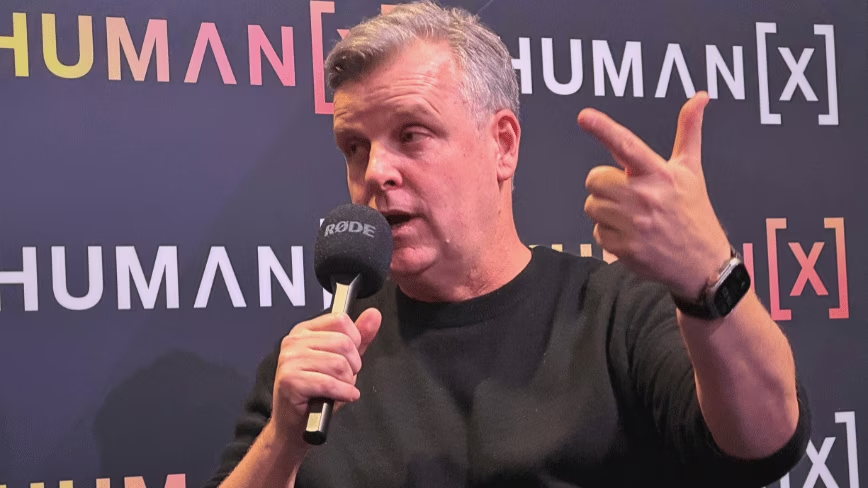
Tom Eggemeier told a HumanX audience in Amsterdam that seats are dead, and Sierra already bills only for the cases its agents resolve. Buyers now have to forecast a billing unit they have never had to track.
The Product Desk · Product desk
What happened
- Zendesk's Tom Eggemeier and Sierra's Clay Bavor told separate sessions at HumanX in Amsterdam on Wednesday that per-seat software pricing is ending and that customers should pay for AI agents only when the agents finish a job.
- Eggemeier said Zendesk plans to take seats out of its whole business, with announcements due in three to six months.
- Zendesk moved its AI agents onto outcome-based pricing in August 2024, which Eggemeier said made it the first company to do so.
- Sierra charges only when its agents resolve an issue or make a sale, Bavor said.
- Bavor said Sierra originates more than $1bn of new mortgages a month for companies such as Rocket Mortgage and serves almost half of the Fortune 50 and one in three of the world's largest banks.
Compiled by The Product DeskSomething wrong?How this is made
Why it matters
- decision Because Zendesk sets the definition of an outcome customer by customer, the buyer has to write that definition into the contract and decide what a solved problem is before signing.
- cost Per-interaction pricing moves the software line from a number finance forecasts off headcount to one that moves with support volume, and the buyer's finance team absorbs the variance.
- exposure Once most interactions are machine-to-machine, the traffic that generates the invoice is produced by software the buyer neither administers nor sees.
- precedent Procurement loses the shared yardstick seat counts gave it, with OpenAI also selling outcome pricing to some customers and each vendor free to define its own unit.
A seat is easy to audit. Someone in finance counts licences against the HR roster, then cancels the ones belonging to people who left. An outcome has to be defined before anyone can count it, and Zendesk defines it with each customer: in support it is usually a problem solved without a human, while for a UK used-car marketplace it can mean an AI agent closing a £500 gap on a sale [9].
Bavor's case rests on one example. A company that pays one euro to resolve a case costing ten in a call centre saves nine euros each time, he said [7]. The buyer in that example pays 10% of the call-centre cost per resolved case [1]. "The ROI is so clear you don't have to do fuzzy envelope math about productivity gains," Bavor said [8]. Neither executive gave a price per outcome.
Few buyers will start at per resolution. Eggemeier said pricing by interaction will be a first step for many companies [5]. Zendesk expects AI agents to handle more than 80% of interactions within about three years, with humans handling the rest [11], and Eggemeier said total interactions will grow sharply [12]. Priced per interaction, the invoice follows volume, so a buyer whose interaction count doubles pays twice as much on the same headcount [2].
Some of that volume will not come from people. Eggemeier said AI agent to AI agent interactions will pass 50% within two years [13]. Bavor said personal agents such as Meta's Muse will be talking directly to business agents within about six months [14]. Zendesk spent part of last weekend testing whether a personal agent could buy its software online, and found a couple of gaps [15]. On a per-interaction price, most billable events in two years would be software talking to software [3].
"Unequivocally: seats are dead," Eggemeier said [2]. He put the change at three to five years, against the ten to twenty the move to the cloud took [16], and he was blunt about vendors that sit it out. "If you're still on seats in two or three years, I believe your company will struggle," Eggemeier said [17].
Two things decide whether this is cheaper for the buyer: whether the unit can be counted from the buyer's own logs without the vendor's dashboard, and whether the volume moves for reasons the buyer controls. A team that can count resolutions independently, and whose ticket load tracks its own customer base, does well on per-resolution pricing. A team that cannot audit the count, or whose volume spikes on the day a release goes wrong, has taken on a variable cost it does not set. The headcount side stays open either way: Bavor said most Sierra customers move staff to higher-value work instead of cutting them, and some have created a new role, the "AI architect", who coaches the agents [19].
What to watch
- Whether Zendesk's promised announcements price non-agent products per interaction, per resolution, or with a volume floor.
- Whether Zendesk publishes how a resolved interaction is counted, and what a customer does when it disputes the count.
- Whether personal agents start generating billable interactions against business agents inside Bavor's six-month estimate.