Product1 publisher3 min readPublished
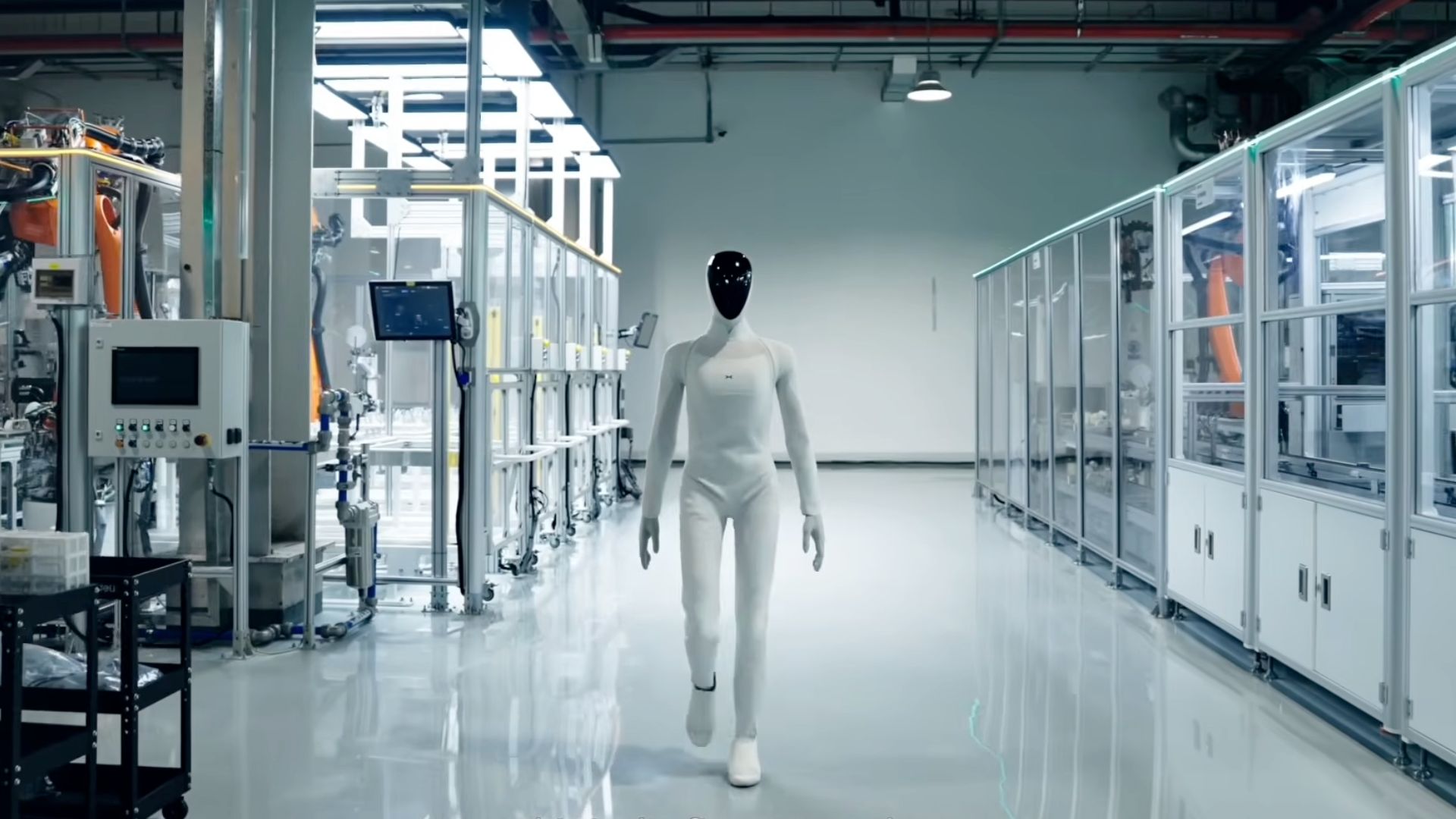
A robot walking itself off a Guangzhou line is a real assembly milestone. XPeng's own timeline still puts mass production at year-end and outside delivery in 2027, the same year Tesla now targets Optimus sales.
The Product Desk · Product desk

Follow any of these and your For You feed starts watching them — no settings page required.
Compiled by The Product DeskSomething wrong?How this is made
The first people to spend a working shift near an IRON will be XPeng store staff and campus employees, because that is where the company says its initial commercial-scenario rollouts begin [8]. Selling to outside buyers, in China or overseas, is a 2027 plan [9]. He Xiaopeng says the aim is a robot with full generalisation that can become a companion in people's lives [14]; the first posting is a shop floor the vendor owns.
That ordering is more useful than the walk-off itself. A line whose core processes are more than 80 percent automated [3] is a claim about build repeatability, not about what the machine does across an eight-hour shift. What the walk-off does establish is narrower and worth having: the unit that powered up and balanced came off a fixture sequence rather than out of the hands of the team that designed it [2]. That is a real difference from a stage prototype. It is also still one unit.
What an operator needs before hosting a fleet is hours of unattended task time per unit per week and a failure rate on the specific task. What the announcement supplies is 76 degrees of freedom across the body with 21 in each hand [4], plus three Turing chips rated at up to 2,250 TOPS in total [5], which works out to roughly 750 TOPS per chip [6]. No unit volume, cycle time, price or uptime figure appears in it [16]. XPeng runs its foundation model on the robot instead of teleoperating it [5], which the company says cuts latency and keeps operational data on the machine [7].
Set that against Tesla, where Optimus production is now expected in the coming months and commercial sales are targeted for the second half of 2027, where earlier plans had production this summer and first sales by late 2026 [10][11]. The sales date has moved by about a year [12]. Line the two calendars up and XPeng's lead shrinks to sequencing inside a single year, because its external delivery and Tesla's commercial sales both sit in 2027 [13]. On what each company has published, no outside buyer takes delivery of either machine before then [18].
So the test for anyone offered a humanoid pilot this year runs on two axes, and the first is who absorbs the cost when the robot fails the task. In a vendor-owned store, the vendor does, which is the sensible place to start, but it is thin evidence of anything beyond that. The second axis is whether the task is scored on completion or on presence. A humanoid greeting visitors in a showroom is scored on presence rather than on completing a task. Anything sitting in the vendor-pays, presence-scored quadrant is a demo with a production line behind it, which beats a hand-built prototype and falls short of a product.
The figures that move a programme out of that quadrant are units shipped to a party that can send them back, and hours of scored task time per unit. XPeng has published neither [16].
Ranked by verification strength, evidence, and original report placement.
XPeng has commissioned a dedicated production facility in Guangzhou for its IRON humanoid robot.
XPeng says an IRON robot autonomously walked off the production line after being assembled.
XPeng says more than 80 percent of the production line's core processes are automated, which it credits for the precision and consistency needed to manufacture complex robotic systems at scale.
IRON has 76 degrees of freedom across its body, and each hand has 21 degrees of freedom.
IRON carries three Turing AI chips providing up to 2,250 TOPS of effective computing power, allowing XPeng to run its physical AI foundation model on the robot rather than relying on remote computing or teleoperation for complex tasks.
According to XPeng, onboard inference is designed to reduce latency and keep operational data on the robot.
Evidence-backed comparisons of source perspectives and observed adoption signals. Read the methodology
Which Builder, Operator, and Investor concerns the observed source mix emphasized—not a truth score.
Evidence, demonstrated adoption, hype gap, incentives, and confidence are assessed independently, each on its own current evidence. How these are measured.
Precise numbers, one source for all of them
The 80 percent automation figure, the DOF counts and the 2,250 TOPS rating are the kind of claims that could be checked, and none has been: they reach readers through Interesting Engineering as XPeng statements, with a single robot walking off a line as the only physical demonstration described. The revised Optimus dates carry even less, appearing without a named Tesla source.
Company-owned pilots first, buyers in 2027
What exists today is a commissioned line and one robot that walked off it. The earliest planned use is inside XPeng's own stores and campuses, and delivery to anyone else is dated 2027 on the company's published schedule, the same window Tesla now gives for Optimus sales.
Production language ahead of production evidence
"Begins mass production" and "walks off production line" describe a commissioned facility and one assembled robot. The disclosure that would make the manufacturing claim checkable, units per shift, cycle time, yield, price, is absent, and the year-end mass production target is still ahead. The Tesla contrast flatters XPeng's position without adding evidence to it.
Announcement written by the party being measured
Every number that the story rests on comes from XPeng, which is also the party competing for capital and attention in humanoid robotics, with its CEO describing the goal as a companion in people's lives. The comparison that gives the news its edge, Tesla slipping to the second half of 2027, is one the announcing company benefits from and does not have to substantiate.
Clear on what was said, thin on what was built
That XPeng announced these specifications, this line and these dates is easy to hold with confidence. Whether the Guangzhou facility produces robots at any meaningful rate is not addressed by the only account available, and a second source would move this figure more than any further detail from the company would.
invest
XPeng's $900m robot spin-out comes with a seven-year clock and a $1bn put2 publishers
product
Chinese carmakers are funding humanoid robots out of the factories they already own1 publisher
product
XPENG's robotics unit banked $900M against a December deadline it set itself1 publisher
product
LG's humanoid is a 2027 promise; the Tennessee wheeled robot is the 2026 fact2 publishers
Publishers with included, body-backed reporting in this cluster.
1 article · September 8, 2026