Loading today’s stories
Build1 distinct publisher3 min readUpdated
Xiaomi's 2,699 RMB four-bay NAS prices the chassis at 675 RMB a slot
The spec sheet reads like a Synology competitor. The launch material supplies exactly one price and no competing one, which leaves buyers comparing a number to a claim.
The Engineer · Build desk
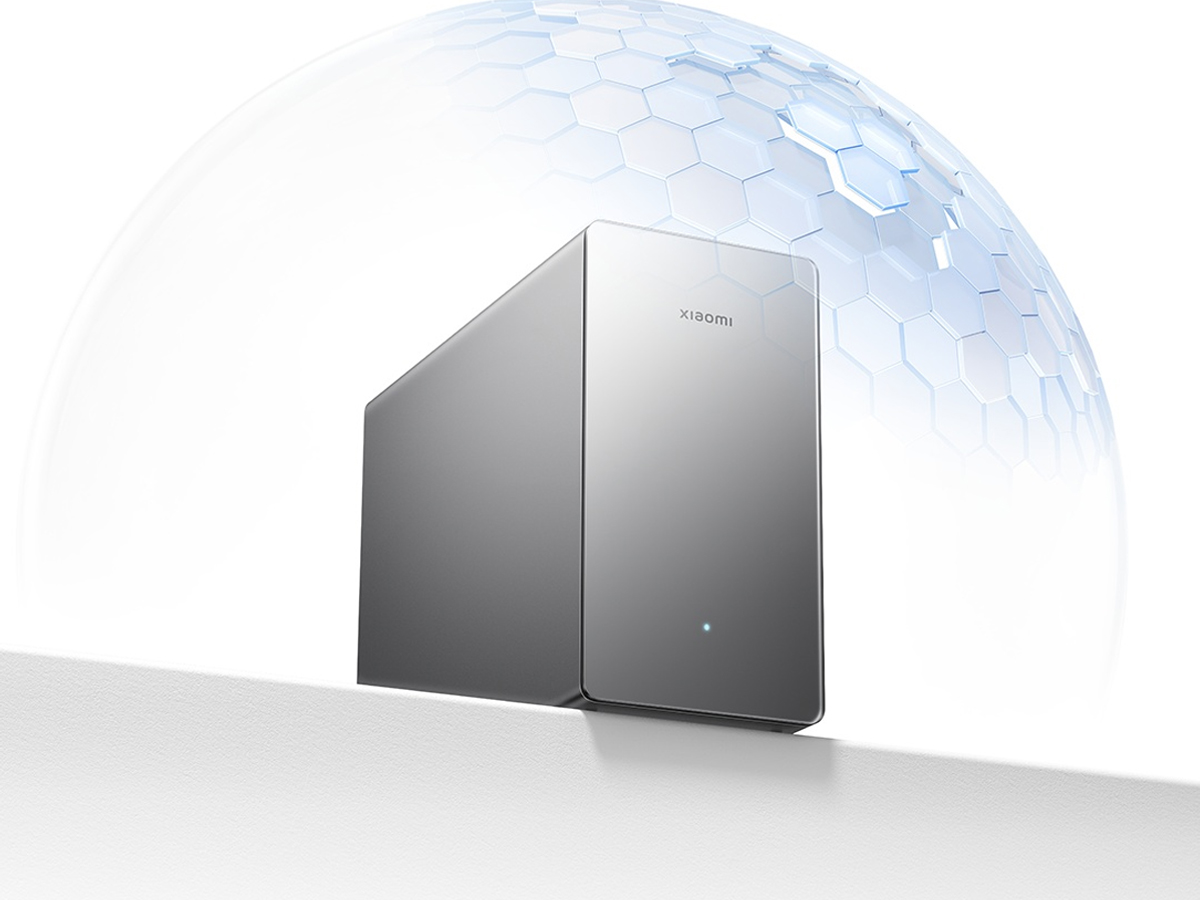
What happened
- On August 21 Xiaomi listed its first NAS product, the Xiaomi Smart Storage, at a starting price of 2,699 RMB, open for reservation.
- The unit is a 4-bay desktop NAS supporting up to 24TB per bay (24TB x 4).
- It uses an Intel N100 CPU with 6GB of RAM.
- Dual 2.5G Ethernet, USB 3.0, HDMI and power connectors are all placed on the rear panel.
- The product supports Docker and phone photo backup.
Compiled by The EngineerSomething wrong?How this is made
Why it matters
Divide the entry price by the bay count and you get 674.75 RMB per slot [15]. That is the only cost figure this launch actually supports, and it is the one a small-office buyer will carry into the next quote they receive.
Everything above it is assertion. The write-up says the specification is competitive against Synology and QNAP at the same price point [6], but names no competing model, no competing price, and does not say whether any drives are included at 2,699 RMB [17]. Drive inclusion is not a detail; it moves the per-slot figure by most of its value. So the parity claim, for now, is an industrial designer's read of a reservation page rather than a line-by-line comparison against a dealer price list.
What the hardware does constrain is the workload. An N100 with 6GB of RAM [3] and Docker support [5] will run a handful of containers and a photo backup target. It will not absorb whatever else a small office wants to consolidate onto its one always-on box, and 6GB is a hard ceiling until somebody confirms whether it is a socketed module. Four bays at 24TB each [2] gives 96TB raw before any redundancy [16], which is a lot of capacity hanging off a processor at that class.
The thermal question is the one the source treats seriously and cannot answer. A 3.5-inch mechanical drive reaches 45 to 50C at full read and write, and four stacked with poor airflow throttle or drop out [8]. The mitigation visible in the official renders is an angled-cut top grille and a rear 120mm fan [9]. Two 2.5G ports sit on the same rear panel as USB 3.0, HDMI and power [4], and 2.5G PHYs draw roughly 30 percent more power than gigabit [11], so the network silicon is adding to the local rise rather than being neutral. Renders do not measure anything.
Read the rest of the design as a statement about who services the machine. The magnetic front panel covers the bays for tool-free swaps, the same intent as Synology's caddies with the magnets moved onto the panel [10]. The angled grille is chosen for dust deflection, on the reasoning that a desk-side unit will not get blown out monthly the way a rack does [9]. The shell is matte white against the matte black of Synology's DS and QNAP's TS lines [12], and the author estimates the texture at VDI-21 to VDI-24 by eye, against the VDI-24 to VDI-27 his own white-appliance projects settled on [13]. Those are all decisions for a living room, not a comms cupboard.
Which is the actual supply-and-cost story. Synology, QNAP, Zspace and UGREEN have been in this category for years [7], pricing entry boxes against software and support rather than against consumer-electronics volume. A four-bay 2.5GbE chassis with a published price of 675 RMB a slot [15] does not include a support commitment, a drive compatibility list, or a ship date, because none of those were stated [17]. Incumbents still get compared to the number anyway.
Loading topic controls
Loading related stories