Science1 publisher2 min readPublished
Deep fault slip helped shrink Kamchatka's 2025 tsunami across the Pacific
Stefano Lorito's INGV team finds the 2025 Kamchatka tsunami began with a tenth to a fifth of the 1952 tsunami's energy, partly because most slip was deep. Shallow slip at the trench still drove a surge of nearly 20 meters onto nearby coasts, a split the first magnitude estimate cannot reveal.
The Scientist · Science desk
What happened
- After the July 2025 magnitude 8.8 quake, Pacific-wide warnings were scaled back as measurements showed a smaller tsunami than early forecasts had suggested.
- The comparison event, the November 1952 magnitude 9.0 quake, destroyed most of Severo-Kurilsk and demolished the bridge from Hilo's shore to Coconut Island.
- The SWOT satellite passed over about 70 minutes after the 2025 quake and measured the tsunami spreading through the open ocean.
- The team combined the satellite data with seabed sensor readings and land-movement measurements, then worked backward to the fault slip that could explain them.
Compiled by The ScientistSomething wrong?How this is made
Why it matters
- constraint Warning centres get magnitude within minutes and slip depth much later, and in 2025 depth helped set how much energy reached the water, so first far-field forecasts lack a variable that mattered.
- exposure A downgraded ocean-wide alert says little about the source coast, where the same rupture's shallow slip drove a surge comparable to 1952's.
- decision Reaching the full rupture picture sooner means investing in more ocean and land sensors and better simulations, according to the researchers.
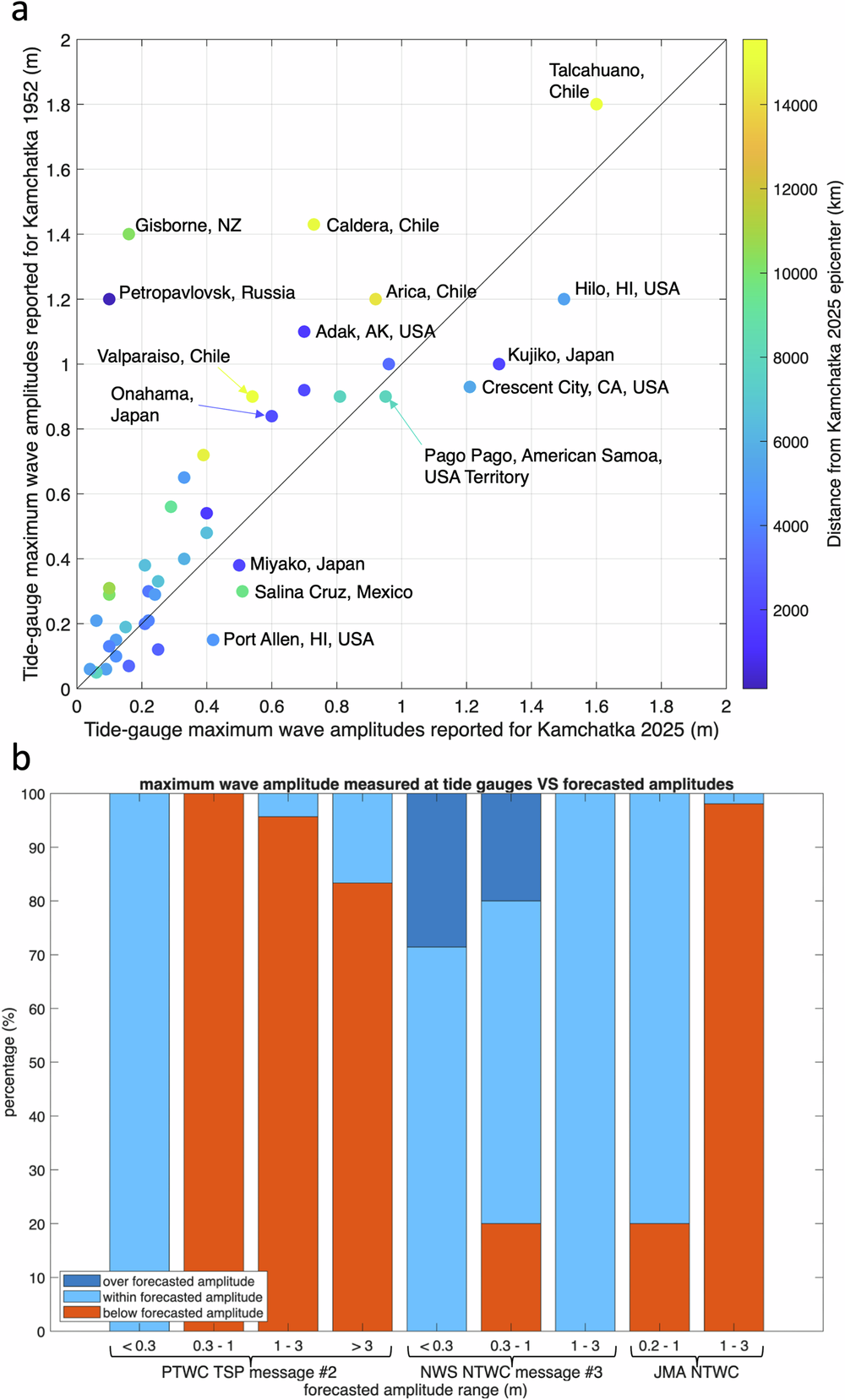
Put the other way, the 1952 tsunami began with 5 to 10 times the energy of the 2025 one [1]. The two earthquakes differ by only 0.2 on the magnitude scale [2]. In the reconstruction by Stefano Lorito of Italy's National Institute of Geophysics and Volcanology and colleagues, two factors account for the gap [5]. The 2025 quake was smaller. Much of its fault movement also happened well below the seabed, and that limited the energy passed into the water [9][11]. The phys.org account reports the two causes together and does not say how much of the far-field shortfall belongs to each [11].
The design leans on a regional control. The 1952 rupture was close to Kamchatka and slightly larger [3], so the comparison asks what besides size separates two tsunamis from the same coast. The slip model is one solution fitted to one earthquake's observations [8], and the energy estimate carries its own factor-of-two range [3]. The satellite snapshot sits closest to the far-field question [7]. Deep water is where a wave has not yet gone through the slowing and steepening that raise heights near shore [14].
Near Kamchatka, though, water heights were comparable to 1952's [12]. Part of the 2025 slip ran closer to the seabed, including a stretch that reached the ocean trench, and that movement generated waves that could grow sharply as they approached land [13]. Waves moving into the shallows slow down and grow taller. The shape of the seabed and the slope of the coast set how high they climb [14]. According to the reconstruction, those local conditions and the shallower slip together turned a less energetic tsunami into a powerful surge on nearby shores [14].
The authors stop short of arguing against magnitude-first warnings. They stress that cautious alerts remain essential to protect lives while the picture of the rupture develops [16]. Their suggestion is to add information as the event unfolds, using early wave measurements alongside earthquake data to refine alerts as a tsunami travels [18]. In my view the result supports faster revision of alerts once wave measurements arrive. One well-observed earthquake cannot show how often magnitude alone misjudges the far field.
What to watch
- Whether Pacific warning centres start pairing early wave measurements with earthquake data to revise alerts mid-event, as the Lorito paper suggests.
- Independent slip models of the July 2025 rupture that test whether most of the movement really sat well below the seabed.