Science1 publisher3 min readPublished
RNA study tracks thousands of gene changes linked to worm's influence on earwigs' water-seeking behavior
Researchers at Otago, UBC and Brown report 673 earwig genes and 2,672 worm genes growing more active as a parasitic worm drives its host toward water. The RNA data give experimenters candidate genes in both species, though the paper stops short of showing which ones make the earwig seek water.
The Scientist · Science desk
What happened
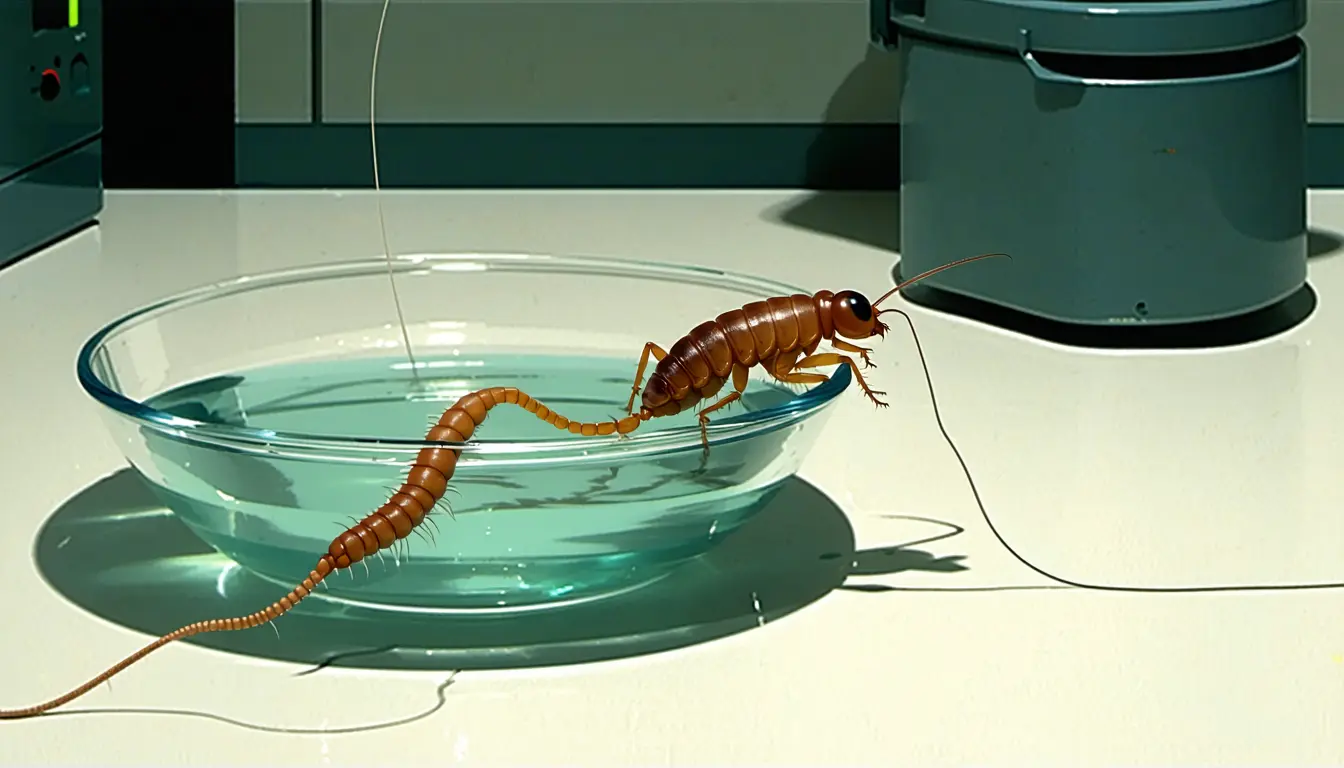
- Earwigs usually avoid open water, but earlier studies found that European earwigs infected with the roundworm Mermis nigrescens tend to head toward it.
- Researchers at Otago, the New Zealand Institute for Bioeconomy Science, UBC and Brown report in Proceedings of the Royal Society B that gene activity shifts in both species.
- The team RNA-sequenced uninfected earwigs alongside earwigs at early and late stages of infection, measuring host and worm gene activity at each stage.
- Across the sampled stages, 673 earwig genes and 2,672 worm genes became more active, while 593 earwig genes and 2,293 worm genes became less active.
Compiled by The ScientistSomething wrong?How this is made
Why it matters
- capability Experimenters now have specific host and parasite genes to disrupt when testing how Mermis nigrescens changes earwig behaviour.
- constraint Until someone blocks a flagged gene and watches the behaviour, any claim that a particular worm secretion controls earwigs goes beyond this evidence.
- precedent Other groups studying parasites that change host behaviour can copy the design directly: sequence host and parasite together at several infection stages.
Adding the up and down counts gives 1,266 earwig genes and 4,965 worm genes, assuming no gene is counted in both directions [1][2]. The team detected 12,876 earwig genes and 9,722 worm genes in all [4]. So about 9.8 percent of the host's active genes changed, against 51 percent of the parasite's [1][2]. The worm's share is roughly five times the earwig's [3].
That gap needs careful reading, because the two species do not have the same control. The earwigs have one: the uninfected insects [3]. The worm cannot. Gemmell described the sampling as "ranging from healthy earwigs to the moment the parasite emerged" [14]. For the worm, that span runs from early infection to leaving its host, and it is going through its own life stages the whole time. Some of its 4,965 changes are probably its own development, mixed in with whatever it does to the earwig. The Phys.org account does not give the number of earwigs sequenced at each stage.
In my view, the direction of the changes tells you more than the count. "We found that earwigs showed increased activity in genes associated with sensory and signaling pathways during manipulation, while the nematodes activated genes involved in transport and secretion, suggesting a sophisticated molecular dialogue between host and parasite that ultimately drives the host's fatal journey to water," Gemmell said [6]. "I think this study provides the first comprehensive genetic picture of how a parasitic nematode manipulates an insect host's behavior," he said [7]. He also said: "We showed that the parasite does not simply overwhelm the host; it appears to subtly influence it through coordinated molecular changes" [8].
The thing this doesn't tell you is which gene, if any, sends the earwig into the water. According to the report, the findings do not establish the direct cause of the behaviour [10]. RNA sequencing measures the RNA molecules genes produce when they are active [3]. Each sample is a snapshot of what changed alongside the march. Comparing against the uninfected group links those shifts to infection. It does not separate manipulation from the general strain of being infected. A rise in sensory genes could be how the worm steers its host. It could also be how a sick insect responds to a parasite.
The question started with a different insect. Gemmell, the paper's senior author, found native weta drowned in New Zealand puddles with worms emerging from their bodies, then moved to earwigs because they were easier to study [11]. "I was curious to know how the parasite exerted that power over its host that ultimately drove it to kill itself," he told Phys.org [12]. The report says comparable molecular processes could underpin the same behaviour in worm-infected weta and other insects [13].
What to watch
- A knockdown or blocking experiment on one of the flagged earwig sensory genes or worm secretion genes, showing whether infected earwigs still head for water.
- An RNA comparison in hairworm-infected weta, testing whether the shared regulatory signature Gemmell described shows up in a second host.
- A control of earwigs carrying a parasite that does not drive them to water, to separate manipulation-linked gene changes from a general response to infection.