Science1 publisher2 min readPublished
A shielded germanium crystal under Gran Sasso excludes one gravitational model of quantum collapse
Physicists under Italy's Gran Sasso mountain hunted the faint radiation that fluctuating spacetime should produce in a shielded germanium crystal. They found only background. One gravitational route to quantum collapse is now closed.
The Scientist · Science desk
What happened
- In the 1960s, Frigyes Karolyhazy proposed that spacetime undergoes tiny unavoidable fluctuations that gradually disrupt quantum superpositions, offering a reason large objects are never in two states at once.
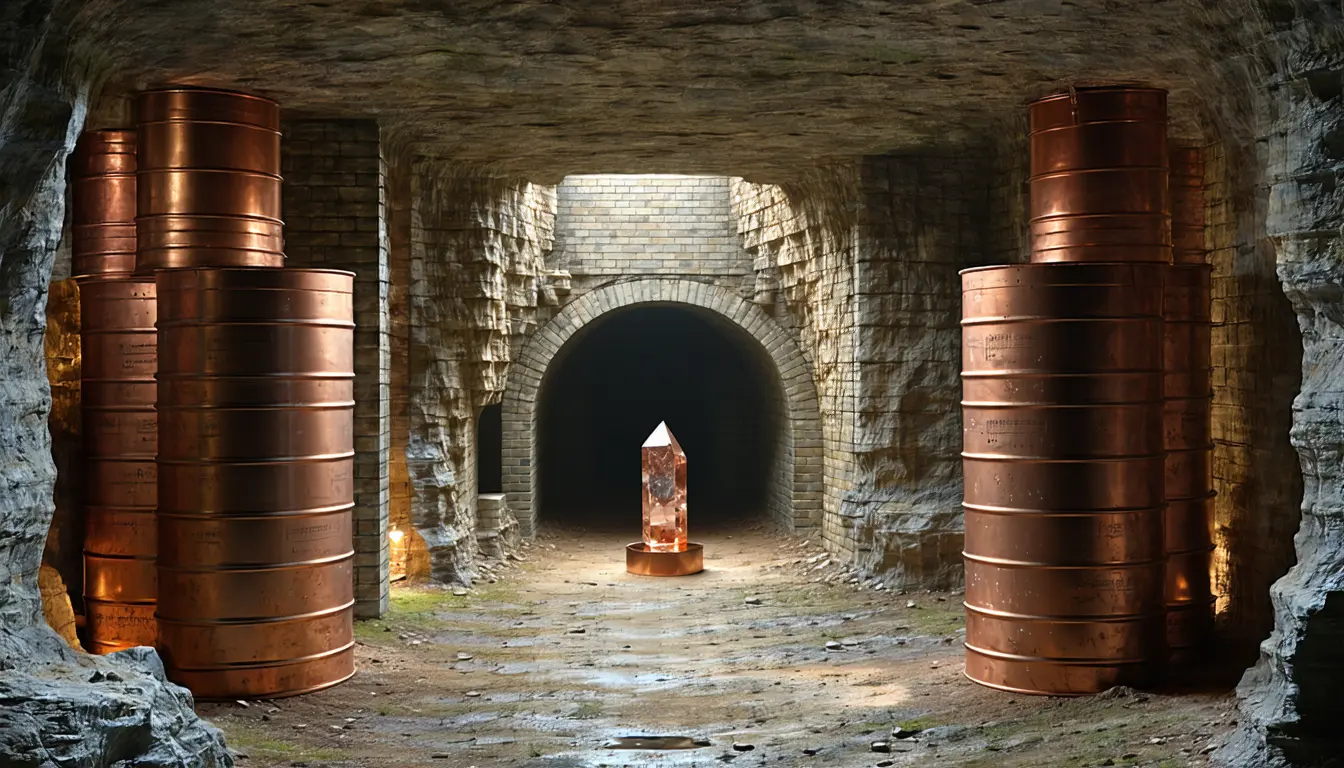
- To test it, researchers used a coffee-mug-sized high-purity germanium crystal wrapped in copper and lead, installed beneath 1.4 kilometres of rock at Italy's Gran Sasso laboratory.
- They counted for 62 days, subtracted the background radiation they expected, compared the remainder with the pattern the Karolyhazy model predicts, and found no signal.
- The results were published in the New Journal of Physics in June 2026, from work supported by the Foundational Questions Institute.
Compiled by The ScientistSomething wrong?How this is made
Why it matters
- constraint Any gravitational collapse model still standing has to predict radiation faint enough to hide inside a background-subtracted germanium spectrum taken under a mountain. That requirement shrinks the space theorists can work in.
- capability Collapse models can be adjudicated with a small crystal and enough shielding, so nobody has to build a macroscopic superposition to put one of these ideas at risk.
- contradiction The release asks whether gravity kills the cat while the collaboration excludes only one formulation, so treating this as a verdict on gravity's role in decoherence overstates what the data support.
The measurement is indirect. If the fluctuations exist, they push electrically charged particles into random acceleration, and those particles then emit extremely faint electromagnetic radiation [7]. Photons are the observable. The version of the model that supplied the number being checked is the one FQXi's Angelo Bassi and colleagues reformulated [6].
Faintness is the difficulty. A signal that weak can sit buried under radiation from other sources, cosmic rays among them [12]. Gran Sasso is the answer to that problem, the world's largest underground laboratory devoted to fundamental physics [1], where "the natural shielding provided by the rock creates one of the quietest environments on Earth for detecting extremely rare physical phenomena," said Catalina Curceanu, director of research at INFN's Frascati laboratory and spokesperson for the VIP Collaboration [10].
How much of a model a null result removes depends on the bound: how far below the predicted count the measured data sit. The ScienceDaily write-up of the work does not include that number [15]. Without it, a reader cannot tell whether the prediction was missed by a factor of two or a factor of a thousand, and the difference decides how much room a reformulated version of the same idea still has.
Roughly six decades separate the original proposal from the measurement that tested it [14]. The write-up, credited to FQXi and dated September 21, is headlined with the question of what kills Schrodinger's cat and the suggestion that gravity may not be the answer [16].
The collaboration's own claim is narrower than that. The result does not prove gravity has nothing to do with quantum decoherence [11]. It excludes one important version of the idea and leaves future theories connecting gravity with decoherence tighter boundaries to fit inside [11]. Why quantum behaviour fades at all, and whether gravity is part of the reason, is still one of the major open questions in fundamental physics [13].
"One of the deepest questions in modern physics is why the strange quantum behavior that governs atoms and elementary particles seems to disappear in the macroscopic world we experience every day," Curceanu said [9].
What to watch
- The published bound in the New Journal of Physics paper, and how far below the model's predicted radiation the 62-day data actually sit.
- Whether Bassi and colleagues reformulate the model again with a radiation spectrum outside this detector's sensitivity.
- A longer run or a larger germanium mass at Gran Sasso. Either would extend the search to models predicting weaker radiation.