Science1 publisher2 min readPublished
Sixty-two days under 1.4 km of rock rule out a 1960s gravity model of quantum collapse
A germanium detector at Gran Sasso listened for the faint radiation that a jittering spacetime should force out of charged particles, and the VIP collaboration reports it recorded none of it.
The Scientist · Science desk
What happened
- An experiment tested one model in which decoherence, the fading of quantum superposition into the sharp classical world we live in, is caused by gravity itself.
- The model dates to the 1960s, when Frigyes Karolyhazy proposed that constant tiny ripples in spacetime gradually erode superpositions and keep macroscopic objects out of Schrodinger-cat states.
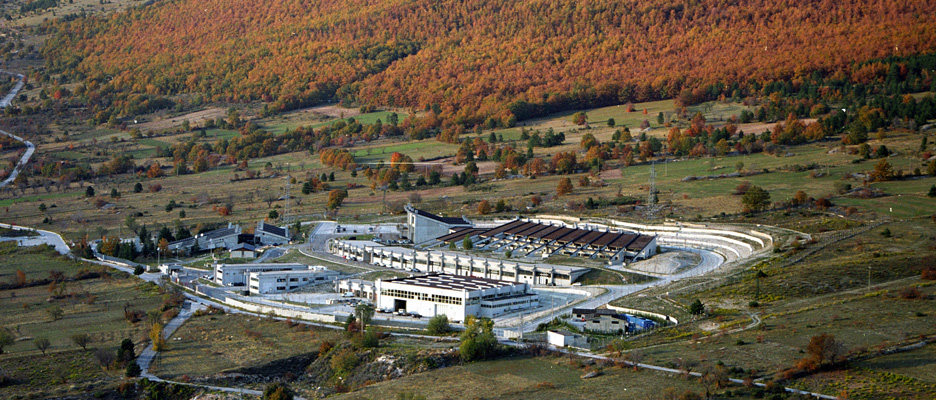
- The detector was a coffee-mug-sized piece of high-purity germanium wrapped in layers of copper and lead, running at Gran Sasso, the world's largest underground laboratory for fundamental physics.
- The team subtracted expected background from 62 days of data, looked for the signature the model predicts and found no signal, in a paper published in the New Journal of Physics in June 2026.
Compiled by The ScientistSomething wrong?How this is made
Why it matters
- constraint Had the model survived, it would have set a ceiling on how large a superposition can be that no experimenter could raise, because the erosion came from spacetime rather than from the apparatus. That particular ceiling is now off the table.
- capability A foundational claim about superposition was tested without anyone building a macroscopic superposition, using low-background nuclear-physics hardware that already exists in underground laboratories.
- contradiction The phys.org headline says the experiment rules out a gravity model, while the same article reports that gravity may still play a role in decoherence. The exclusion applies to one formulation, and a reader who stops at the headline will over-read it.
The design is indirect. Karolyhazy's spacetime fluctuations cannot be observed directly, but a charged particle sitting in them should jiggle and accelerate at random, and a randomly accelerated charge gives off telltale trails of electromagnetic radiation [7]. So the search needs no cat and no superposition.
Quiet is the hard part. The radiation would be faint enough to be lost in electromagnetic background from sources like cosmic rays [8], which is why the apparatus sat beneath 1.4 kilometres of rock [9]. Catalina Curceanu is spokesperson for the VIP Collaboration and director of research at INFN's Frascati laboratory. "The natural shielding provided by the rock creates one of the quietest environments on Earth for detecting extremely rare physical phenomena," she said [10][3].
A null result is worth as much as the prediction it tests, and the version under test is the model as revived and reformulated by Angelo Bassi and colleagues [6]. "This absence of a signal is itself a major scientific result," Curceanu said [14].
About six decades separate the original proposal from this measurement [20]. What kept the idea in circulation is its foundation: a fundamental limit on the precision with which an object can be located and a length measured. That limit recurs in contemporary attempts to unite quantum physics and gravity, including string theory and loop quantum gravity [16]. Kristian Piscicchia, a quantum physicist at the Enrico Fermi Research Center, is the experimental lead on the study. "Every quantum gravity approach ends up predicting the existence of a minimal length connected to the uncertainty in the measurement of spacetime," he said [17][18].
The phys.org account does not report the numerical bound the collaboration placed on the model's parameter [21]. The direction it does report comes from Curceanu. "By ruling out one of the oldest and most natural gravity-induced decoherence models, this work narrows the search for the theory describing the interplay between gravity and quantum mechanics," she said [19].
What to watch
- Whether the collaboration publishes a numerical exclusion range for the model's parameter, which would show how deep into the model space this run reached.
- Whether the same low-background germanium setup is pointed at other spontaneous-collapse models, and with a longer exposure than 62 days.
- Whether theorists reformulate the Karolyhazy picture so that it predicts radiation below what this detector could have seen.