Leadership1 publisher3 min readPublished
Azoma's own-platform sample attributes 73% of Alexa shopping citations to affiliate sites
The figure comes from an observational analysis the company itself says is not a random sample, and it points the money that moves an AI recommendation toward affiliate and earned media work sitting outside the SEO budget.
The Board Room · Leadership desk
What happened
- Max Sinclair, CEO and co-founder of Azoma.ai, defines agentic commerce optimization as improving how products are discovered, understood, evaluated and recommended by AI shopping agents.
- Sinclair wrote that the analysis is not a random sample, placing the caveat in the same sentence as the finding.
- He sets out five areas for an ACO strategy: completeness, context, citations, correctness and customer acquisition.
Compiled by The Board RoomSomething wrong?How this is made
Why it matters
- decision If affiliate pages carry most of the evidence an agent cites, the reallocation question is which team owns discovery spend, since commissions and press placement are not on-site work.
- constraint A brand controls the 11% slice on its own domain; the rest has to be earned from publishers and retailers whose editorial choices it does not set.
- cost Attribute completeness across thousands of SKUs is manual catalogue work, and it is paid for months before any recommendation changes.
- precedent A vendor's self-described non-random sample is the only published count of agent citations, so it becomes the planning number until someone measures independently.
In the second-quarter 2026 analysis, affiliate sites supplied 73% of the citations observed in Alexa for Shopping responses, earned media 16% and brand-owned website content 11% [3][4]. What Sinclair counted was citations. Add the first two together and 89% of the cited evidence sat off the brand's own domain, about eight times the brand-owned share [14].
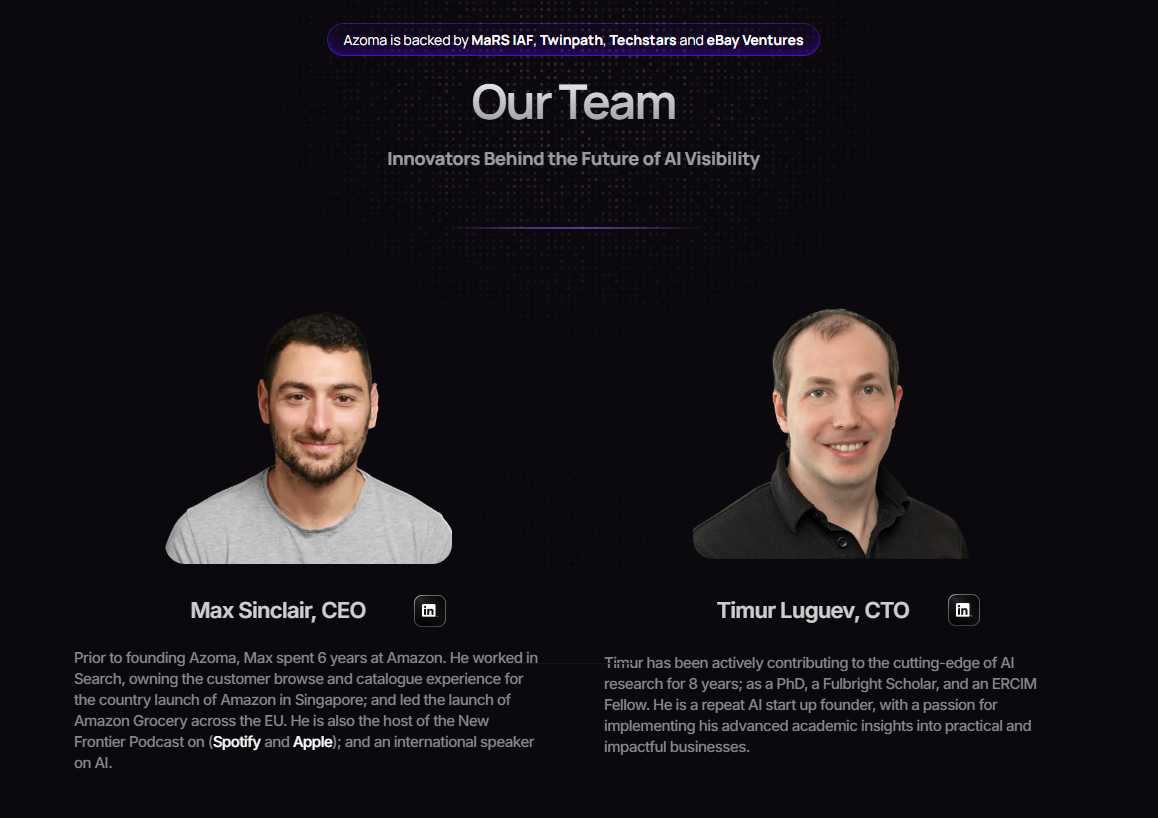
Max Sinclair is CEO and co-founder of Azoma.ai. The Forbes Tech Council post describes it as an Agentic Commerce Optimisation and AI Visibility startup, and the company works with brands on ACO and generative engine optimization [1][11][15]. So the outfit that measured the split sells the remedy. He flagged the design problem in the same sentence as the finding, writing that "it should be noted that this is not a random sample" [5]. The post does not say how many brands sit on the Azoma platform.
Rewriting product pages reaches only the 11% share. In Sinclair's account the agent may rely on product specifications, reviews, editorial coverage, affiliate roundups, retailer information and other third-party sources. So a brand with a strong product, a well-optimized website and good marketplace placement can be absent from the answer [9].
Ownership is the first thing that has to be settled. Brands have long optimized for search rankings, marketplace placement and paid media [13]. Affiliate coverage and earned media sit off the site, and if the composition even roughly holds, the spend that changes a recommendation is commissioned and placed by a team other than the one running the site.
The other half of the job Sinclair describes is catalogue labour. He writes that a catalogue can hold thousands of SKUs while ingredients, dimensions, use cases and pack sizes are missing, inconsistent or hard to compare. Brands, he writes, need to audit their digital shelf so the attributes AI systems are likely to use are complete and consistent [12]. He lists five areas for an ACO strategy: completeness, context, citations, correctness and customer acquisition [7].
A vendor's own-platform count describing its own market is a weak sample, and Sinclair concedes it. Composition is a separate question. An agent answering a request for the best moisturizer for sensitive skin has to assemble evidence from somewhere, and the only published count of where puts most of it on affiliate pages [3].
Scope limits the finding harder than sample design does. The breakdown reported in the post covers Alexa for Shopping responses, while the piece also names Walmart Sparky, ChatGPT and Gemini among the systems shoppers ask [8][16]. The record does not say whether those three cite the same mix, and a brand planning a reallocation across all four surfaces would be extrapolating from one. Running the prompts a category's shoppers actually use, then logging which domains the answers cite, is a cheaper test than a budget line.
On why brands have not already done this work, Sinclair wrote: "I've found many brands still struggle with applying the lessons from those disciplines to systems that can interpret intent and make recommendations." [10]
What to watch
- A published citation breakdown for ChatGPT, Gemini or Walmart Sparky responses would show whether affiliate dominance is specific to Alexa for Shopping.
- An independently sampled study of agent citations would either confirm or shrink the 89% off-domain share.
- A disclosed change in how Alexa for Shopping sources its recommendations would reset the number brands are planning against.