Product1 publisher3 min readPublished
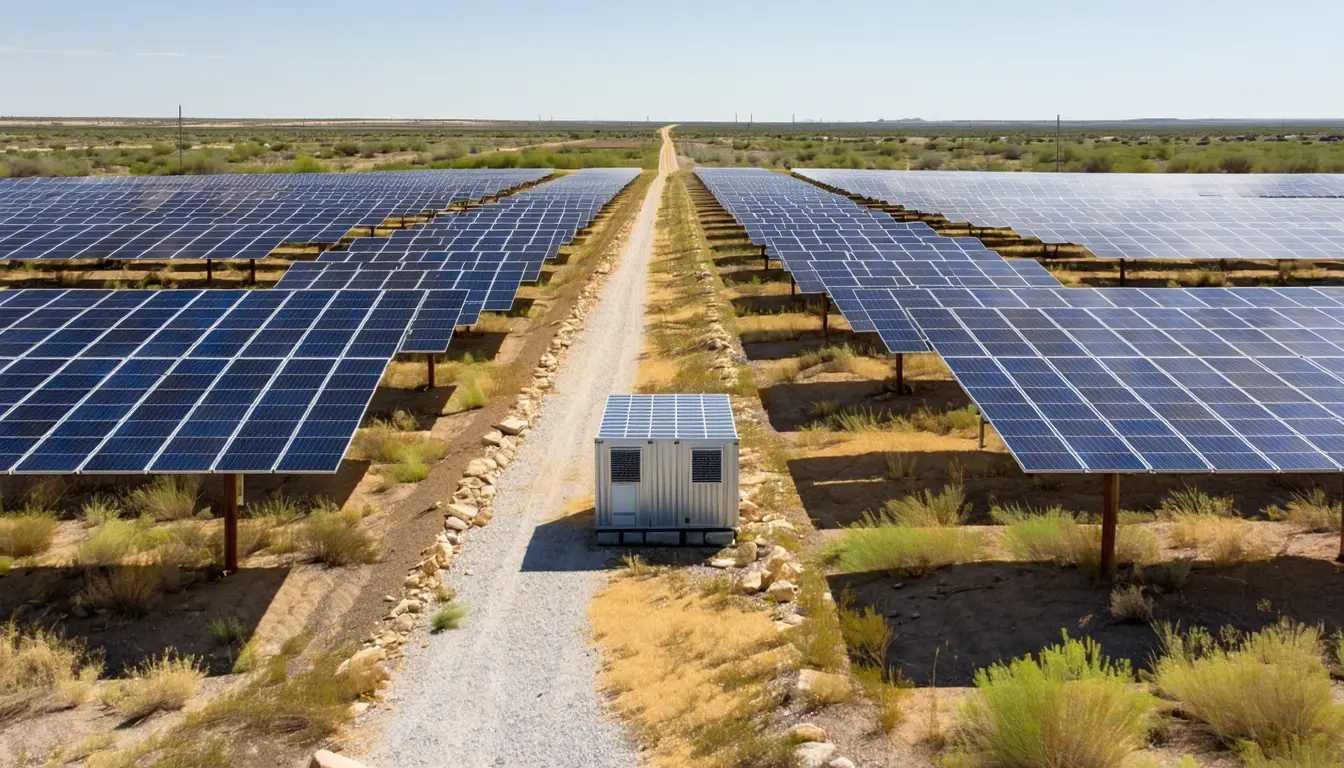
Rune parks a megawatt of inference at a Texas solar farm to soak up curtailed power
A $40 million Series A led by Spark Capital funds 8-by-8-foot modules that plug straight into solar panels and run on the midday surplus grids refuse. Rune puts the saving at about 90% per megawatt of capacity.
The Product Desk · Product desk
What happened
- Rune raised a $40 million Series A led by Spark Capital for a model that sites modular compute at solar farms to use power the grid cannot absorb.
- Its southwest Texas site has 50 modules and 1 megawatt of capacity, is not connected to the grid, and took an hour to put in place after two years of module design.
- The modules take direct current straight from the panels, so Rune says the build needs no traditional transformers at a time when that equipment is in short supply.
- Chief executive William Layden put the cost of delivering compute this way at about 90% less on a per-megawatt basis than the alternatives.
- Rune owns and operates the modules, partners with solar farms and soon wind farms for their excess power, and plans to deploy 100 MW over the next year.
Compiled by The Product DeskSomething wrong?How this is made
Why it matters
- constraint Compute fed by curtailment is available when the host farm overproduces, which happens around midday. A buyer's scheduling flexibility decides whether the saving holds once the job is scheduled.
- decision Teams running interruptible batch inference now have a cheaper place to put it. Each job has to be priced on what an hour of unavailability costs before it moves.
- capability On Rune's account, a megawatt can be added at an existing solar plant without a permitting fight, an interconnection application, or a wait for a transformer.
- precedent Solar operators with saturated grid connections get a second buyer for output they currently spill, and wind operators are next in line if the Texas site holds up.
Capacity at a curtailed solar farm comes with a schedule attached. Rune taps the surplus directly instead of parking it in large-scale batteries [26], and the surplus exists because grids cannot use all the solar arriving in the middle of the day [5].
California's 2025 total gives the size of the pool. The state's grid wasted about 3.5 million megawatt-hours of solar last year [6]. Divided by the 8,760 hours in a year, that is roughly 400 megawatts of load running flat out [21]. The energy does not arrive on that schedule. It bunches into a few midday hours, so absorbing all of it would take a multiple of 400 MW of installed compute, idle for the rest of the day.
Layden said "We're about 90% less expensive on a per-megawatt basis" [14]. The unit there is a megawatt of capacity. A megawatt available six hours a day delivers a quarter of the work of one available around the clock, and cost per GPU-hour follows the hours. Rune did not say how many hours a day the Texas modules run [25].
Fifty modules make a megawatt, so each 8-by-8-foot box carries about 20 kilowatts [22]. At that ratio, the 100 megawatts Rune wants deployed within a year is 5,000 boxes, about 14 placed every day for a year [23]. Rune describes itself as a manufacturing business churning out standardized modules [27].
Rune never joins an interconnection queue of its own. Curtailment happens because a grid is refusing power a farm wanted to sell, which means the host plant already holds the interconnection and Rune's modules sit behind it. Layden said "We don't need to wait three years, four years, five years for new infrastructure to get built. We're using what we have today to bring on compute today." [4]
The national version of the pitch leans on 161 gigawatts of US utility-scale solar [16] and the company's estimate that spare energy at those farms covers all inference demand for the next several years [17]. The 20% waste figure Rune cites is a share of energy generated [5]. The 161 GW is nameplate capacity. Nameplate times a share of energy generated gives you energy, not hours of compute.
For a team weighing this against a hosted GPU contract, the sort has two inputs: what an hour of unavailability costs, and whether the job can be scheduled into daylight. Bulk embedding and transcription backlogs pass both. A chat endpoint with a latency commitment fails the first, and covering it with storage or a fallback site adds back the cost the 90% figure cut. Rune is selling inference capacity [15], and Layden said "I believe that every solar facility in the United States is a latent data center." [18]
What to watch
- Whether Rune publishes availability hours or any service level for capacity sold off a site with no grid connection.
- A named inference customer buying from the Texas site, and what it pays per GPU-hour rather than per megawatt.
- What Rune pays solar and wind operators for surplus power as it moves from 1 MW to its 100 MW target.