Product1 publisher3 min readPublished
Divine drops invite codes, and the Vine revival becomes an open bet on nostr
The 6-second video reboot is now open to anyone. The archive of 2M-plus restored Vine clips and a decentralised backend matter more than the nostalgia.
The Product Desk · Product desk
Drafted by a language model from the sources cited here and checked against its claim ledger before publication. How we use AISend a correction
What happened
- Divine, a Vine reboot led by one of Twitter's earliest employees, has eliminated sign-up codes and is open to anyone, a little more than three months after launching its app in invitation-only mode.
- Divine has so far managed to restore more than 2 million original videos from Vine's archive.
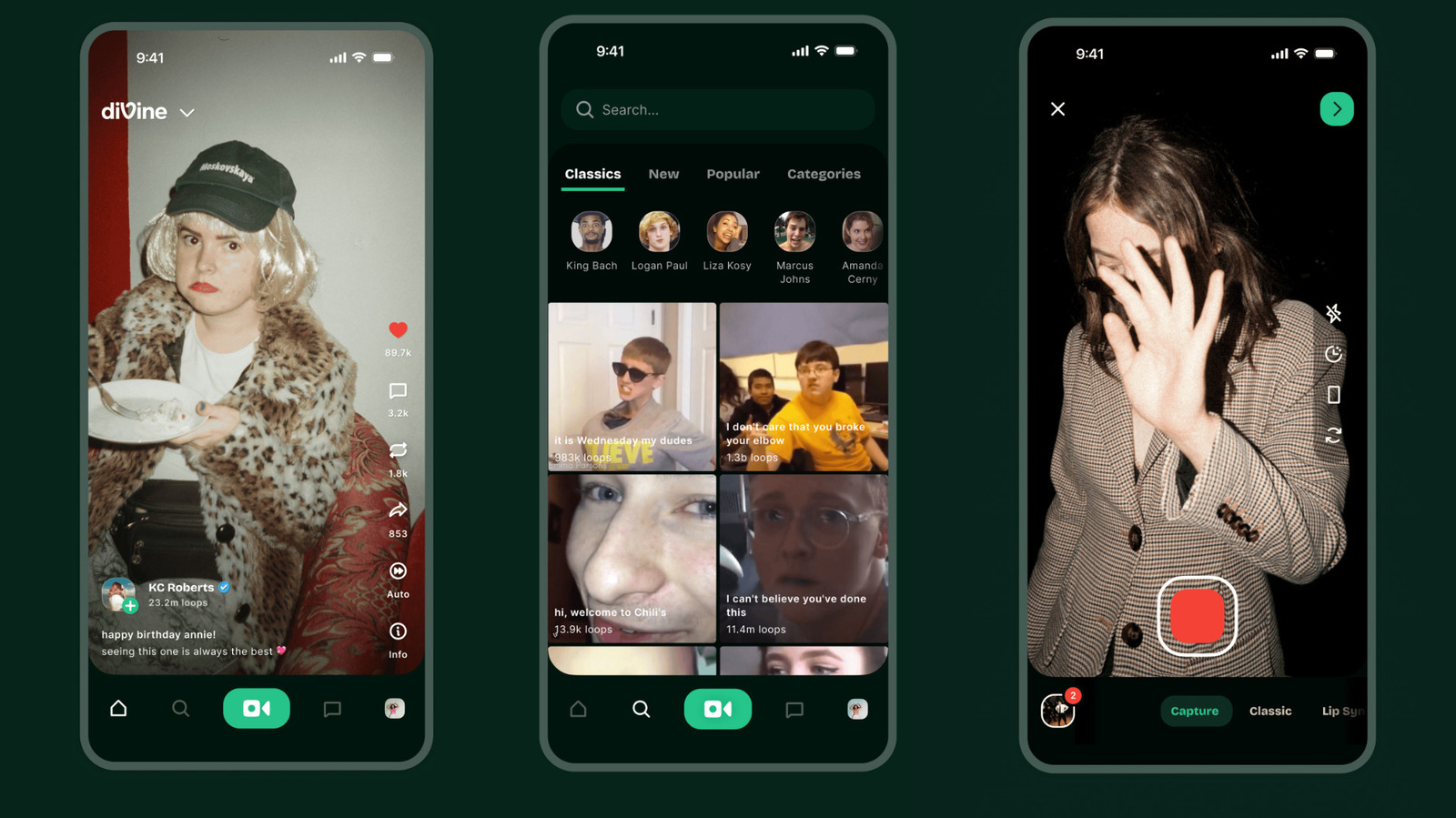
- The Divine app has a "classic" feed of clips from Vine's original archive.
- Two million clips at a maximum of 6 seconds each is an upper bound of about 3,333 hours of video.
- Divine relies on the same 6-second looping video format used by the original Vine.
Compiled by The Product DeskSomething wrong?How this is made
Why it matters
Divine, the Vine reboot run by one of Twitter's earliest employees, has removed sign-up codes and opened to anyone, a little more than three months after it launched in invitation-only mode [1]. That turns a controlled experiment into a public platform, and it shifts the question from whether people remember Vine to whether two structural choices - a restored archive and a decentralised backend - hold up under load.
The archive is the more tangible of the two. Divine says it has restored more than 2 million videos from Vine's original archive, which feed a "classic" tab inside the app [2][3]. At the format's 6-second ceiling, that is an upper bound of roughly 3,300 hours of looping video [4] - a cold-start library that no new short-video app can otherwise buy, because the original folded nearly a decade ago and Divine is not officially affiliated with it [5][6].
The backend is the part marketing usually skips. Divine is decentralised and runs on the open-source nostr protocol, which Jack Dorsey has funded; Dorsey also funds Divine, though the company says he holds no equity or ownership in it [7][8]. Founder Evan "Rabble" Henshaw-Plath frames that as a design constraint rather than a feature: "With Divine, our theory is that part of the problem is that we centralize power in a few people's control," he told Engadget, adding that the aim is to build it "so that it can't be enshittified in the future" [9].
The supply-side rules are unusually strict. Users can only post videos recorded with Divine's in-app camera, and the app runs built-in AI detection as further verification [10]. Henshaw-Plath's argument is that this produces a feed with no overlap with anything else: "None of the stuff you see on Divine was ever on other platforms before, it was either on Vine originally or it's now on Divine," he said, describing the result as full of "lots of weird stuff" [11][12]. The cost is obvious. Blocking the camera roll blocks cross-posting, which is how most creators actually distribute, and every clip has to be made for Divine specifically.
That is where the unresolved part sits. Vine's original decline was driven in part by creators leaving over inadequate support from its leaders [13]. Henshaw-Plath says he is thinking about monetisation tools Vine never had, while conceding the mechanics are undecided: "We don't know exactly how it's all going to work, but we do know that as creators grow, as they build an audience, they want the ability to make money" [14]. An open sign-up with no payout path is a retention problem waiting on a roadmap.
The timing leans on a broader nostalgia wave. A passing comment in a recent Myspace documentary has generated weeks of headlines about a comeback despite no specific plans being announced, and other small apps are chasing the same early-social-media feel [15][16].
Worth watching: whether the classic archive stays the most-used surface or gets overtaken by new uploads, whether the in-app-camera rule survives contact with creators who want to post everywhere, and what the monetisation model turns out to be when it is finally specified.