Build1 publisher3 min readPublished
Vention's four-month bin-picking demo needed a further year of engineering for one factory cell
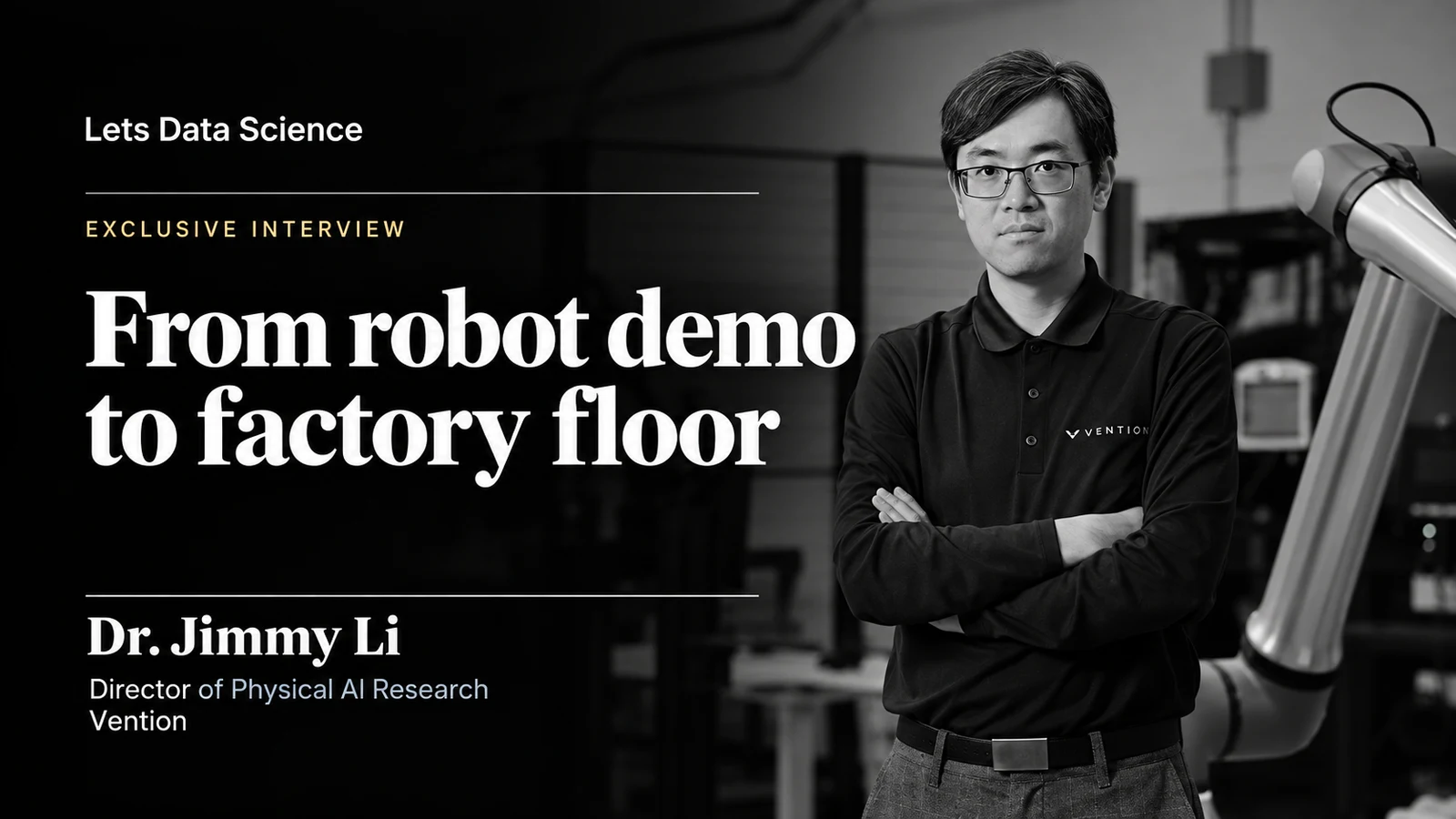
Vention's Jimmy Li told Lets Data Science that the work after the trade-show demo was collision models, grasp tuning and a bevel on the receptacle, and he defined the reliability metrics but gave no numbers.
The Engineer · Build desk
What happened
- Four months of core research gave Vention a bin-picking demo that worked at a trade show, its Director of Physical AI Research, Jimmy Li, said in written answers to Lets Data Science.
- Li said changing the robot's finger material and adding slight chamfers to a receptacle had a large effect on consistency.
- Li listed three operational metrics for the cell: cycle time, percentage of parts dropped, and human interventions per hour.
Compiled by The EngineerSomething wrong?How this is made
Why it matters
- cost The demo is the short quarter of the schedule, and the year that follows is spent on one cell at one customer, so a pilot budget built on demo effort understates the job by a factor of three or more.
- decision Anyone specifying fixturing has to keep the mechanical design open through the AI work, because two of the changes Li credits for consistency were finger material and a beveled receptacle edge.
- constraint A cycle-time average absorbs automatic retries by design, so one number cannot tell a buyer how often a pick missed; the pick rate has to be instrumented on its own.
- capability An integrator whose planner blocks until a placement finishes has cycle time available without new hardware, by computing the next pick during the current place.
Seeing the part and finding a path to it were only the beginning, Li wrote. The cell also had to hit a required cycle time and repeat the operation reliably [5].
Most of the planner work was model work. Li said the team had to tune its motion planner and build accurate collision models for the surrounding scene, the robot and the workpiece [6]. Those models describe the shapes the planner has to account for. It matters most at the bottom of a deep bin, where the route has to leave the robot enough room to reach the part and retrieve it [7]. Li said mature software utilities were needed to build and tune those representations [8].
A secure grip is not sufficient either. Li told Lets Data Science: "Grasping also needs to be carefully tuned to not only cope with complex workpiece geometry, but also make downstream placement feasible." [9] A perception system can locate the right object and a gripper can lift it while the overall operation still struggles at insertion [22].
Two of the fixes were mechanical. Li said changing the robot's finger material and adding slight chamfers, or beveled edges, to a receptacle had a large effect on consistency [10]. A bevel on a receptacle is a cheaper change than retraining anything. The scheduling fix was to compute the next pick while the robot was still placing the previous workpiece; Li said that helped the system reach its target cycle time. He gave no figure for either [11].
Four months to the demo. More than a year of additional engineering after it, for one complex cell at a customer's factory [2][3]. Twelve over four is three, so the integration ran at least three times the length of the core research, and the whole sequence is at least sixteen months [21]. I would budget a pilot on that split, because the demo is the short phase and the year is spent per cell. Lets Data Science notes the timeline describes this development experience, not a stated average for current Vention installations [19]. The account sits behind Vention's September 9 announcement of a Physical AI lab in Montreal [18].
The metric definitions are worth copying. Cycle time is the time between successful placements, and because the robot automatically retries a missed pick, the retry shows up as a longer cycle; Li said his team does not track pick rate separately in this measurement approach [13]. "A missed attempt simply shows up as a longer overall cycle," Li said [14]. Percentage of parts dropped counts how often a part falls onto the floor or somewhere the robot cannot recover it, with poor grasps and misaligned placement identified as typical causes [15]. Human interventions per hour counts how often an operator must clear a fault during standard operation [16].
For any of those to say something about your line, they have to be measured on it. Li's answers did not include cycle-time measurements, drop percentages, intervention counts, test duration or the number of placements observed, and only partly explained how resets and downtime enter the calculation [17]. Lets Data Science wrote that a recording of one clean pick cannot reveal how often the robot needed a second attempt or how much operator attention sustained the process [20].
What to watch
- Whether Vention publishes cycle-time, drop-rate and intervention numbers from a running customer cell, with test duration and the number of placements observed.
- Whether the Montreal Physical AI lab shortens the post-demo engineering stretch on the next cell, and by how much.
- Whether pick rate is ever reported alongside cycle time, given Li said the team does not track it separately.