Science1 publisher3 min readPublished
Ultraviolet light exposes banded tail patterning on a 125-million-year-old Catalan crocodile
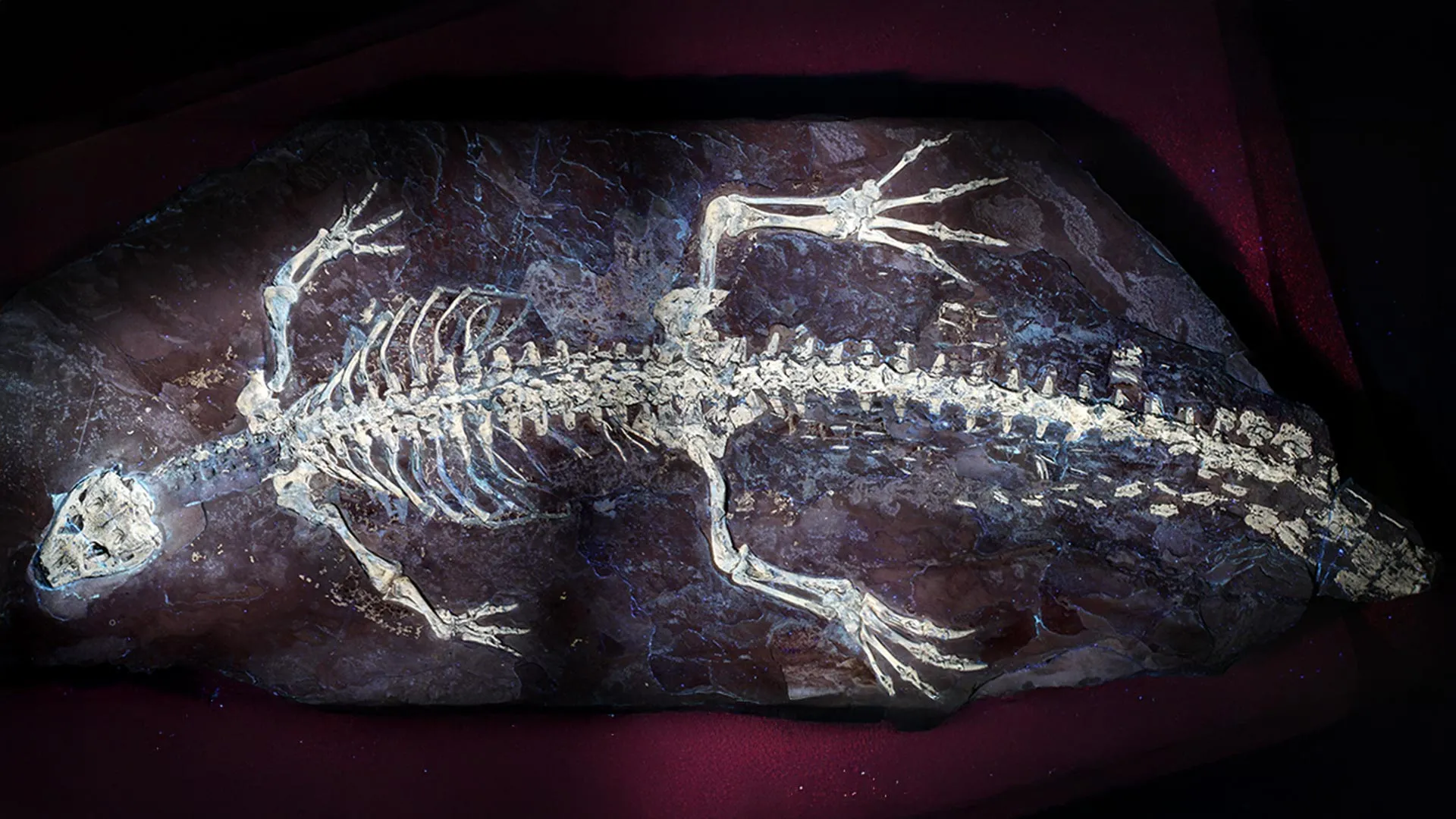
The holotype of Montsecosuchus depereti has been in a Barcelona museum for more than a century. A team led from the Institut Catala de Paleontologia put it under UV and got scales, chest cartilage and a tail pattern.
The Scientist · Science desk
What happened
- A study in the Zoological Journal of the Linnean Society gives the first detailed description of soft tissues in Montsecosuchus depereti, a Lower Cretaceous crocodylomorph from the Pedrera de Meia site in Lleida.
- The UV imaging documented epidermal scales that vary considerably in shape and size across the body, the first detailed picture of the animal's skin since it was named in the early 20th century.
- The animal lacked the high caudal fin that modern crocodiles have.
Compiled by The ScientistSomething wrong?How this is made
Why it matters
- capability A specimen collected more than a century ago yielded skin, chest cartilage and a tail pattern without a new dig or a new quarry, so the limiting resource for this kind of result is curatorial time.
- constraint Because the claim to oldest crocodylomorph coloration rests on a fluorescence pattern with no pigment chemistry reported, comparative work that wants to build on it has to treat the banding as provisional.
- precedent The localised-then-widespread account of skin sense organs is now a stated expectation that other early crocodylomorph holotypes can confirm or break, and each test takes a UV lamp and an afternoon.
Ultraviolet illumination works here for a simple reason: fossilised tissue and the rock around it respond to the light differently, so structures that daylight leaves invisible stand out against the matrix [6]. What the image records is where organic residue survived. The alternating bands along the tail are, in the first instance, a pattern in that residue [15]. Reading them as the living animal's colour scheme is a further step. The release describes the bands as possible camouflage and says they potentially preserve the oldest known coloration in a crocodylomorph [15]; it does not report any analysis of the residue's chemistry.
The chest evidence is more direct. UV exposed cartilaginous structures there, which the team takes as an efficient respiratory system sharing features with modern crocodiles, and as a sign that sophisticated thoracic anatomy appeared early in crocodylomorph history [13]. The animal is small, about 50 centimetres long as preserved [3]. "These traits indicate that, despite being a primitive animal, it was already very well adapted to a semi-aquatic lifestyle," Castillo-Visa said [14].
The sensory finding is the one I would most like to see repeated. Possible sense organs show up inside some scales around the neck, the limbs and the flanks of the trunk and tail, and only in small scales at the edges of the body [10]. In living crocodiles, organs of that kind register touch and changes in water pressure, and respond to temperature and chemical signals [11]. The authors suggest the restricted distribution could mark an early stage, with such organs localised first and spreading across the skin in later lineages [12]. That hypothesis has an obvious test: put the same UV imaging on other early crocodylomorph holotypes.
This was museum work. MGB-512 is the holotype, it sits in the Museum of Natural Sciences of Barcelona, it was collected more than a century ago, and it drew some scientific attention in the 1990s [3][4]. More than a hundred years passed between its discovery and the first detailed description of its soft tissues [18]. The description exists because Oscar Castillo and Jesus Serrano were compiling a database of Montsec lithographic limestone fossils held in Catalan and European museums and looked at this one under UV [5]. "UV light allows us to see details that would otherwise remain completely hidden in the rock," Castillo-Visa said [7].
The case for screening collections is strong on this evidence and thin on one number: how often the lamp returns something. One success in a lagerstatte does not give a hit rate for a drawer of ordinary limestone. This specimen came from a karstic lake near the coast of what is now the Catalan Pre-Pyrenees, settled into fine sediments under conditions favourable enough to preserve it in exceptional detail, in beds that became the lithographic limestones of the Pedrera de Meia [2].
A note on the paper trail: the ScienceDaily posting, dated 15 September 2026, lists its source institution as the Institute of Industrial Science at the University of Tokyo [16], while the text of the release credits the Institut Catala de Paleontologia Miquel Crusafont with leading the work, published in the Zoological Journal of the Linnean Society [1].
What to watch
- Whether a pigment-chemistry analysis of the banded tail region is published, which would move the coloration claim from possible to measured.
- Whether the rest of the Montsec lithographic limestone specimens in the database survey yield tissue under UV, and at what rate.
- Whether other early crocodylomorphs also show possible sense organs confined to small scales at the body margins.