Science1 publisher3 min readPublished
A tweezer array stops benchmarking itself and measures two conformal field theories
Caltech's Endres and Alicea groups report the first direct measurement of Ising and tricritical Ising energy spectra in synthetic quantum matter, on chains of up to 35 strontium atoms.
The Scientist · Science desk
Drafted by a language model from the sources cited here and checked against its claim ledger before publication. How we use AISend a correction
What happened
- A collaboration between the experimental group of Caltech's Manuel Endres, professor of physics, and Jason Alicea's theory group, together with theorists at Universite Paris-Saclay and the Technical University of Munich, reported the work in the journal Nature.
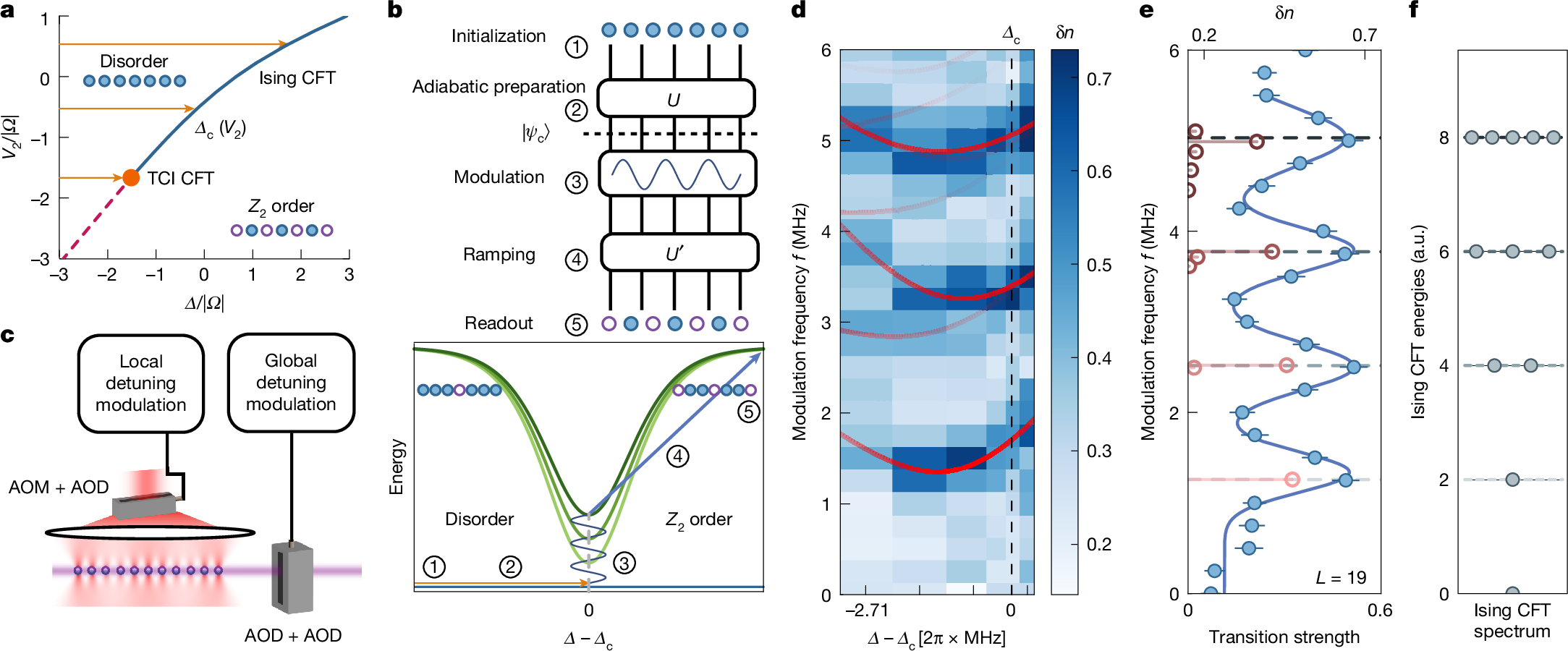
- Using new technology developed for quantum simulators, the team reports the first direct measurement of energy levels in synthetic quantum matter as predicted by the Ising and tricritical Ising conformal field theories.
- The team performed first-of-their-kind experiments on two different conformal field theories using quantum simulators, which are simplified versions of quantum computers tailored for specific tasks.
- For four decades researchers used conformal field theories to calculate the spacings between the energy rungs, which come in precise ratios, but nobody had measured them in an experiment until now.
- Jason Alicea, William K. Davis Professor of Theoretical Physics, on universality: "the messy, microscopic details wash out and only a few essential features survive"; the math underlying these universal traits is commonly described by conformal field theory.
Compiled by The ScientistSomething wrong?How this is made
Why it matters
A collaboration between the experimental group of Manuel Endres and the theory group of Jason Alicea at Caltech, with theorists at Universite Paris-Saclay and the Technical University of Munich, has reported in Nature the first direct measurement of energy levels in synthetic quantum matter as predicted by the Ising and tricritical Ising conformal field theories [1][2]. The result matters less as a physics headline than as a provenance story: the measurement was made on hardware built for quantum computing, aimed at a question theorists had left unmeasured for four decades [3][4].
Conformal field theory is the standard description of universality, the observation that different materials passing through a phase transition start obeying the same mathematics. Alicea, Caltech's William K. Davis Professor of Theoretical Physics, describes it as the messy microscopic details washing out so that only a few essential features survive [5]. Both theories in question describe what emerges when a quantum system sits at a tipping point between a more ordered and a less ordered state [6], a transition driven not by temperature but by quantum effects at temperatures near absolute zero [7]. At that point the system can be excited into a discrete series of energies, like rungs on a ladder [8]. Researchers have been computing the ratios between those rungs for forty years without anyone measuring them in an experiment [4]. According to Alicea, the levels are worth measuring because they encode information about the theories themselves [9].
The apparatus is unremarkable by current standards, which is part of the point. Strontium atoms were held in a line by optical tweezers, then driven into Rydberg states so that neighbours interacted strongly enough that the chain behaved as one entity rather than a row of independent particles; the lasers were then tuned to park the chain at the critical point [10]. Readout used a new technique the team calls many-body modulation spectroscopy: modulate the lasers at a chosen frequency, measure how hard the atoms respond, sweep the frequency, and record where the response spikes [11]. The group's own analogy is a wet finger on a wine glass, which resonates at one speed and does nothing at others [12].
Co-lead author Xiangkai Sun, a graduate student in the Endres lab, says the experiment was repeated on chains of up to 35 atoms and that the spectra collapsed onto a single universal curve once rescaled for size, as Ising conformal field theory predicts [13]. The team then tuned to the tricritical point and measured the lowest levels of that distinct spectrum, which came out in the different ratios the theory specifies [14].
Scale is not what made this work. A related neutral-atom platform in the same lab recently trapped 6,100 atoms in a single array [15], roughly 174 times the length of the chain used here [16]. Sun frames the past decade as learning to control these systems well enough to now turn them on fundamental physics questions [17].
Two things to watch. First, whether modulation spectroscopy travels to other tweezer and superconducting platforms, since a portable readout method is worth more than any single spectrum. Second, the numbers this summary omits: the source material gives no error bars, no count of resolved rungs, and no comparison against classical simulation of the same 35-site chain [13].