Science1 publisher2 min readPublished
NASA Glenn makes a bacterial plastic stronger by mixing in simulated moon and Mars dust
NASA Glenn engineers mixed simulated moon and Mars dust into a plastic that bacteria can produce and found the blend was stronger and easier to process. The agency says making it on site would let missions pack fewer supplies, but it has not said how much mass that would save.
The Scientist · Science desk
What happened
- The plastic is biodegradable, and NASA says bacteria fed on crew waste or carbon dioxide could produce it.
- Changing the type and amount of dust let the team adjust the material's properties.
- NASA proposes the material for equipment inside habitats, such as structural brackets, wrenches and chairs.
- Samples are being tested in Glenn's Lunar Environment Structural Test Rig to see how they cope with extreme temperatures.
- More samples are due to fly on the MISSE-23 mission, which will expose them to conditions outside the International Space Station.
Compiled by The ScientistSomething wrong?How this is made
Why it matters
- constraint Without strength figures or a dust loading, no one outside Glenn can yet size a bracket or a wrench made from this blend.
- constraint The resupply savings depend on two steps this work did not test: bacteria turning crew waste into the plastic, and real regolith behaving like its simulant.
- decision Mission planners who adopt it would start with pressurised interior parts, because any use on the open surface has to wait for the thermal and orbital exposure results.
NASA describes the strength result only in words. Its account of the work does not give a test method, a dust loading, or a figure for the plain plastic the dust-filled samples were compared against [5]. "Stronger" could mean resistance to bending or the load a part takes before it breaks. For a wrench, those are different properties.
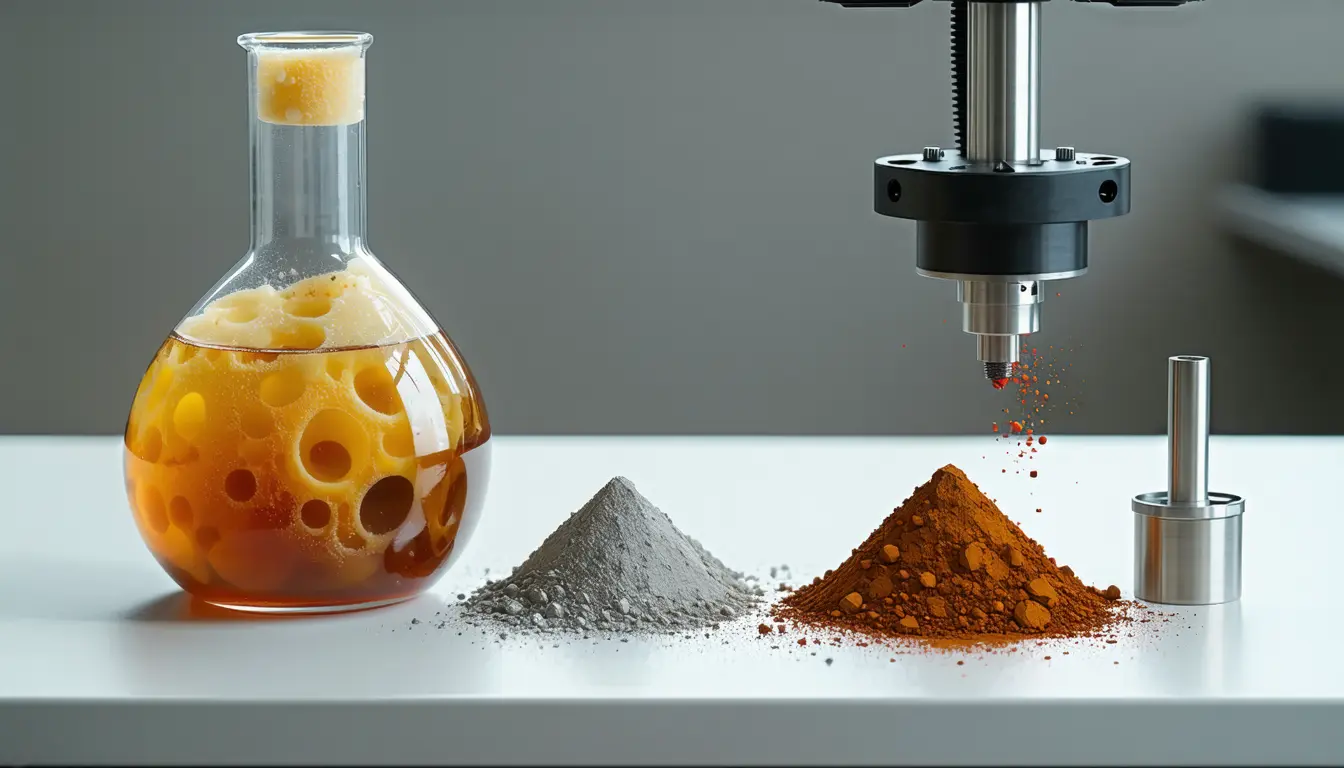
The team varied both the dust type and the amount [6], so there is presumably a set of blends behind the one-line summary. With numbers attached, that set would show which simulant at what loading makes the best part, and at what point adding more dust stops helping. The only images released are micrographs of the crystal structure, gray for samples made with mock moon dust and reddish for mock Mars dust [7].
Allison Christy, a research chemical engineer at Glenn, did the work with three summer interns [2]. She described where the plastic comes from plainly. "The plastic literally grows within the bacteria's little bodies," she said [4]. NASA's wording on the feedstock is conditional [3], and the dust in these samples was simulant [2].
So what has been demonstrated is the blend. Plastic grown from a crew's waste and real regolith, the two inputs that would actually be local, have not yet been shown together in one material. NASA links the work to on-demand, fully recyclable fabrication with lunar surface material and to its goal of a permanent Moon base [9]. Christy framed the goal as repair. "You can't just bring everything with you to the Moon or Mars," she said. "If something breaks, you have to find a way to fix it with what you have. This is a very versatile material, which is a huge benefit." [10]
Every use NASA lists is for equipment inside a habitat [8]. Whether the material can be used outside, on the lunar or Martian surface, is a question the team still hopes to study [11]. The temperature rig at Glenn and the MISSE-23 flight are the first tests that bear on it [12][13].
I think the team has the order right. First show that the blend behaves on the bench, then expose it to extreme temperatures and to space, and only then tackle growing the plastic from waste. The case for a lighter launch manifest depends on the last step, and that step is not part of this work. The research is funded through NASA Glenn's 2026 Center Innovation Fund [14].
What to watch
- Numbers from Glenn's Lunar Environment Structural Test Rig showing how the dust blends hold up at extreme temperatures.
- The condition of the MISSE-23 samples after exposure outside the space station, the first evidence on use beyond a habitat's walls.
- A published set of blends giving strength against dust type and loading, or a sample made from plastic grown by bacteria on crew waste or carbon dioxide.